Departamento de Parasitologia, Universidade Federal de Minas Gerais, Belo Horizonte, Brazil.
Laboratory of Parasitic Diseases, NIAID, National Institutes of Health, Bethesda, MD, USA.
Parasitology. 2021 Dec;148(14):1795-1805. doi: 10.1017/s0031182021001347. Epub 2021 Aug 9.
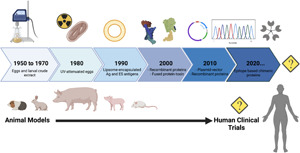
Ascariasis is the most prevalent helminth infection in the world and leads to significant, life-long morbidity, particularly in young children. Current efforts to control and eradicate ascariasis in endemic regions have been met with significant challenges including high-rates of re-infection and potential development of anthelminthic drug resistance. Vaccines against ascariasis are a key tool that could break the transmission cycle and lead to disease eradication globally. Evolution of the vaccine pipeline has progressed, however no vaccine product has been brought to human clinical trials to date. Advancement in recombinant protein technology may provide the first step in generating an vaccine as well as a pan-helminthic vaccine ready for human trials. However, several roadblocks remain and investment in new technologies will be important to develop a successful human vaccine that is critically needed to prevent significant morbidity in -endemic regions around the world.
蛔虫病是世界上最普遍的寄生虫感染,会导致严重的终身发病,尤其是在幼儿中。目前,在流行地区控制和根除蛔虫病的努力面临着重大挑战,包括高比例的再感染和驱虫药物耐药性的潜在发展。针对蛔虫病的疫苗是一种关键工具,可以打破传播周期,从而在全球范围内消灭这种疾病。疫苗研发已经取得进展,但迄今为止,没有一种疫苗产品被推向人体临床试验。重组蛋白技术的进步可能为开发疫苗以及一种适用于人体试验的泛寄生虫疫苗提供了第一步。然而,仍有几个障碍需要克服,对新技术的投资对于开发一种成功的人类疫苗至关重要,这种疫苗迫切需要预防世界各地流行地区的严重发病。