Steventon Chloe, Harley Dan, Wicker Leanne, Legione Alistair R, Devlin Joanne M, Hufschmid Jasmin
Australian Wildlife Health Centre, Healesville Sanctuary, Glen Eadie Avenue, Healesville, VIC, 3777, Australia.
Asia Pacific Centre for Animal Health, Melbourne Veterinary School, Faculty of Veterinary and Agricultural Sciences, The University of Melbourne, Parkville, VIC, 3010, Australia.
Int J Parasitol Parasites Wildl. 2022 May 10;18:152-156. doi: 10.1016/j.ijppaw.2022.05.002. eCollection 2022 Aug.
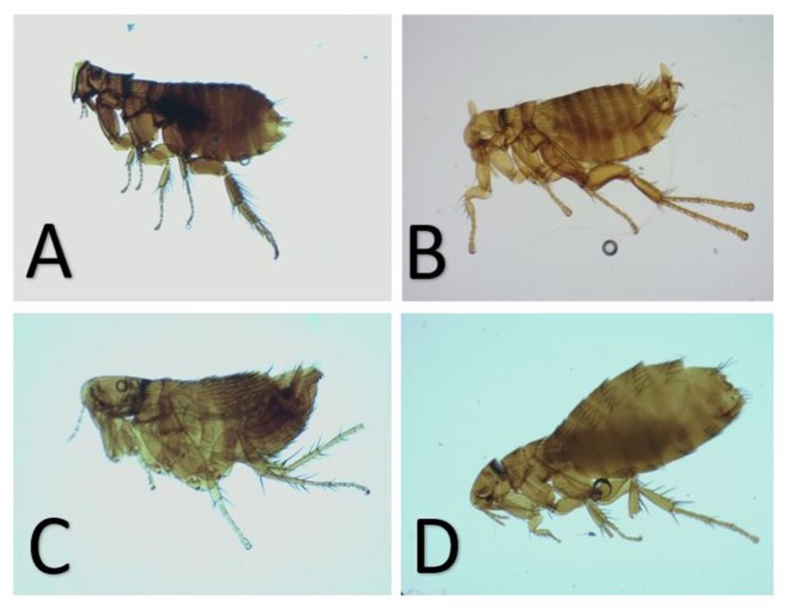
Leadbeater's possum () is a nocturnal arboreal marsupial with a restricted range centered on the Victorian Central Highlands, south-eastern Australia. Most populations inhabit wet montane ash forest and subalpine woodland, with one notable exception - a small, outlying and genetically-distinct lowland population inhabiting swamp forest at Yellingbo, Victoria. The species has been listed as critically endangered since 2015. Translocations are the mainstay of critical genetic rescue and this study explores the ectoparasites that are 'along for the ride' during translocation activities. Ectoparasites (133 fleas, 15 ticks and 76 mites) were collected opportunistically from 24 Leadbeater's possum colonies during population monitoring and genetic sampling across the lowland and highland populations. The composition of the flea assemblage varied by habitat type. Significantly greater numbers of the general marsupial fleas and (as a proportion of total flea numbers) were detected in lowland habitats, compared to highland habitats (Fishers exact test, P < 0.0001). Two host-specific flea species, and were detected only on possums in highland habitats. As a proportion of total fleas this was significantly different to possums in lowland habitats (Fisher's exact test, P = 0.0042 and P < 0.0001, respectively). was suspected to be extinct prior to this study. Ticks (, n = 15) and mites (, n = 47 and , n = 29) have been identified in Leadbeater's possums historically. The possible causes of the different flea assemblages may be environmental/climatic, or due to the historic geographic division between highland and lowland animals. The planned translocations of highland individuals to lowland habitats will expose lowland individuals to novel species of previously exclusively highland fleas with unknown indirect consequences, thus careful monitoring will be required to manage any potential risks.
利德比特氏袋貂()是一种夜间活动的树栖有袋动物,其活动范围有限,集中在澳大利亚东南部维多利亚州的中部高地。大多数种群栖息在湿润的山地桉树林和亚高山林地,但有一个显著例外——一个位于偏远地区、基因独特的低地种群,栖息在维多利亚州耶林博的沼泽森林中。自2015年以来,该物种被列为极度濒危物种。种群转移是关键基因拯救的主要手段,本研究探讨了在种群转移活动中“搭便车”的体外寄生虫。在对低地和高地种群进行种群监测和基因采样期间,从24个利德比特氏袋貂群落中随机收集了体外寄生虫(133只跳蚤、15只蜱和76只螨)。跳蚤群落的组成因栖息地类型而异。与高地栖息地相比,在低地栖息地检测到的普通有袋类跳蚤和(占跳蚤总数的比例)数量显著更多(费舍尔精确检验,P < 0.0001)。仅在高地栖息地的袋貂身上检测到两种宿主特异性跳蚤物种和。与低地栖息地的袋貂相比,这两种跳蚤占跳蚤总数的比例有显著差异(费舍尔精确检验,分别为P = 0.0042和P < 0.0001)。在本研究之前,怀疑已灭绝。历史上在利德比特氏袋貂身上已鉴定出蜱(,n = 15)和螨(,n = 47和,n = 29)。不同跳蚤群落的可能原因可能是环境/气候因素,或者是由于高地和低地动物之间的历史地理分隔。计划将高地个体转移到低地栖息地,这将使低地个体接触到以前仅存在于高地的新型跳蚤物种,其间接后果未知,因此需要仔细监测以管理任何潜在风险。