Department of Anesthesiology, Perioperative, and Pain Medicine, Brigham & Women's Hospital, Harvard Medical School, Boston, Massachusetts, USA.
Pain Med. 2022 Dec 1;23(12):2010-2021. doi: 10.1093/pm/pnac079.
Individuals experience chronic pain differently, not only because of different clinical diagnoses, but also because of differing degrees of influence from biopsychosocial pain modulators. We aimed to cluster patients with chronic pain into distinct subgroups based on psychosocial characteristics and pain intensity, and we subsequently examined group differences in pain-related interference approximately 1 year later.
In this observational, longitudinal study, patients with chronic pain (n = 94) completed validated assessments of psychosocial characteristics and pain intensity at the beginning of COVID-19-related social distancing (April to June 2020). One year later (May to June 2021), patients completed a follow-up survey with assessments of pain interference, loneliness, social support, mindfulness, and optimism.
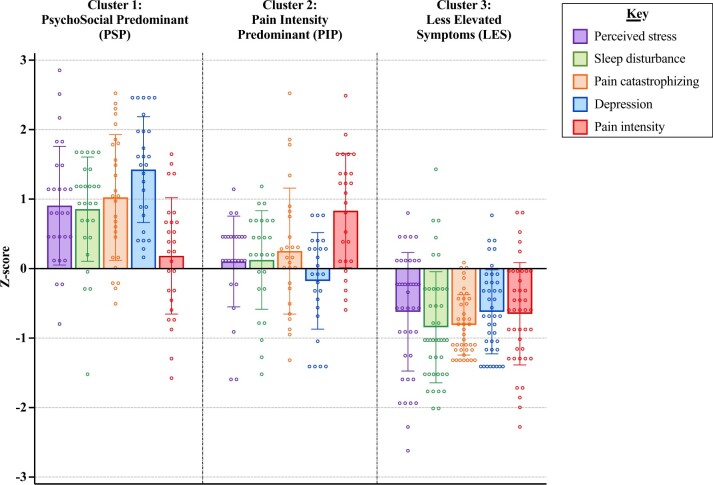
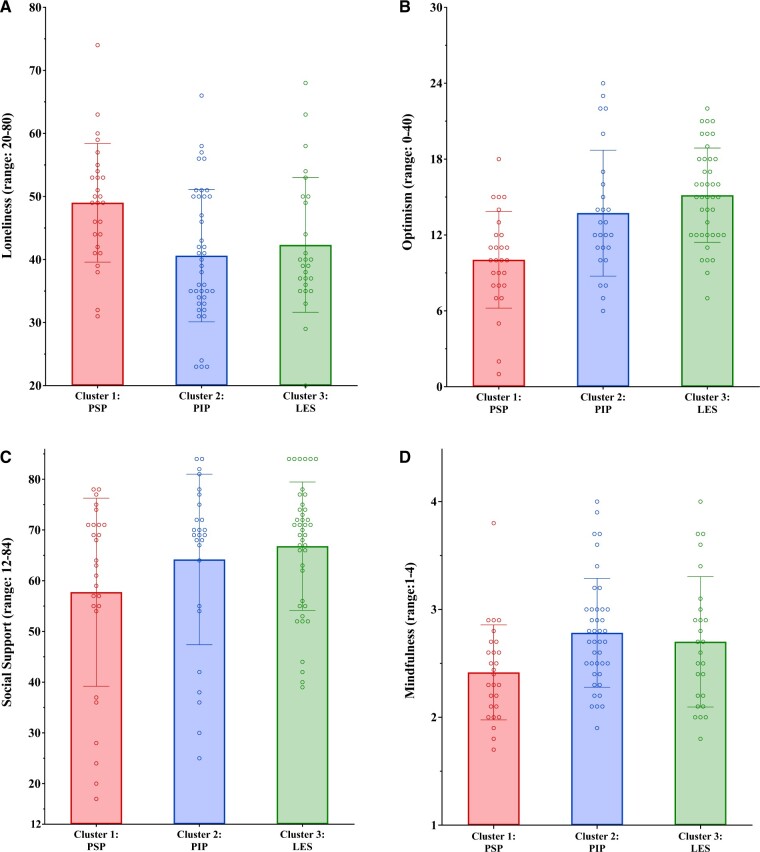
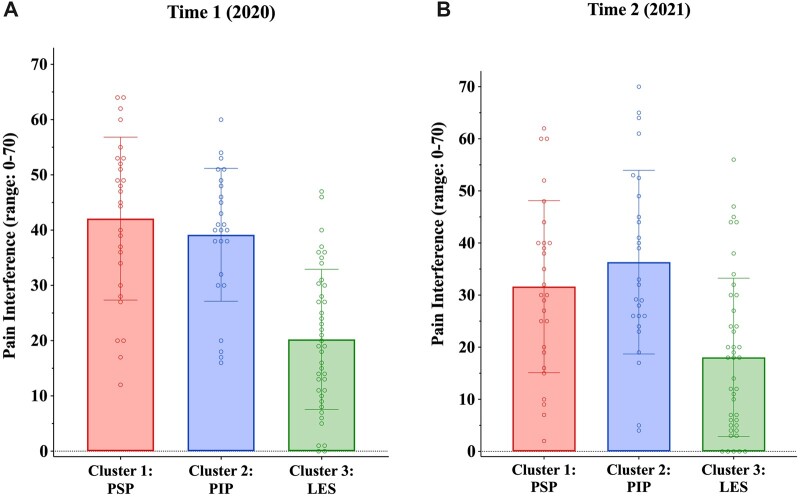
A cluster analysis, using psychosocial factors and pain intensity, empirically produced three patient groups: 1) psychosocial predominant (PSP), characterized by high psychosocial distress and average pain intensity; 2) pain intensity predominant (PIP), characterized by average psychosocial distress and high pain intensity; and 3) less elevated symptoms (LES), characterized by low psychosocial distress and low pain intensity. At the 1-year follow-up, patients in the PSP and PIP clusters suffered greater pain interference than patients in the LES cluster, while patients in the PSP cluster also reported greater loneliness and lower mindfulness and optimism.
An empirical psychosocial-based clustering of patients identified three distinct groups that differed in pain interference. Patients with high psychosocial modulation of pain at the onset of social distancing (the PSP cluster) suffered not only greater pain interference but also greater loneliness and lower levels of mindfulness and optimism, which suggests some potential behavioral targets for this group in the future.
个体对慢性疼痛的体验存在差异,这不仅是因为不同的临床诊断,还因为生物心理社会疼痛调制器的影响程度不同。我们的目的是根据心理社会特征和疼痛强度将慢性疼痛患者分为不同的亚组,并随后在大约 1 年后检查疼痛相关干扰方面的组间差异。
在这项观察性、纵向研究中,慢性疼痛患者(n=94)在 COVID-19 相关社交距离(2020 年 4 月至 6 月)开始时完成了心理社会特征和疼痛强度的验证评估。1 年后(2021 年 5 月至 6 月),患者完成了一项后续调查,评估疼痛干扰、孤独感、社会支持、正念和乐观程度。
使用心理社会因素和疼痛强度的聚类分析,经验性地产生了三组患者:1)心理社会为主(PSP),表现为高度心理社会困扰和平均疼痛强度;2)疼痛强度为主(PIP),表现为平均心理社会困扰和高疼痛强度;3)症状不那么明显(LES),表现为低心理社会困扰和低疼痛强度。在 1 年随访时,PSP 和 PIP 组的患者比 LES 组的患者遭受更大的疼痛干扰,而 PSP 组的患者还报告了更大的孤独感和更低的正念和乐观程度。
基于经验的心理社会聚类分析确定了三个在疼痛干扰方面存在差异的不同亚组。在社交隔离开始时具有较高心理社会调制疼痛的患者(PSP 组)不仅遭受更大的疼痛干扰,而且还遭受更大的孤独感和更低的正念和乐观程度,这表明该组在未来可能存在一些潜在的行为目标。