Laboratory of Cell Death and Cancer Therapy, Department of Molecular Biomedicine, Centro de Investigaciones Biológicas Margarita Salas, Consejo Superior de Investigaciones Científicas (CSIC), Ramiro de Maeztu 9, E-28040 Madrid, Spain.
Biochem Soc Trans. 2022 Jun 30;50(3):1105-1118. doi: 10.1042/BST20211115.
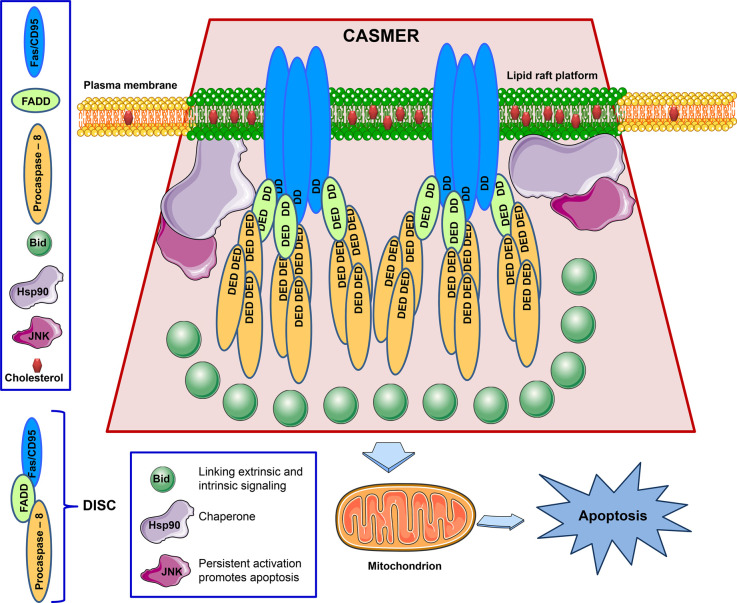
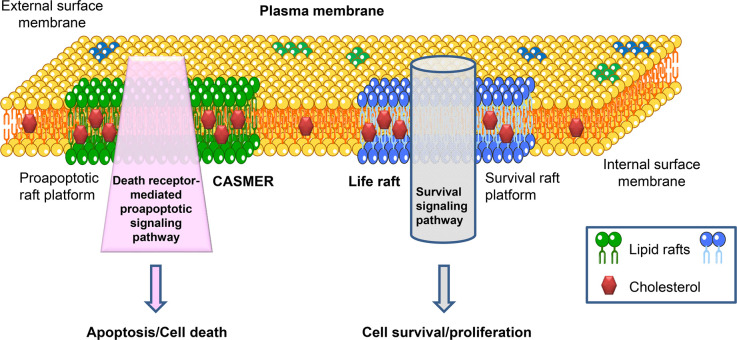
Mammalian cells show the ability to commit suicide through the activation of death receptors at the cell surface. Death receptors, among which Fas/CD95 is one of their most representative members, lack enzymatic activity, and depend on protein-protein interactions to signal apoptosis. Fas/CD95 death receptor-mediated apoptosis requires the formation of the so-called death-inducing signaling complex (DISC), bringing together Fas/CD95, Fas-associated death domain-containing protein and procaspase-8. In the last two decades, cholesterol-rich lipid raft platforms have emerged as scaffolds where Fas/CD95 can be recruited and clustered. The co-clustering of Fas/CD95 and rafts facilitates DISC formation, bringing procaspase-8 molecules to be bunched together in a limited membrane region, and leading to their autoproteolytic activation by oligomerization. Lipid raft platforms serve as a specific region for the clustering of Fas/CD95 and DISC, as well as for the recruitment of additional downstream signaling molecules, thus forming the so-called cluster of apoptotic signaling molecule-enriched rafts, or CASMER. These raft/CASMER structures float in the membrane like icebergs, in which the larger portion lies inside the cell and communicates with other subcellular structures to facilitate apoptotic signal transmission. This allows an efficient spatiotemporal compartmentalization of apoptosis signaling machinery during the triggering of cell death. This concept of proapoptotic raft platforms as a basic chemical-biological structure in the regulation of cell death has wide-ranging implications in human biology and disease, as well as in cancer therapy. Here, we discuss how these raft-centered proapoptotic hubs operate as a major linchpin for apoptosis signaling and as a promising target in cancer therapy.
哺乳动物细胞通过表面死亡受体的激活表现出自杀能力。死亡受体缺乏酶活性,依赖于蛋白质-蛋白质相互作用来发出凋亡信号,其中 Fas/CD95 是其最具代表性的成员之一。Fas/CD95 死亡受体介导的凋亡需要形成所谓的死亡诱导信号复合物 (DISC),将 Fas/CD95、含 Fas 相关死亡结构域的蛋白和前胱天蛋白酶-8 聚集在一起。在过去的二十年中,富含胆固醇的脂质筏平台已成为 Fas/CD95 可以被招募和聚集的支架。Fas/CD95 和筏的共聚类促进了 DISC 的形成,使前胱天蛋白酶-8 分子聚集在一起在一个有限的膜区域中,并导致它们通过寡聚化进行自身蛋白水解激活。脂质筏平台作为 Fas/CD95 和 DISC 聚类的特定区域,以及募集其他下游信号分子的区域,从而形成所谓的富含凋亡信号分子的筏聚类,或 CASMER。这些筏/CASMER 结构像冰山一样漂浮在膜中,其中较大的部分位于细胞内部,并与其他亚细胞结构进行通信,以促进凋亡信号的传递。这允许在触发细胞死亡期间对凋亡信号机制进行有效的时空分隔。这种促凋亡筏平台作为调节细胞死亡的基本化学生物学结构的概念在人类生物学和疾病以及癌症治疗中具有广泛的意义。在这里,我们讨论了这些以筏为中心的促凋亡枢纽如何作为凋亡信号的主要关键因素发挥作用,以及如何成为癌症治疗的有前途的靶标。