Laboratory of Cell Death and Cancer Therapy, Department of Molecular Biomedicine, Centro de Investigaciones Biológicas, Consejo Superior de Investigaciones Cientificas (CSIC), E-28040 Madrid, Spain. Electronic address: mailto:
Laboratory of Cell Death and Cancer Therapy, Department of Molecular Biomedicine, Centro de Investigaciones Biológicas, Consejo Superior de Investigaciones Cientificas (CSIC), E-28040 Madrid, Spain.
J Lipid Res. 2020 May;61(5):611-635. doi: 10.1194/jlr.TR119000439. Epub 2020 Nov 7.
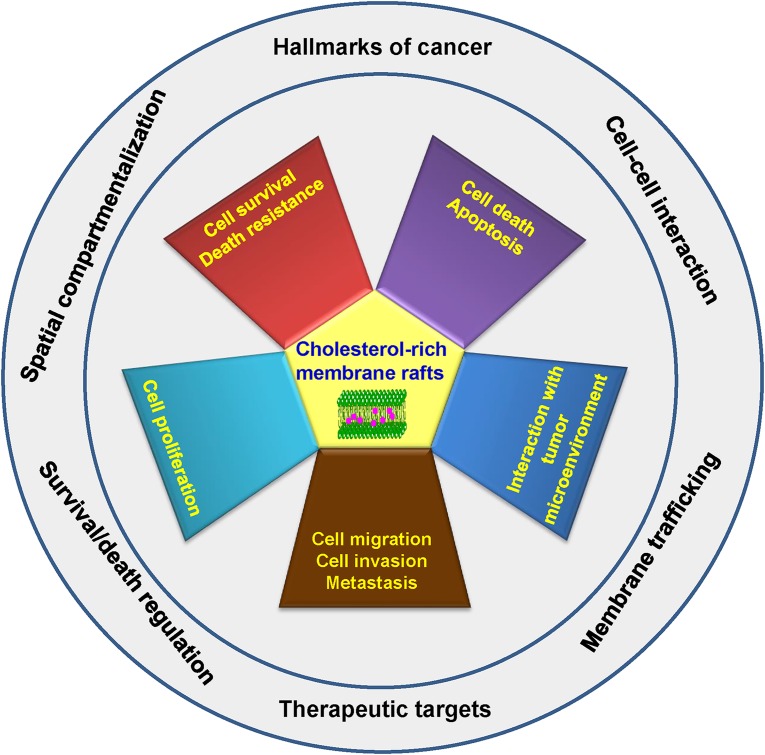
Cholesterol/sphingolipid-rich membrane domains, known as lipid rafts or membrane rafts, play a critical role in the compartmentalization of signaling pathways. Physical segregation of proteins in lipid rafts may modulate the accessibility of proteins to regulatory or effector molecules. Thus, lipid rafts serve as sorting platforms and hubs for signal transduction proteins. Cancer cells contain higher levels of intracellular cholesterol and lipid rafts than their normal non-tumorigenic counterparts. Many signal transduction processes involved in cancer development (insulin-like growth factor system and phosphatidylinositol 3-kinase-AKT) and metastasis [cluster of differentiation (CD)44] are dependent on or modulated by lipid rafts. Additional proteins playing an important role in several malignant cancers (e.g., transmembrane glycoprotein mucin 1) are also being detected in association with lipid rafts, suggesting a major role of lipid rafts in tumor progression. Conversely, lipid rafts also serve as scaffolds for the recruitment and clustering of Fas/CD95 death receptors and downstream signaling molecules leading to cell death-promoting raft platforms. The partition of death receptors and downstream signaling molecules in aggregated lipid rafts has led to the formation of the so-called cluster of apoptotic signaling molecule-enriched rafts, or CASMER, which leads to apoptosis amplification and can be pharmacologically modulated. These death-promoting rafts can be viewed as a linchpin from which apoptotic signals are launched. In this review, we discuss the involvement of lipid rafts in major signaling processes in cancer cells, including cell survival, cell death, and metastasis, and we consider the potential of lipid raft modulation as a promising target in cancer therapy.
胆固醇/神经鞘脂丰富的膜域,称为脂筏或膜筏,在信号通路的区室化中起着关键作用。脂筏中蛋白质的物理隔离可能调节蛋白质对调节或效应分子的可及性。因此,脂筏充当信号转导蛋白的分拣平台和中心。癌细胞比正常非肿瘤细胞含有更高水平的细胞内胆固醇和脂筏。许多参与癌症发展(胰岛素样生长因子系统和磷脂酰肌醇 3-激酶-AKT)和转移[分化(CD)44]的信号转导过程依赖于脂筏或受其调节。在几种恶性肿瘤中发挥重要作用的其他蛋白质(例如跨膜糖蛋白黏蛋白 1)也与脂筏相关联被检测到,这表明脂筏在肿瘤进展中起主要作用。相反,脂筏也作为 Fas/CD95 死亡受体和导致促进筏状平台的细胞死亡的下游信号分子募集和聚集的支架。死亡受体和聚集的脂筏中的下游信号分子的分区导致了所谓的富含凋亡信号分子的筏状聚集的形成,或 CASMER,这导致了凋亡的放大,并可以通过药理学进行调节。这些促进死亡的筏可以被视为启动凋亡信号的关键。在这篇综述中,我们讨论了脂筏在癌细胞中的主要信号转导过程中的参与,包括细胞存活、细胞死亡和转移,并且我们考虑了脂筏调节作为癌症治疗中一个有前途的靶点的潜力。