
从儿童期到青春期早期听力下降的危险因素。
Risk Factors For Hearing Decline From Childhood To Early Adolescence.
机构信息
Department of Otorhinolaryngology, Head and Neck Surgery, Erasmus University Medical Center, Rotterdam, the Netherlands.
The Generation R Study Group, Erasmus University Medical Center, Rotterdam, the Netherlands.
出版信息
Laryngoscope. 2023 Feb;133(2):389-395. doi: 10.1002/lary.30207. Epub 2022 May 19.
OBJECTIVE
To identify risk factors of hearing decline between 9 and 13 years of age. The risk factors examined included sociodemographic, health, and lifestyle-related factors.
METHODS
This study was embedded within a population-based prospective cohort study from fetal life onwards in the Netherlands. Pure-tone audiometry and tympanometry were performed at the age of 9 and 13 years. The hearing decline was defined as an increase in low-frequency or high-frequency pure-tone average of at least 5 dB in one of both ears. Multivariable logistic regression was performed to examine the association of possible risk factors with hearing decline. The study was conducted from April 2012 to October 2015, and from April 2016 to September 2019.
RESULTS
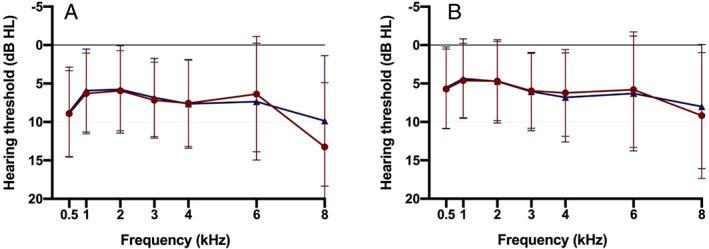
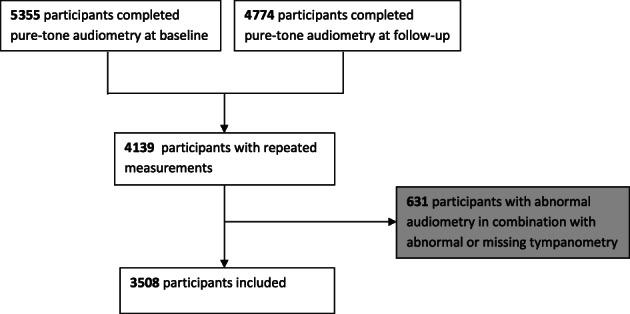
Of the 3,508 participants included, 7.8% demonstrated a hearing decline in the low frequencies, and 11.3% in the high frequencies. Participants who reported alcohol consumption were more likely to have a hearing decline in the low frequencies (OR 1.5, 95% CI 1.1; 2.0). Moreover, a lower educational level was associated with an increased odds of having a hearing decline in the high frequencies (OR 1.4, 95% CI 1.0; 1.8). Age, sex, household income, personal music player use, and body mass index were not associated with hearing decline.
CONCLUSION
Educational level and risky behavior were significantly associated with hearing decline from childhood to early adolescence. The findings of the present study can help in the design of public health interventions to prevent hearing loss at a young age.
LEVEL OF EVIDENCE
2 (prospective cohort study) Laryngoscope, 133:389-395, 2023.
目的
确定 9 至 13 岁听力下降的危险因素。所检查的危险因素包括社会人口统计学、健康和生活方式相关因素。
方法
本研究是在荷兰一项从胎儿期开始的基于人群的前瞻性队列研究中进行的。在 9 岁和 13 岁时进行纯音测听和鼓室压测量。听力下降定义为一只或两只耳朵的低频或高频纯音平均听力至少增加 5dB。采用多变量逻辑回归分析可能的危险因素与听力下降的关系。该研究于 2012 年 4 月至 2015 年 10 月,以及 2016 年 4 月至 2019 年 9 月进行。
结果
在 3508 名参与者中,7.8%的人低频听力下降,11.3%的人高频听力下降。报告饮酒的参与者低频听力下降的可能性更大(OR 1.5,95%CI 1.1;2.0)。此外,较低的教育水平与高频听力下降的几率增加相关(OR 1.4,95%CI 1.0;1.8)。年龄、性别、家庭收入、个人音乐播放器使用和体重指数与听力下降无关。
结论
教育水平和危险行为与儿童期至青春期早期的听力下降显著相关。本研究的结果有助于设计公共卫生干预措施,以预防年轻时的听力损失。
证据水平
2(前瞻性队列研究)喉镜,133:389-395,2023。
 Zotero 插件