Faculty of Mathematics and Mechanics, Saint Petersburg State University, Saint Petersburg, Russia.
W. M. Keck Science Center, The Claremont Colleges, Claremont, CA, USA.
Sci Rep. 2022 May 19;12(1):8480. doi: 10.1038/s41598-022-12513-w.
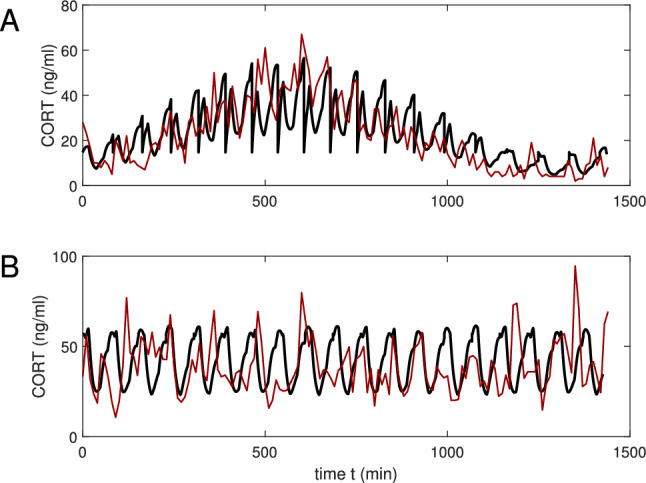
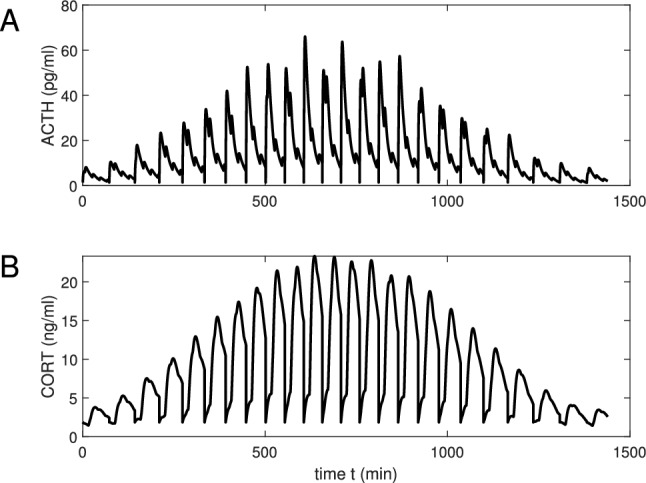
A new mathematical model for biological rhythms in the hypothalamic-pituitary-adrenal (HPA) axis is proposed. This model takes the form of a system of impulsive time-delay differential equations which include pulsatile release of adrenocorticotropin (ACTH) by the pituitary gland and a time delay for the release of glucocorticoid hormones by the adrenal gland. Numerical simulations demonstrate that the model's response to periodic and circadian inputs from the hypothalamus are consistent with those generated by recent models which do not include a pulsatile pituitary. In contrast the oscillatory phenomena generated by the impulsive delay equation mode occur even if the time delay is zero. The observation that the time delay merely introduces a small phase shift suggesting that the effects of the adrenal gland are "downstream" to the origin of pulsativity. In addition, the model accounts for the occurrence of ultradian oscillations in an isolated pituitary gland. These observations suggest that principles of pulse modulated control, familiar to control engineers, may have an increasing role to play in understanding the HPA axis.
提出了一个新的下丘脑-垂体-肾上腺(HPA)轴生物节律的数学模型。该模型采用脉冲时滞微分方程组的形式,包括垂体脉冲释放促肾上腺皮质激素(ACTH)和肾上腺释放糖皮质激素的时滞。数值模拟表明,该模型对来自下丘脑的周期性和昼夜节律输入的反应与不包括脉冲垂体的最近模型生成的反应一致。相比之下,即使时滞为零,脉冲延迟方程模型产生的振荡现象也会发生。观察到的时滞仅引入小的相移,表明肾上腺的作用是“下游”于脉冲起源。此外,该模型解释了孤立垂体中超短周期振荡的发生。这些观察结果表明,控制工程师所熟悉的脉冲调制控制原理可能在理解 HPA 轴方面发挥越来越重要的作用。