Photonics Research Institute, Department of Electrical Engineering, The Hong Kong Polytechnic University, Hong Kong, China.
Shenzhen Research Institute, The Hong Kong Polytechnic University, Shenzhen 518057, China.
Sensors (Basel). 2022 Apr 20;22(9):3145. doi: 10.3390/s22093145.
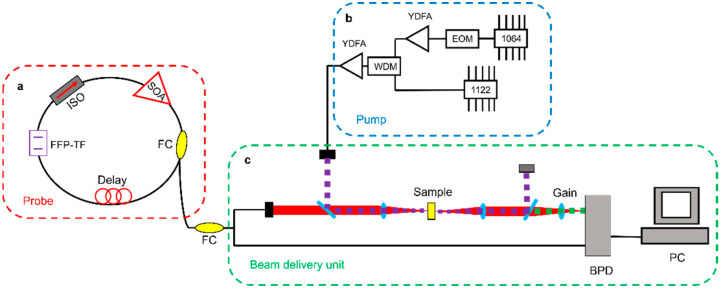
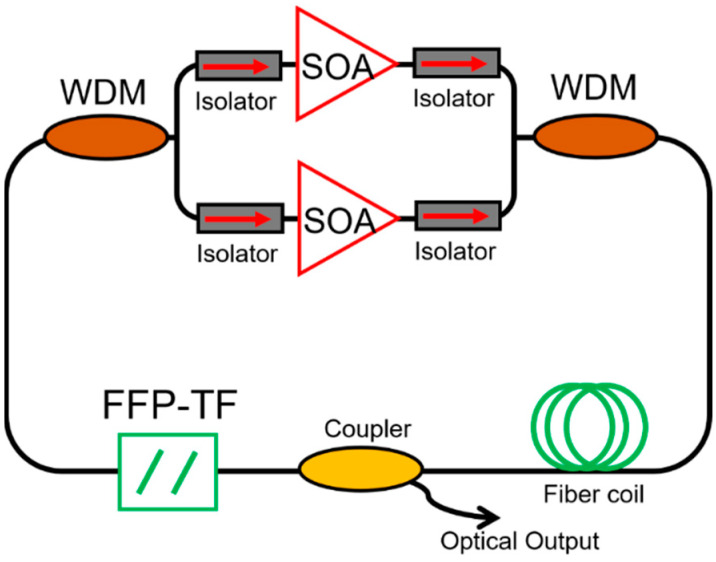
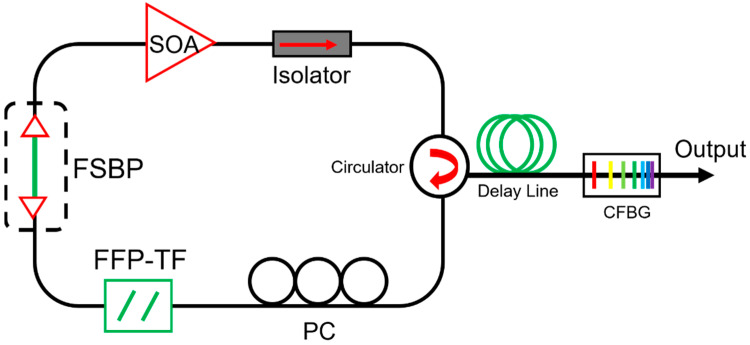
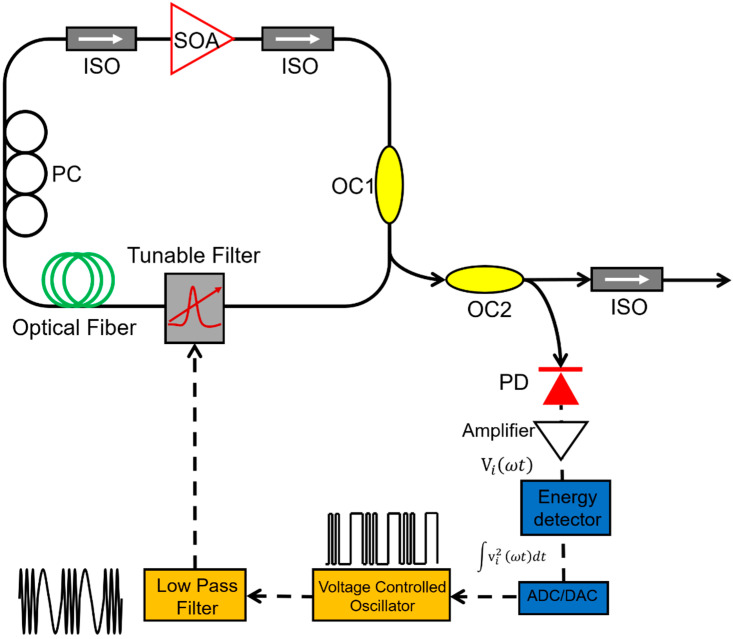
The sweep rate of conventional short-cavity lasers with an intracavity-swept filter is limited by the buildup time of laser signals from spontaneous emissions. The Fourier domain mode-locked (FDML) laser was proposed to overcome the limitations of buildup time by inserting a long fiber delay in the cavity to store the whole swept signal and has attracted much interest in both theoretical and experimental studies. In this review, the theoretical models to understand the dynamics of the FDML laser and the experimental techniques to realize high speed, wide sweep range, long coherence length, high output power and highly stable swept signals in FDML lasers will be discussed. We will then discuss the applications of FDML lasers in optical coherence tomography (OCT), fiber sensing, precision measurement, microwave generation and nonlinear microscopy.
传统短腔激光的扫频速率受到激光信号自发射的建立时间的限制。为了克服建立时间的限制,人们提出了傅里叶域锁模(FDML)激光器,该方法通过在腔中插入长光纤延迟来存储整个扫频信号。FDML 激光器在理论和实验研究中都引起了广泛的关注。在这篇综述中,我们将讨论理解 FDML 激光动力学的理论模型,以及在 FDML 激光器中实现高速、宽扫频范围、长相干长度、高输出功率和高度稳定扫频信号的实验技术。然后,我们将讨论 FDML 激光器在光学相干断层扫描(OCT)、光纤传感、精密测量、微波产生和非线性显微镜中的应用。