• 文献检索
  • 文档翻译
  • 深度研究
  • 学术资讯
  • Suppr Zotero 插件Zotero 插件
  • 邀请有礼
  • 套餐&价格
  • 历史记录
应用&插件
Suppr Zotero 插件Zotero 插件浏览器插件Mac 客户端Windows 客户端微信小程序
定价
高级版会员购买积分包购买API积分包
服务
文献检索文档翻译深度研究API 文档MCP 服务
关于我们
关于 Suppr公司介绍联系我们用户协议隐私条款
关注我们

Suppr 超能文献

核心技术专利:CN118964589B侵权必究
粤ICP备2023148730 号-1Suppr @ 2026

文献检索

告别复杂PubMed语法,用中文像聊天一样搜索,搜遍4000万医学文献。AI智能推荐,让科研检索更轻松。

立即免费搜索

文件翻译

保留排版,准确专业,支持PDF/Word/PPT等文件格式,支持 12+语言互译。

免费翻译文档

深度研究

AI帮你快速写综述,25分钟生成高质量综述,智能提取关键信息,辅助科研写作。

立即免费体验

惯性传感器到段的校准,以实现 OpenSim 中精确的 3D 关节角度计算。

Inertial Sensor-to-Segment Calibration for Accurate 3D Joint Angle Calculation for Use in OpenSim.

机构信息

Department of Movement Sciences, Katholieke Universiteit Leuven, 3001 Leuven, Belgium.

出版信息

Sensors (Basel). 2022 Apr 24;22(9):3259. doi: 10.3390/s22093259.

DOI:10.3390/s22093259
PMID:35590949
原文链接:https://pmc.ncbi.nlm.nih.gov/articles/PMC9104520/
Abstract

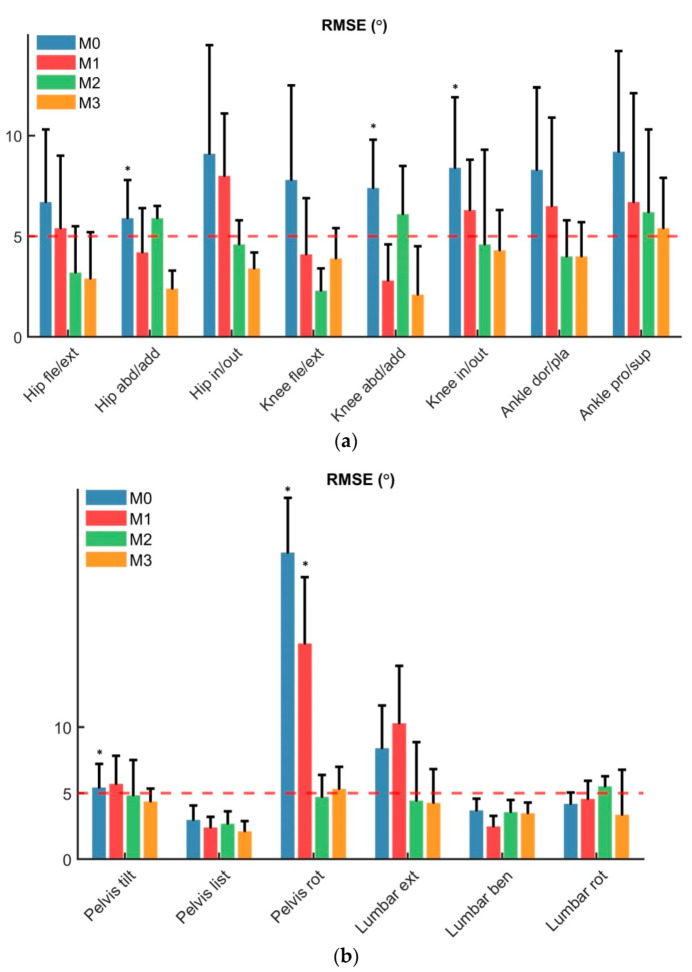
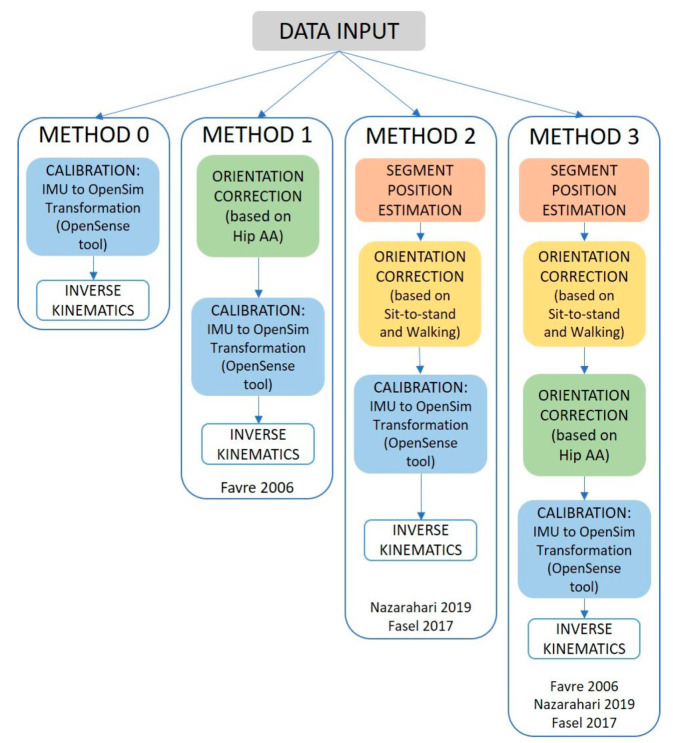
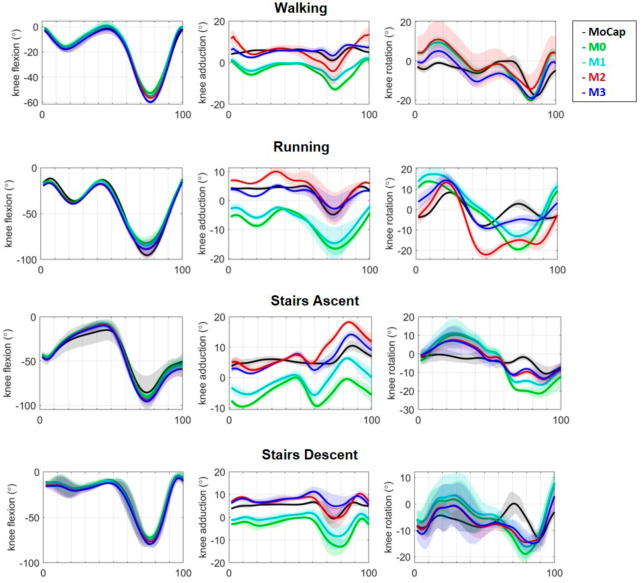
Inertial capture (InCap) systems combined with musculoskeletal (MSK) models are an attractive option for monitoring 3D joint kinematics in an ecological context. However, the primary limiting factor is the sensor-to-segment calibration, which is crucial to estimate the body segment orientations. Walking, running, and stair ascent and descent trials were measured in eleven healthy subjects with the Xsens InCap system and the Vicon 3D motion capture (MoCap) system at a self-selected speed. A novel integrated method that combines previous sensor-to-segment calibration approaches was developed for use in a MSK model with three degree of freedom (DOF) hip and knee joints. The following were compared: RMSE, range of motion (ROM), peaks, and R between InCap kinematics estimated with different calibration methods and gold standard MoCap kinematics. The integrated method reduced the RSME for both the hip and the knee joints below 5°, and no statistically significant differences were found between MoCap and InCap kinematics. This was consistent across all the different analyzed movements. The developed method was integrated on an MSK model workflow, and it increased the sensor-to-segment calibration accuracy for an accurate estimate of 3D joint kinematics compared to MoCap, guaranteeing a clinical easy-to-use approach.

摘要

惯性捕获 (InCap) 系统与肌肉骨骼 (MSK) 模型相结合,是在生态背景下监测 3D 关节运动学的一种很有吸引力的选择。然而,主要的限制因素是传感器到节段的校准,这对于估计身体节段的方向至关重要。在 11 名健康受试者中,以自选择的速度进行了步行、跑步、上下楼梯试验,使用 Xsens Incap 系统和 Vicon 3D 运动捕捉 (MoCap) 系统进行测量。开发了一种新的集成方法,该方法结合了以前的传感器到节段校准方法,用于具有三个自由度 (DOF) 髋关节和膝关节的 MSK 模型。比较了以下内容:不同校准方法和黄金标准 MoCap 运动学估计的 Incap 运动学的 RMSE、运动范围 (ROM)、峰值和 R。该集成方法将髋关节和膝关节的 RMSE 降低到 5°以下,并且在 MoCap 和 Incap 运动学之间没有发现统计学上的显著差异。这在所有不同的分析运动中都是一致的。该方法已集成到 MSK 模型工作流程中,与 MoCap 相比,它提高了传感器到节段的校准精度,可实现 3D 关节运动学的准确估计,保证了临床易于使用的方法。
https://cdn.ncbi.nlm.nih.gov/pmc/blobs/e0cd/9104520/5e0a10d8fd3a/sensors-22-03259-g004.jpg
https://cdn.ncbi.nlm.nih.gov/pmc/blobs/e0cd/9104520/54b4c1ed5060/sensors-22-03259-g001.jpg
https://cdn.ncbi.nlm.nih.gov/pmc/blobs/e0cd/9104520/56003076b4e7/sensors-22-03259-g002.jpg
https://cdn.ncbi.nlm.nih.gov/pmc/blobs/e0cd/9104520/0a910b0e1da8/sensors-22-03259-g003.jpg
https://cdn.ncbi.nlm.nih.gov/pmc/blobs/e0cd/9104520/5e0a10d8fd3a/sensors-22-03259-g004.jpg
https://cdn.ncbi.nlm.nih.gov/pmc/blobs/e0cd/9104520/54b4c1ed5060/sensors-22-03259-g001.jpg
https://cdn.ncbi.nlm.nih.gov/pmc/blobs/e0cd/9104520/56003076b4e7/sensors-22-03259-g002.jpg
https://cdn.ncbi.nlm.nih.gov/pmc/blobs/e0cd/9104520/0a910b0e1da8/sensors-22-03259-g003.jpg
https://cdn.ncbi.nlm.nih.gov/pmc/blobs/e0cd/9104520/5e0a10d8fd3a/sensors-22-03259-g004.jpg

相似文献

1
Inertial Sensor-to-Segment Calibration for Accurate 3D Joint Angle Calculation for Use in OpenSim.惯性传感器到段的校准,以实现 OpenSim 中精确的 3D 关节角度计算。
Sensors (Basel). 2022 Apr 24;22(9):3259. doi: 10.3390/s22093259.
2
Estimation of 3D Knee Joint Angles during Cycling Using Inertial Sensors: Accuracy of a Novel Sensor-to-Segment Calibration Procedure Based on Pedaling Motion.使用惯性传感器估算自行车骑行过程中的 3D 膝关节角度:基于蹬踏运动的新型传感器到肢体标定程序的准确性。
Sensors (Basel). 2019 May 30;19(11):2474. doi: 10.3390/s19112474.
3
Sagittal plane knee kinematics can be measured during activities of daily living following total knee arthroplasty with two IMU.全膝关节置换术后,可使用两个 IMU 在日常生活活动中测量矢状面膝关节运动学。
PLoS One. 2024 Feb 15;19(2):e0297899. doi: 10.1371/journal.pone.0297899. eCollection 2024.
4
Validation of wearable inertial sensor-based gait analysis system for measurement of spatiotemporal parameters and lower extremity joint kinematics in sagittal plane.验证基于可穿戴惯性传感器的步态分析系统在矢状面测量时空参数和下肢关节运动学的准确性。
Proc Inst Mech Eng H. 2022 May;236(5):686-696. doi: 10.1177/09544119211072971. Epub 2022 Jan 8.
5
Validation of Novel Relative Orientation and Inertial Sensor-to-Segment Alignment Algorithms for Estimating 3D Hip Joint Angles.新型相对姿态和惯性传感器-节段配准算法估计三维髋关节角度的验证。
Sensors (Basel). 2019 Nov 24;19(23):5143. doi: 10.3390/s19235143.
6
Lower Extremity Inverse Kinematics Results Differ Between Inertial Measurement Unit- and Marker-Derived Gait Data.下肢运动学反演结果在惯性测量单元和标记点运动学数据之间存在差异。
J Appl Biomech. 2023 Apr 6;39(3):133-142. doi: 10.1123/jab.2022-0194. Print 2023 Jun 1.
7
Inertial motion capture validation of 3D knee kinematics at various gait speed on the treadmill with a double-pose calibration.在跑步机上进行双姿态标定,以不同的行走速度验证 3D 膝关节运动学的惯性运动捕捉。
Gait Posture. 2020 Mar;77:132-137. doi: 10.1016/j.gaitpost.2020.01.029. Epub 2020 Jan 31.
8
Gait kinematics based on inertial measurement units with the sensor-to-segment calibration and multibody optimization adapted to the patient's motor capacities, a pilot study.基于惯性测量单元的步态运动学,采用传感器与肢体标定和多体优化方法,适应患者的运动能力,初步研究。
Gait Posture. 2024 Feb;108:275-281. doi: 10.1016/j.gaitpost.2023.12.015. Epub 2023 Dec 22.
9
Body-Worn IMU-Based Human Hip and Knee Kinematics Estimation during Treadmill Walking.基于穿戴式惯性测量单元的跑步机步行时人体髋关节和膝关节运动学估计。
Sensors (Basel). 2022 Mar 26;22(7):2544. doi: 10.3390/s22072544.
10
Lower Limb Kinematics Using Inertial Sensors during Locomotion: Accuracy and Reproducibility of Joint Angle Calculations with Different Sensor-to-Segment Calibrations.使用惯性传感器进行下肢运动学研究:不同传感器-节段标定方法计算关节角度的准确性和可重复性。
Sensors (Basel). 2020 Jan 28;20(3):715. doi: 10.3390/s20030715.

引用本文的文献

1
Quantification of 3D Kinematic Measurements for Knee Flexion and Tibial Rotation Using an IMU-Based Sensor and Ultrasound Imaging System: A Cadaveric Study.使用基于惯性测量单元的传感器和超声成像系统对膝关节屈曲和胫骨旋转进行三维运动学测量的量化:一项尸体研究。
Sensors (Basel). 2025 Jul 6;25(13):4211. doi: 10.3390/s25134211.
2
Can We Target Close Therapeutic Goals in the Gait Re-Education Algorithm for Stroke Patients at the Beginning of the Rehabilitation Process?在康复治疗过程的早期,我们能否针对脑卒中患者步态再教育算法中的接近治疗目标?
Sensors (Basel). 2024 May 25;24(11):3416. doi: 10.3390/s24113416.
3
SensAA-Design and Verification of a Cloud-Based Wearable Biomechanical Data Acquisition System.

本文引用的文献

1
OpenSense: An open-source toolbox for inertial-measurement-unit-based measurement of lower extremity kinematics over long durations.OpenSense:一个基于惯性测量单元的开源工具包,用于长时间测量下肢运动学。
J Neuroeng Rehabil. 2022 Feb 20;19(1):22. doi: 10.1186/s12984-022-01001-x.
2
Reliability and Validity of an Inertial Measurement System to Quantify Lower Extremity Joint Angle in Functional Movements.惯性测量系统在功能性运动中量化下肢关节角度的可靠性和有效性。
Sensors (Basel). 2022 Jan 23;22(3):863. doi: 10.3390/s22030863.
3
A Comparison of Dynamic and Static Hip-Knee-Ankle Angle during Gait in Knee Osteoarthritis Patients and Healthy Individuals.
SensAA——基于云的可穿戴生物力学数据采集系统的设计与验证
Sensors (Basel). 2024 Apr 9;24(8):2405. doi: 10.3390/s24082405.
4
Machine Learning for Optical Motion Capture-Driven Musculoskeletal Modelling from Inertial Motion Capture Data.基于惯性运动捕捉数据的光学运动捕捉驱动的肌肉骨骼建模的机器学习
Bioengineering (Basel). 2023 Apr 24;10(5):510. doi: 10.3390/bioengineering10050510.
5
Peak Tibiofemoral Contact Forces Estimated Using IMU-Based Approaches Are Not Significantly Different from Motion Capture-Based Estimations in Patients with Knee Osteoarthritis.基于惯性测量单元的方法估计的胫骨股骨峰值接触力与基于运动捕捉的估计在膝骨关节炎患者中没有显著差异。
Sensors (Basel). 2023 May 4;23(9):4484. doi: 10.3390/s23094484.
6
Gait Alteration in Individual with Limb Loss: The Role of Inertial Sensors.肢体缺失者步态改变:惯性传感器的作用。
Sensors (Basel). 2023 Feb 7;23(4):1880. doi: 10.3390/s23041880.
7
The Automatization of the Gait Analysis by the Vicon Video System: A Pilot Study.利用 Vicon 视频系统实现步态分析自动化:一项初步研究。
Sensors (Basel). 2022 Sep 21;22(19):7178. doi: 10.3390/s22197178.
膝关节骨关节炎患者与健康个体在步态中动态和静态髋-膝-踝角度的比较。
Appl Bionics Biomech. 2021 Nov 22;2021:6231406. doi: 10.1155/2021/6231406. eCollection 2021.
4
IMU-based knee flexion, abduction and internal rotation estimation during drop landing and cutting tasks.基于惯性测量单元的落地和变向过程中膝关节弯曲、外展和内旋的估计。
J Biomech. 2021 Jul 19;124:110549. doi: 10.1016/j.jbiomech.2021.110549. Epub 2021 Jun 13.
5
Towards the Monitoring of Functional Status in a Free-Living Environment for People with Hip or Knee Osteoarthritis: Design and Evaluation of the JOLO Blended Care App.面向髋或膝关节骨关节炎患者的自由生活环境下功能状态监测:JOLO 混合照护应用的设计与评估。
Sensors (Basel). 2020 Dec 5;20(23):6967. doi: 10.3390/s20236967.
6
Concurrent validity and within-session reliability of gait kinematics measured using an inertial motion capture system with repeated calibration.使用经过多次校准的惯性运动捕捉系统测量步态运动学的同时效度和会话内可靠性。
J Bodyw Mov Ther. 2020 Oct;24(4):251-260. doi: 10.1016/j.jbmt.2020.06.008. Epub 2020 Aug 4.
7
Spring-loaded inverted pendulum modeling improves neural network estimation of ground reaction forces.弹载倒立摆建模提高了神经网络对地面反作用力的估计。
J Biomech. 2020 Dec 2;113:110069. doi: 10.1016/j.jbiomech.2020.110069. Epub 2020 Sep 30.
8
Sensor-to-Segment Calibration Methodologies for Lower-Body Kinematic Analysis with Inertial Sensors: A Systematic Review.基于惯性传感器的下肢运动学分析的传感器-分割标定方法:系统评价。
Sensors (Basel). 2020 Jun 11;20(11):3322. doi: 10.3390/s20113322.
9
Wearable Inertial Sensors for Range of Motion Assessment.用于运动范围评估的可穿戴惯性传感器
IEEE Sens J. 2020 Apr;20(7):3777-3787. doi: 10.1109/JSEN.2019.2960320. Epub 2019 Dec 17.
10
A Machine Learning Approach to Estimate Hip and Knee Joint Loading Using a Mobile Phone-Embedded IMU.一种使用手机内置惯性测量单元估计髋关节和膝关节负荷的机器学习方法。
Front Bioeng Biotechnol. 2020 Apr 15;8:320. doi: 10.3389/fbioe.2020.00320. eCollection 2020.