Zhang Li, Liu Geng, Han Bing, Yan Yuzhou, Fei Junhua, Ma Jianbing, Zhang Yunfei
Innovation Center of Bioengineering, Shaanxi Engineering Laboratory for Transmissions and Controls, Northwestern Polytechnical University, Xi'an 710072, China.
Honghui Hospital, Xi'an Jiaotong University College of Medicine, Xi'an 710054, China.
Appl Bionics Biomech. 2021 Nov 22;2021:6231406. doi: 10.1155/2021/6231406. eCollection 2021.
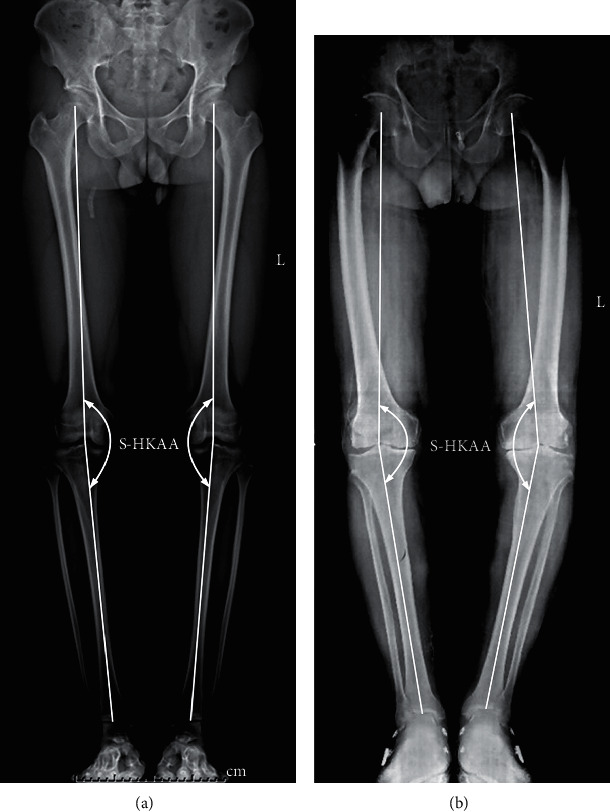
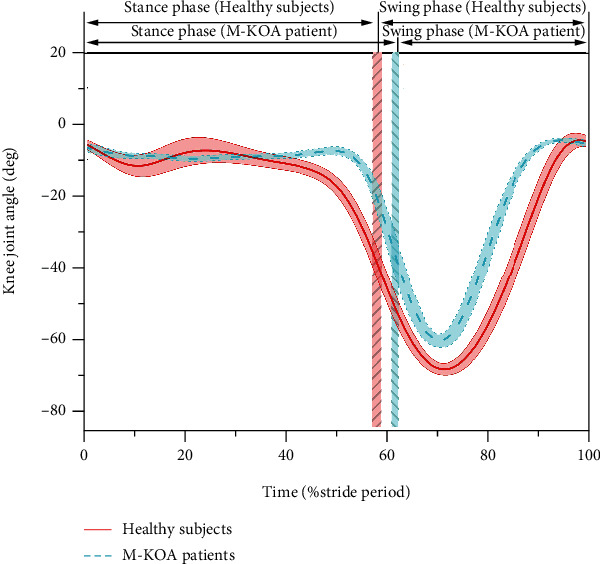
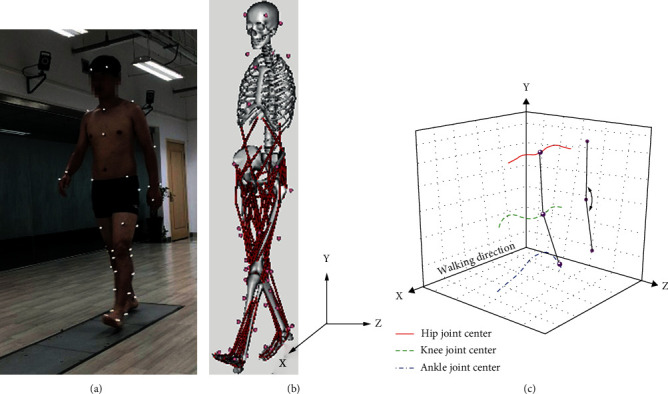
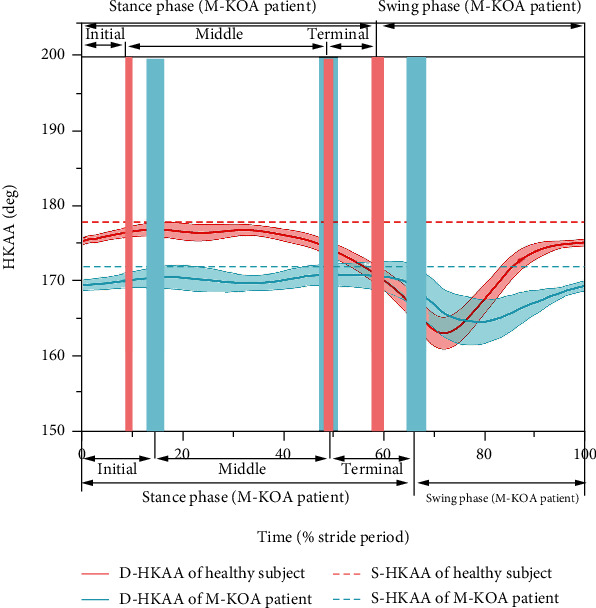
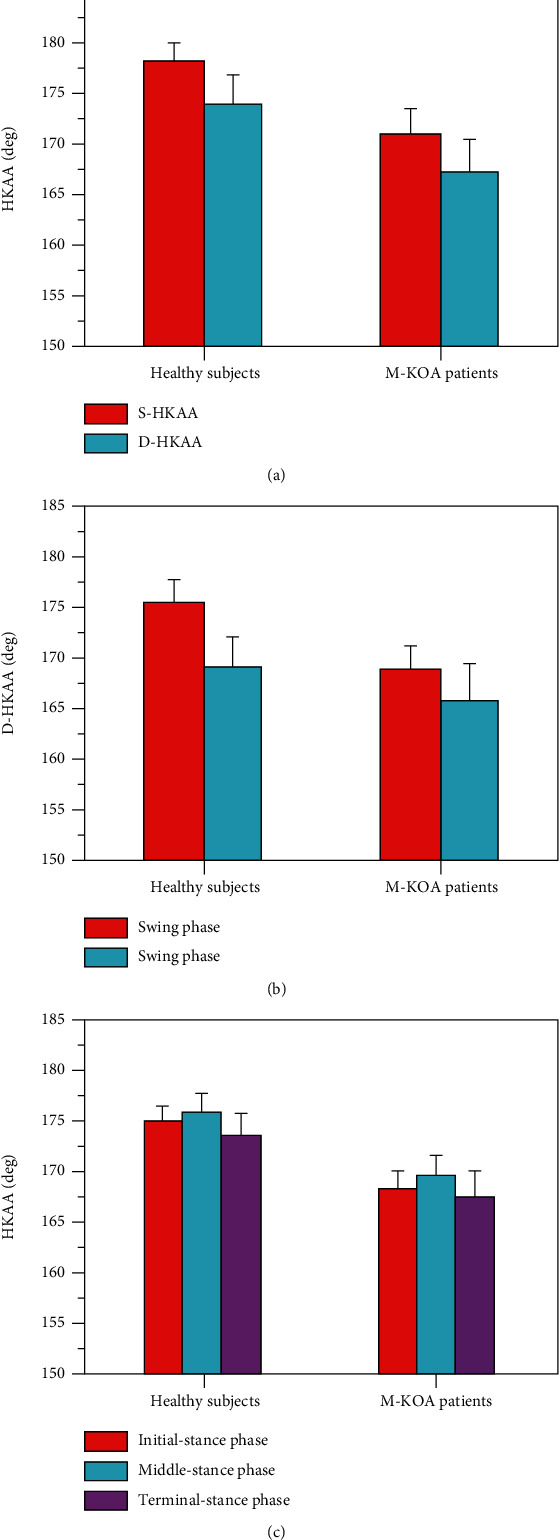
Malalignment of the lower limbs is the main biomechanical factor for knee osteoarthritis (KOA). The static hip-knee-ankle angle (S-HKAA) measured from radiograph is regarded as the "gold standard" of the malalignment. However, many evidences showed that the S-HKAA has no significant correlation with the knee dynamic-load distribution, unlike the dynamic HKAA (D-HKAA). The purpose of this study was to quantitatively analyze the D-HKAA and investigate the relationship between D-HKAA and S-HKAA for both KOA and healthy participants. In this paper, twenty-five healthy subjects and twenty-five medial compartment KOA (M-KOA) patients were recruited. Three-dimensional motion analysis and standing lower-limbs-full-length radiograph were utilized to obtain the D-HKAA and S-HKAA, respectively. The results showed that the mean D-HKAA was more varus than the S-HKAA ( < 0.05). For the mean D-HKAA, larger varus angle was observed in swing phase than stance phase ( < 0.05). Compared with healthy subjects, the M-KOA patients had remarkably smaller S-HKAA and D-HKAA during gait cycle ( < 0.01). For the relationship between the S-HKAA and mean D-HKAA, no significant correlation was found for both healthy subjects and M-KOA patients ( < 0.357, = 25, > 0.05, Spearman correlation analysis). In conclusion, the S-HKAA was limited to predict the D-HKAA for both M-KOA patients and healthy subjects. The D-HKAA should be given more attention to the orthopedist and the designer of knee brace and orthotics.
下肢力线不正为膝关节骨关节炎(KOA)的主要生物力学因素。通过X线片测量的静态髋-膝-踝角(S-HKAA)被视为力线不正的“金标准”。然而,许多证据表明,与动态髋-膝-踝角(D-HKAA)不同,S-HKAA与膝关节动态负荷分布无显著相关性。本研究旨在定量分析D-HKAA,并探讨KOA患者和健康受试者中D-HKAA与S-HKAA之间的关系。本文招募了25名健康受试者和25名内侧间室KOA(M-KOA)患者。分别利用三维运动分析和站立位下肢全长X线片获取D-HKAA和S-HKAA。结果显示,平均D-HKAA比S-HKAA内翻更明显(<0.05)。对于平均D-HKAA,在摆动期观察到的内翻角度大于站立期(<0.05)。与健康受试者相比,M-KOA患者在步态周期中的S-HKAA和D-HKAA明显更小(<0.01)。对于S-HKAA与平均D-HKAA之间的关系,在健康受试者和M-KOA患者中均未发现显著相关性(<0.357,=25,>0.05,Spearman相关性分析)。总之,S-HKAA在预测M-KOA患者和健康受试者的D-HKAA方面存在局限性。骨科医生以及膝关节支具和矫形器设计者应更多关注D-HKAA。