Department of Physics and Chemistry (DiFC)-Emilio Segrè, University of Palermo, Viale delle Scienze, Edificio 18, 90128 Palermo, Italy.
IMEM/CNR, Parco Area delle Scienze 37/A, 43100 Parma, Italy.
Sensors (Basel). 2022 Apr 29;22(9):3409. doi: 10.3390/s22093409.
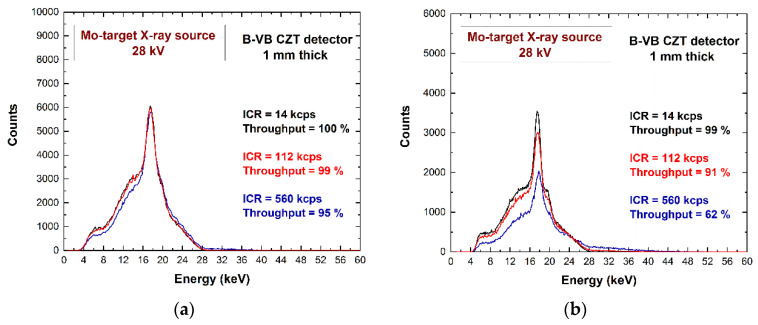
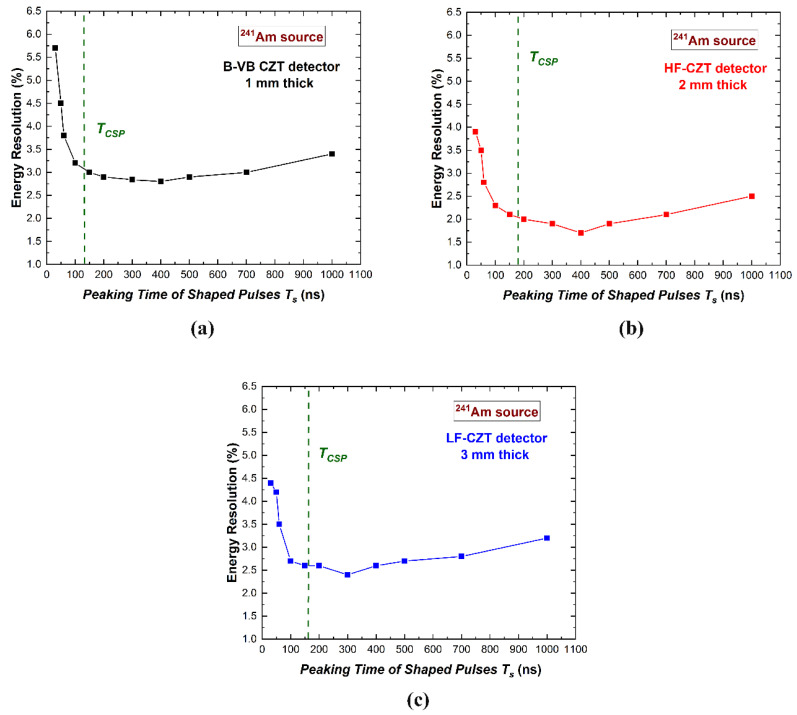
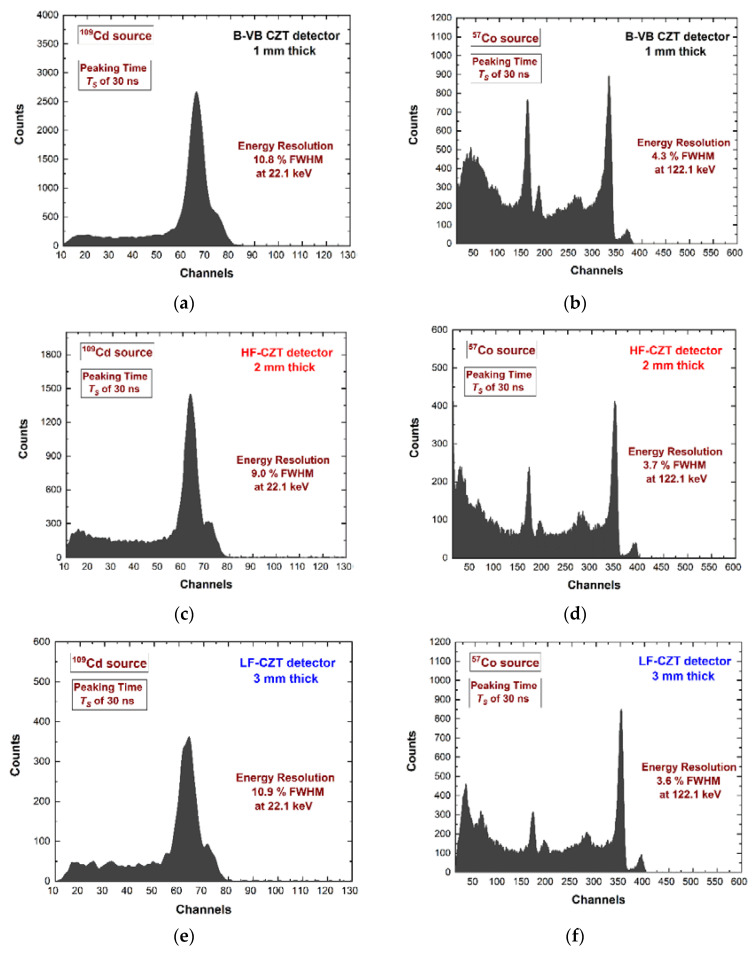
High-flux X-ray measurements with high-energy resolution and high throughput require the mitigation of pile-up and dead time effects. The reduction of the time width of the shaped pulses is a key approach, taking into account the distortions from the ballistic deficit, non-linearity, and time instabilities. In this work, we will present the performance of cadmium−zinc−telluride (CdZnTe or CZT) pixel detectors equipped with digital shapers faster than the preamplifier peaking times (ballistic deficit pulse processing). The effects on energy resolution, throughput, energy-linearity, time stability, charge sharing, and pile-up are shown. The results highlight the absence of time instabilities and high-energy resolution (<4% FWHM at 122 keV) when ballistic deficit pulse processing (dead time of 90 ns) was used in CZT pixel detectors. These activities are in the framework of an international collaboration on the development of spectroscopic imagers for medical applications (mammography, computed tomography) and non-destructive testing in the food industry.
高能分辨率和高吞吐量的高通量 X 射线测量需要减轻堆积和死区时间效应。减小整形脉冲的时间宽度是一种关键方法,需要考虑弹道亏损、非线性和时间不稳定性引起的失真。在这项工作中,我们将展示配备数字整形器的碲化镉锌(CdZnTe 或 CZT)像素探测器的性能,其速度超过前置放大器的峰值时间(弹道亏损脉冲处理)。展示了对能量分辨率、吞吐量、能线性、时间稳定性、电荷共享和堆积的影响。结果突出表明,当在 CZT 像素探测器中使用弹道亏损脉冲处理(90ns 的死区时间)时,不存在时间不稳定性和高能分辨率(在 122keV 时小于 4%FWHM)。这些活动是在为医疗应用(乳房 X 光摄影、计算机断层扫描)和食品工业中的无损检测开发光谱成像仪的国际合作框架内进行的。