Senthil Kumaran, Hefti Marco M, Singh Larry N, Morgan Ryan W, Mavroudis Constantine D, Ko Tiffany, Gaudio Hunter, Nadkarni Vinay M, Ehinger Johannes, Berg Robert A, Sutton Robert M, McGowan Francis X, Kilbaugh Todd J
Children's Hospital of Philadelphia and University of Pennsylvania Perelman School of Medicine, Department of Anesthesiology and Critical Care Medicine, United States.
University of Iowa, Division of Pathology, United States.
Resusc Plus. 2022 May 11;10:100243. doi: 10.1016/j.resplu.2022.100243. eCollection 2022 Jun.
The effect of cardiac arrest (CA) on cerebral transcriptomics and metabolomics is unknown. We previously demonstrated hemodynamic-directed CPR (HD-CPR) improves survival with favorable neurologic outcomes versus standard CPR (Std-CPR). We hypothesized HD-CPR would preserve the cerebral transcriptome and metabolome compared to Std-CPR.
Randomized pre-clinical animal trial.
Large animal resuscitation laboratory at an academic children's hospital.
Four-week-old female piglets (8-11 kg).
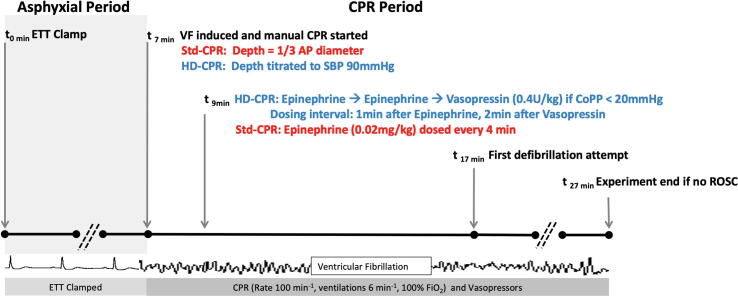
Pigs (1-month-old), three groups: 1) HD-CPR (compression depth to systolic BP 90 mmHg, vasopressors to coronary perfusion pressure 20 mmHg); 2) Std-CPR and 3) shams (no CPR). HD-CPR and Std-CPR underwent asphyxia, induced ventricular fibrillation, 10-20 min of CPR and post-resuscitation care. Primary outcomes at 24 h in cerebral cortex: 1) transcriptomic analysis (n = 4 per treatment arm, n = 8 sham) of 1727 genes using differential gene expression and 2) metabolomic analysis (n = 5 per group) of 27 metabolites using one-way ANOVA, post-hoc Tukey HSD.
65 genes were differentially expressed between HD-CPR and Std-CPR and 72 genes between Std-CPR and sham, but only five differed between HD-CPR and sham. Std-CPR increased the concentration of five AA compared to HD-CPR and sham, including the branched chain amino acids (BCAA), but zero metabolites differed between HD-CPR and sham.
In cerebral cortex 24 h post CA, Std-CPR resulted in a different transcriptome and metabolome compared with either HD-CPR or sham. HD-CPR preserves the transcriptome and metabolome, and is neuroprotective. Global molecular analyses may be a novel method to assess efficacy of clinical interventions and identify therapeutic targets.
IAC 16-001023.
心脏骤停(CA)对脑转录组学和代谢组学的影响尚不清楚。我们之前证明,与标准心肺复苏(Std-CPR)相比,血流动力学导向的心肺复苏(HD-CPR)可提高生存率并改善神经功能预后。我们假设与Std-CPR相比,HD-CPR能保护脑转录组和代谢组。
随机临床前动物试验。
一家学术儿童医院的大型动物复苏实验室。
4周龄雌性仔猪(8 - 11千克)。
1月龄猪,分为三组:1)HD-CPR(按压深度至收缩压90 mmHg,使用血管升压药使冠状动脉灌注压达到20 mmHg);2)Std-CPR;3)假手术组(不进行心肺复苏)。HD-CPR组和Std-CPR组经历窒息、诱发室颤、10 - 20分钟的心肺复苏及复苏后护理。大脑皮层24小时时的主要结局指标:1)使用差异基因表达对1727个基因进行转录组分析(每个治疗组n = 4,假手术组n = 8);2)使用单因素方差分析及事后Tukey HSD检验对27种代谢物进行代谢组分析(每组n = 5)。
HD-CPR组和Std-CPR组之间有65个基因差异表达,Std-CPR组和假手术组之间有72个基因差异表达,但HD-CPR组和假手术组之间只有5个基因不同。与HD-CPR组和假手术组相比,Std-CPR组使5种氨基酸浓度升高,包括支链氨基酸(BCAA),但HD-CPR组和假手术组之间没有代谢物差异。
在心脏骤停后24小时的大脑皮层中,与HD-CPR组或假手术组相比,Std-CPR组导致了不同的转录组和代谢组。HD-CPR能保护转录组和代谢组,具有神经保护作用。整体分子分析可能是评估临床干预效果和确定治疗靶点的一种新方法。
IAC 16 - 001023。