Institute of Ophthalmology, University College London, London EC1V 9EL, United Kingdom.
Department of Ophthalmology, King's College London, London SE1 7EH, United Kingdom.
Proc Natl Acad Sci U S A. 2022 May 24;119(21):e2119675119. doi: 10.1073/pnas.2119675119. Epub 2022 May 20.
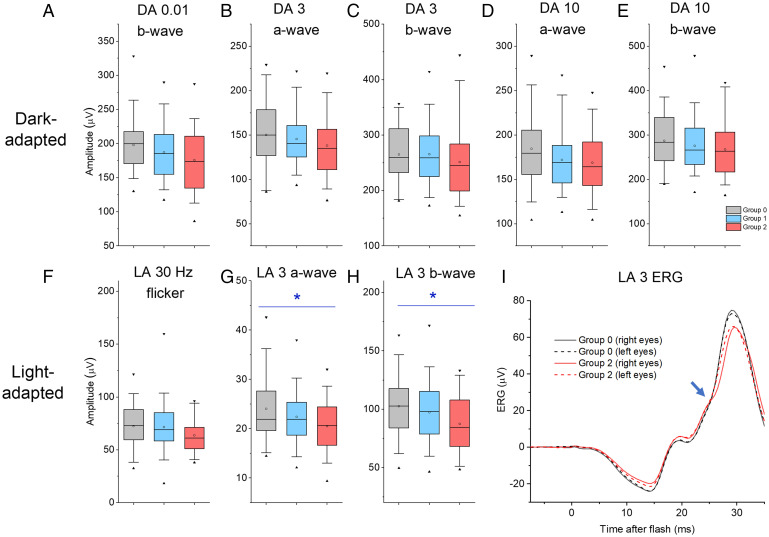
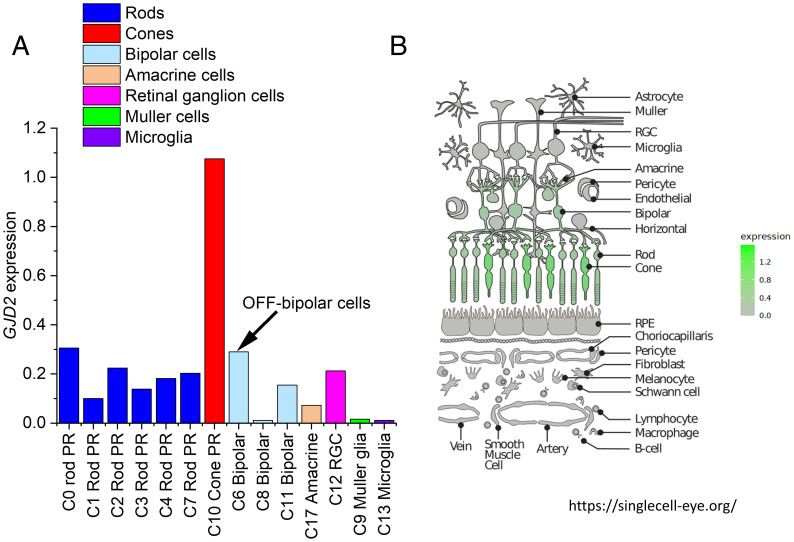
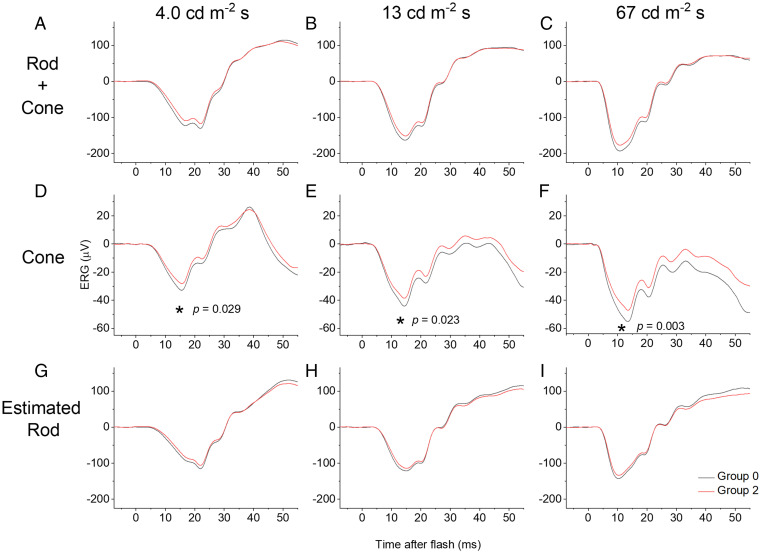
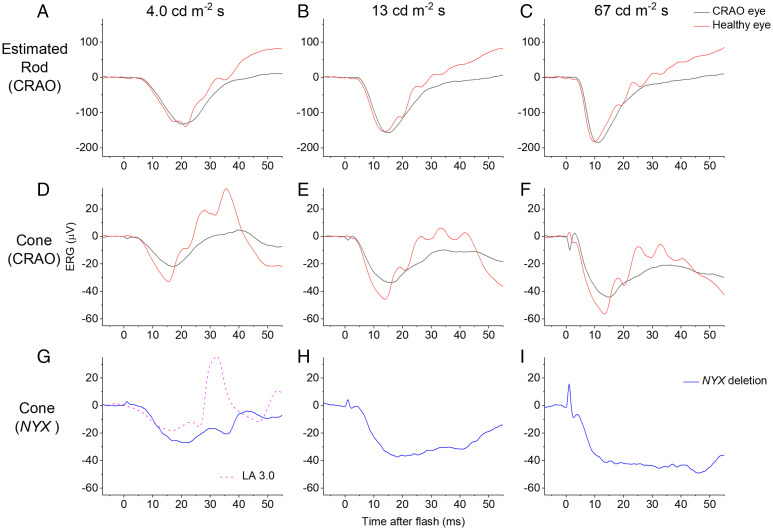
Myopia is the commonest visual impairment. Several genetic loci confer risk, but mechanisms by which they do this are unknown. Retinal signals drive eye growth, and myopia usually results from an excessively long eye. The common variant most strongly associated with myopia is near the GJD2 gene, encoding connexin-36, which forms retinal gap junctions. Light-evoked responses of retinal neurons can be recorded noninvasively as the electroretinogram (ERG). We analyzed these responses from 186 adult twin volunteers who had been genotyped at this locus. Participants underwent detailed ERG recordings incorporating international standard stimuli as well as experimental protocols aiming to separate dark-adapted rod- and cone-driven responses. A mixed linear model was used to explore association between allelic dosage at the locus and international standard ERG parameters after adjustment for age, sex, and family structure. Significant associations were found for parameters of light-adapted, but not dark-adapted, responses. Further investigation of isolated rod- and cone-driven ERGs confirmed associations with cone-driven, but not rod-driven, a-wave amplitudes. Comparison with responses to similar experimental stimuli from a patient with a prior central retinal artery occlusion, and from two patients with selective loss of ON-bipolar cell signals, was consistent with the associated parameters being derived from signals from cone-driven OFF-bipolar cells. Analysis of single-cell transcriptome data revealed strongest GJD2 expression in cone photoreceptors; bipolar cell expression appeared strongest in OFF-bipolar cells and weakest in rod-driven ON-bipolar cells. Our findings support a potential role for altered signaling in cone-driven OFF pathways in myopia development.
近视是最常见的视力障碍。有几个遗传位点赋予了患病风险,但它们的作用机制尚不清楚。视网膜信号驱动眼球生长,而近视通常是由于眼球过长引起的。与近视相关性最强的常见变异位于 GJD2 基因附近,该基因编码间隙连接蛋白 36,形成视网膜缝隙连接。视网膜神经元的光诱发电响应可以作为视网膜电图(ERG)无创记录。我们分析了 186 名成年双胞胎志愿者的这些反应,这些志愿者在该基因座进行了基因分型。参与者接受了详细的 ERG 记录,包括国际标准刺激以及旨在分离暗适应棒状和锥状驱动反应的实验方案。使用混合线性模型探索了该基因座等位基因剂量与国际标准 ERG 参数之间的关联,同时调整了年龄、性别和家庭结构的影响。发现光适应参数存在显著关联,但暗适应参数不存在关联。对分离的棒状和锥状驱动 ERG 的进一步研究证实了与锥状驱动、而不是棒状驱动 a 波幅度的关联。与一位先前患有中央视网膜动脉阻塞的患者以及两位选择性丧失 ON-双极细胞信号的患者的类似实验刺激的反应进行比较,与相关参数源自锥状驱动 OFF-双极细胞信号的结果一致。单细胞转录组数据分析表明,GJD2 表达最强的是锥状光感受器;双极细胞表达最强的是 OFF-双极细胞,最弱的是棒状驱动的 ON-双极细胞。我们的研究结果支持在近视发展过程中,改变的信号传递可能在锥状驱动的 OFF 通路中发挥作用。