Department of Population Health Science and Policy, Icahn School of Medicine at Mount Sinai, New York, New York, USA.
Institute for Health Care Delivery Science, Mount Sinai Health System, New York, New York, USA.
J Am Med Inform Assoc. 2022 Aug 16;29(9):1618-1630. doi: 10.1093/jamia/ocac081.
To describe adaptations necessary for effective use of direct-to-consumer (DTC) cameras in an inpatient setting, from the perspective of health care workers.
Our qualitative study included semi-structured interviews and focus groups with clinicians, information technology (IT) personnel, and health system leaders affiliated with the Mount Sinai Health System. All participants either worked in a coronavirus disease 2019 (COVID-19) unit with DTC cameras or participated in the camera implementation. Three researchers coded the transcripts independently and met weekly to discuss and resolve discrepancies. Abiding by inductive thematic analysis, coders revised the codebook until they reached saturation. All transcripts were coded in Dedoose using the final codebook.
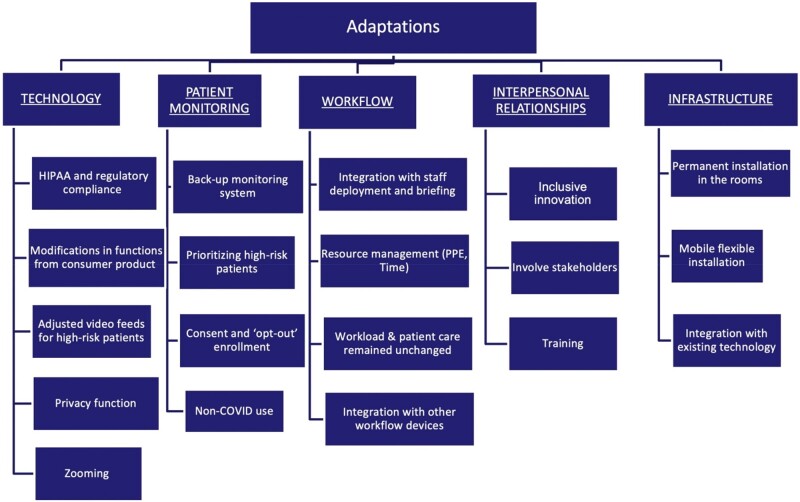
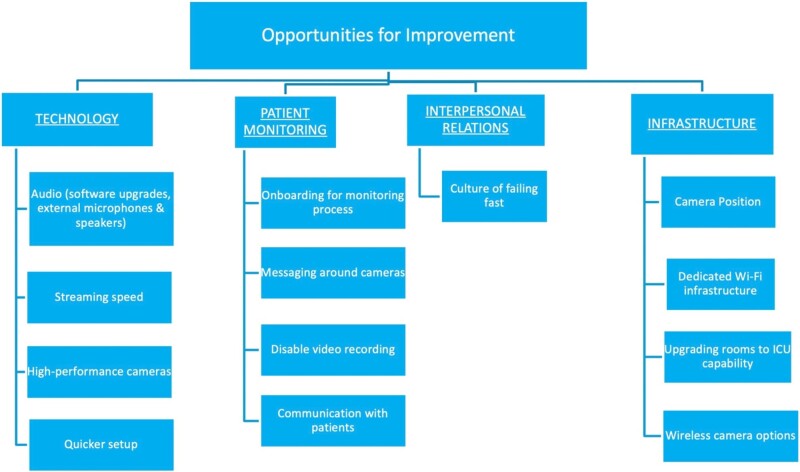
Frontline clinical staff, IT personnel, and health system leaders (N = 39) participated in individual interviews and focus groups in November 2020-April 2021. Our analysis identified 5 areas for effective DTC camera use: technology, patient monitoring, workflows, interpersonal relationships, and infrastructure. Participants described adaptations created to optimize camera use and opportunities for improvement necessary for sustained use. Non-COVID-19 patients tended to decline participation.
Deploying DTC cameras on inpatient units required adaptations in many routine processes. Addressing consent, 2-way communication issues, patient privacy, and messaging about video monitoring could help facilitate a nimble rollout. Implementation and dissemination of inpatient video monitoring using DTC cameras requires input from patients and frontline staff.
Given the resources and time it takes to implement a usable camera solution, other health systems might benefit from creating task forces to investigate their use before the next crisis.
从医护人员的角度描述在住院环境中有效使用直接面向消费者(DTC)摄像头所需的适应措施。
我们的定性研究包括与西奈山卫生系统相关的临床医生、信息技术(IT)人员和卫生系统领导者的半结构式访谈和焦点小组。所有参与者均在配备 DTC 摄像头的 2019 冠状病毒病(COVID-19)病房工作,或参与了摄像头的实施。三位研究人员独立对记录进行编码,并每周开会讨论和解决差异。根据归纳主题分析,编码员对代码簿进行修订,直到达到饱和状态。所有记录均使用最终代码簿在 Dedoose 中进行编码。
2020 年 11 月至 2021 年 4 月,一线临床人员、IT 人员和卫生系统领导者(N=39)参加了个人访谈和焦点小组。我们的分析确定了有效使用 DTC 摄像头的 5 个方面:技术、患者监测、工作流程、人际关系和基础设施。参与者描述了为优化摄像头使用而创建的适应措施,以及为持续使用所需的改进机会。非 COVID-19 患者往往拒绝参与。
在住院病房部署 DTC 摄像头需要对许多常规流程进行调整。解决同意、双向沟通问题、患者隐私以及关于视频监测的信息传递问题,有助于灵活推出。使用 DTC 摄像头实施和传播住院视频监测需要患者和一线工作人员的投入。
鉴于实施可用摄像头解决方案所需的资源和时间,其他卫生系统可能会受益于成立专门工作组,在下次危机之前调查其使用情况。