Polgárová Kamila, Otáhal Pavel, Šálek Cyril, Pytlík Robert
1st Department of Medicine, First Faculty of Medicine, Charles University, Prague, Czechia.
1st Department of Medicine, General University Hospital in Prague, Prague, Czechia.
Front Oncol. 2022 May 6;12:876758. doi: 10.3389/fonc.2022.876758. eCollection 2022.
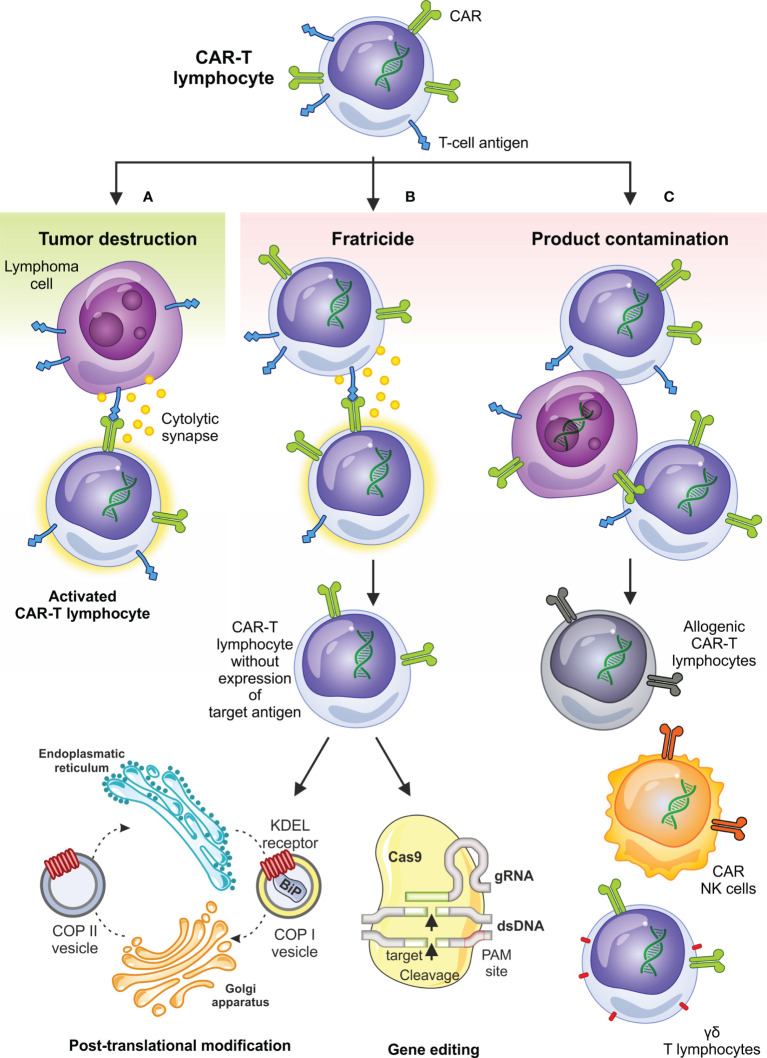
T-cell malignancies can be divided into precursor (T-acute lymphoblastic leukemia/lymphoblastic lymphoma, T-ALL/LBL) and mature T-cell neoplasms, which are comprised of 28 different entities. Most of these malignancies are aggressive with rather poor prognosis. Prognosis of relapsed/refractory (R/R) disease is especially dismal, with an expected survival only several months after progression. Targeted therapies, such as antiCD30 immunotoxin brentuximab vedotin, antiCD38 antibody daratumumab, and anti-CCR4 antibody mogamulizumab are effective only in subsets of patients with T-cell neoplasms. T-cells equipped with chimeric antigen receptor (CAR-Ts) are routinely used for treatment of R/R B-cell malignancies, however, there are specific obstacles for their use in T-cell leukemias and lymphomas which are fratricide killing, risk of transfection of malignant cells, and T-cell aplasia. The solution for these problems relies on target antigen selection, CRISPR/Cas9 or TALEN gene editing, posttranslational regulation of CAR-T surface antigen expression, and safety switches. Structural chromosomal changes and global changes in gene expression were observed with gene-edited products. We identified 49 studies of CAR-based therapies registered on www.clinicaltrials.gov. Most of them target CD30 or CD7 antigen. Results are available only for a minority of these studies. In general, clinical responses are above 50% but reported follow-up is very short. Specific toxicities of CAR-based therapies, namely cytokine release syndrome (CRS), seem to be connected with the antigen of interest and source of cells for manufacturing. CRS is more frequent in antiCD7 CAR-T cells than in antiCD30 cells, but it is mild in most patients. More severe CRS was observed after gene-edited allogeneic CAR-T cells. Immune effector cell associated neurotoxicity (ICANS) was mild and infrequent. Graft-versus-host disease (GvHD) after allogeneic CAR-T cells from previous hematopoietic stem cell donor was also observed. Most frequent toxicities, similarly to antiCD19 CAR-T cells, are cytopenias. CAR-based cellular therapy seems feasible and effective for T-cell malignancies, however, the optimal design of CAR-based products is still unknown and long-term follow-up is needed for evaluation of their true potential.
T细胞恶性肿瘤可分为前驱性(T细胞急性淋巴细胞白血病/淋巴细胞淋巴瘤,T-ALL/LBL)和成熟T细胞肿瘤,后者包含28种不同的实体。这些恶性肿瘤大多具有侵袭性,预后相当差。复发/难治性(R/R)疾病的预后尤其糟糕,进展后预期生存期仅几个月。靶向治疗,如抗CD30免疫毒素brentuximab vedotin、抗CD38抗体daratumumab和抗CCR4抗体mogamulizumab仅对部分T细胞肿瘤患者有效。配备嵌合抗原受体(CAR-T)的T细胞常规用于治疗R/R B细胞恶性肿瘤,然而,在T细胞白血病和淋巴瘤中使用它们存在一些特殊障碍,即自相残杀、恶性细胞转染风险和T细胞发育不全。解决这些问题依赖于靶抗原选择、CRISPR/Cas9或TALEN基因编辑、CAR-T表面抗原表达的翻译后调控以及安全开关。基因编辑产物可观察到结构染色体变化和基因表达的整体变化。我们在www.clinicaltrials.gov上确定了49项基于CAR的治疗研究。其中大多数靶向CD30或CD7抗原。这些研究中只有少数有结果。总体而言,临床缓解率超过50%,但报告的随访时间非常短。基于CAR的治疗的特定毒性,即细胞因子释放综合征(CRS),似乎与感兴趣的抗原和制造用细胞来源有关。抗CD7 CAR-T细胞中的CRS比抗CD30细胞中更常见,但大多数患者症状较轻。基因编辑的同种异体CAR-T细胞后观察到更严重的CRS。免疫效应细胞相关神经毒性(ICANS)较轻且不常见。还观察到来自先前造血干细胞供体的同种异体CAR-T细胞后的移植物抗宿主病(GvHD)。与抗CD19 CAR-T细胞类似,最常见的毒性是血细胞减少。基于CAR的细胞治疗似乎对T细胞恶性肿瘤可行且有效,然而,基于CAR的产品的最佳设计仍然未知,需要长期随访以评估其真正潜力。