Feijen Michelle, Egorova Anastasia D, Treskes Roderick W, Mertens Bart J A, Jukema J Wouter, Schalij Martin J, Beeres Saskia L M A
Department of Cardiology, Leiden University Medical Center, Leiden, Netherlands.
Department of Biomedical Data Sciences, Leiden University Medical Center, Leiden, Netherlands.
Front Cardiovasc Med. 2022 May 6;9:883873. doi: 10.3389/fcvm.2022.883873. eCollection 2022.
Early detection of impending fluid retention and timely adjustment of (medical) therapy can prevent heart failure related hospitalizations. The multisensory cardiac implantable electronic device (CIED) based algorithm HeartLogic aims to alert in case of impending fluid retention. The aim of the current analysis is to evaluate the performance of the HeartLogic guided heart failure care path in a real-world heart failure population and to investigate whether the height of the index and the duration of the alert state are indicative of the degree of fluid retention.
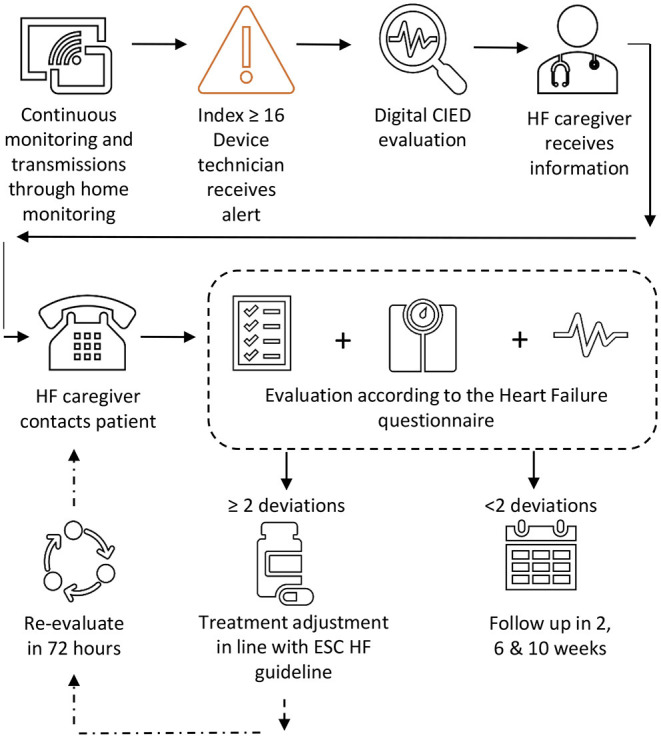
Consecutive adult heart failure patients with a CIED and an activated HeartLogic algorithm were eligible for inclusion. Patients were followed up according to the hospital's heart failure care path. The device technician reviewed alerts for a technical CIED checkup. Afterwards, the heart failure nurse contacted the patient to identify impending fluid retention. An alert was either true positive or false positive. Without an alert a patient was true negative or false negative.
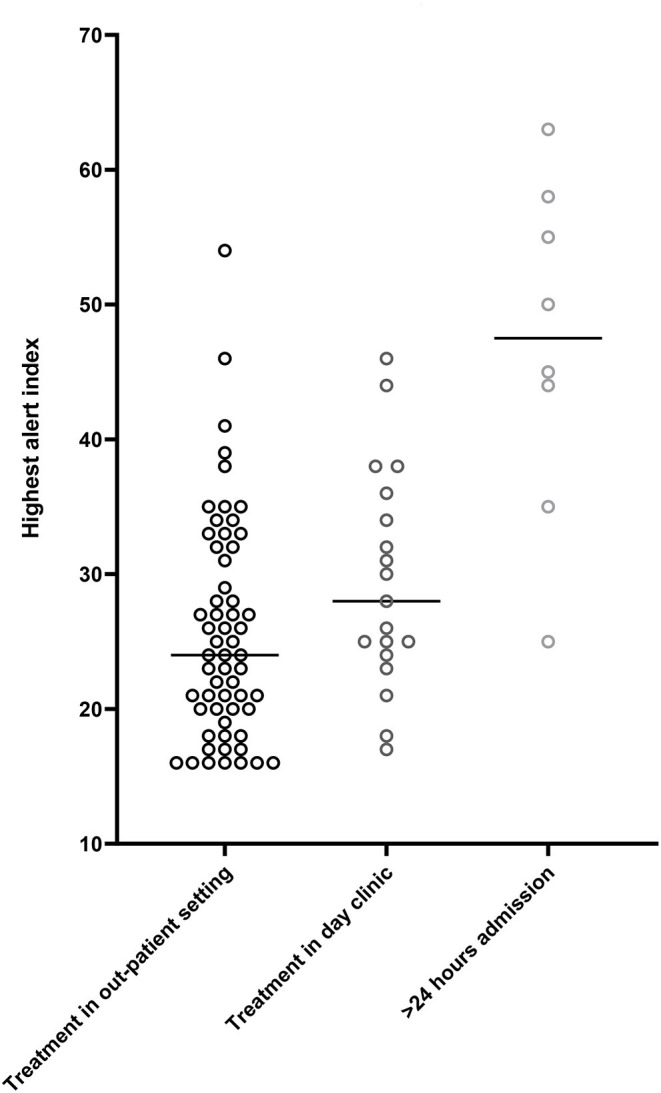
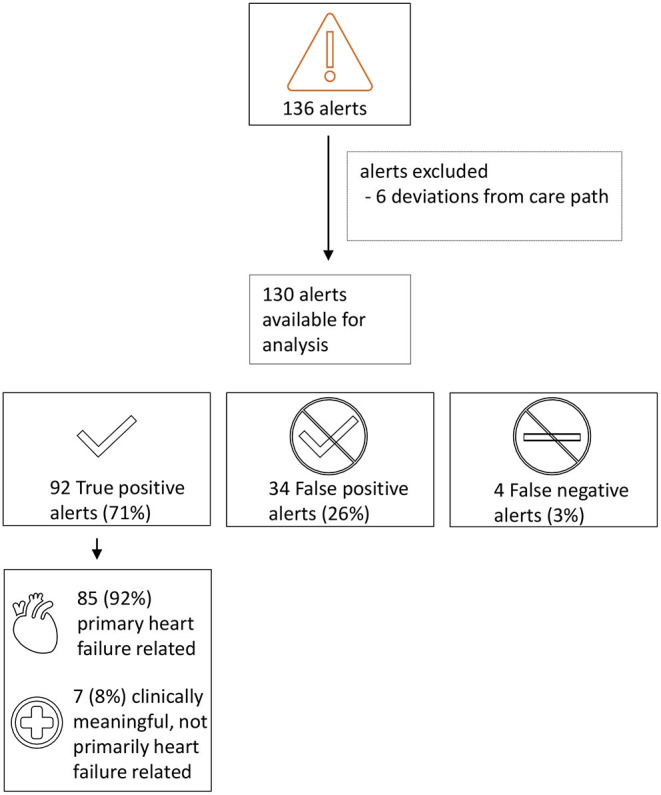
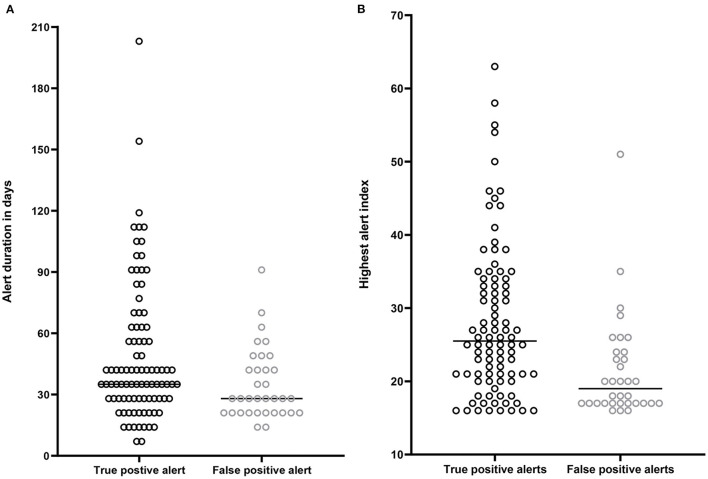
Among 107 patients, [82 male, 70 (IQR 60-77) years, left ventricular ejection fraction 37 ± 11%] 130 HeartLogic alerts were available for analysis. Median follow up was 14 months [IQR 8-23]. The sensitivity to detect impending fluid retention was 79%, the specificity 88%. The positive predictive was value 71% and the negative predictive value 91%. The unexplained alert rate was 0.23 alerts/patient year and the false negative rate 0.17 alerts/patient year. True positive alerts [42 days (IQR 28-63)] lasted longer than false positive alerts [28 days (IQR 21-44)], = 0.02. The maximal HeartLogic index was higher in true positive alerts [26 (IQR 21-34)] compared to false positive alerts [19 (IQR 17-24)], < 0.01. Patients with higher HeartLogic indexes required more intense treatment (index height in outpatient setting 25 [IQR 20-32], day clinic treatment 28 [IQR 24-36] and hospitalized patients 45 [IQR 35-58], respectively), < 0.01.
The CIED-based HeartLogic algorithm facilitates early detection of impending fluid retention and thereby enables clinical action to prevent this at early stage. The current analysis illustrates that higher and persistent alerts are indicative for true positive alerts and higher index values are indicative for more severe fluid retention.
早期发现即将发生的液体潴留并及时调整(药物)治疗可预防与心力衰竭相关的住院治疗。基于多感官心脏植入式电子设备(CIED)的算法HeartLogic旨在在即将发生液体潴留时发出警报。本分析的目的是评估在真实世界的心力衰竭患者群体中,HeartLogic指导的心力衰竭护理路径的性能,并研究指数的高低和警报状态的持续时间是否可指示液体潴留的程度。
连续纳入有CIED且激活了HeartLogic算法的成年心力衰竭患者。患者按照医院的心力衰竭护理路径进行随访。设备技术人员检查警报以进行CIED技术检查。之后,心力衰竭护士联系患者以确定是否即将发生液体潴留。警报分为真阳性或假阳性。无警报时患者为真阴性或假阴性。
在107例患者中(82例男性,70岁[四分位间距60 - 77岁],左心室射血分数37±11%),有130次HeartLogic警报可供分析。中位随访时间为14个月[四分位间距8 - 23个月]。检测即将发生液体潴留的敏感性为79%,特异性为88%。阳性预测值为71%,阴性预测值为91%。无法解释的警报率为0.23次警报/患者年,假阴性率为0.17次警报/患者年。真阳性警报[42天(四分位间距28 - 63天)]持续时间长于假阳性警报[28天(四分位间距21 - 44天)],P = 0.02。真阳性警报的最大HeartLogic指数[26(四分位间距21 - 34)]高于假阳性警报[19(四分位间距17 - 24)],P < 0.01。HeartLogic指数较高的患者需要更强化的治疗(门诊患者的指数高度为25[四分位间距20 - 32],日间诊所治疗患者为28[四分位间距24 - 36],住院患者为45[四分位间距35 - 58]),P < 0.01。
基于CIED的HeartLogic算法有助于早期发现即将发生的液体潴留,从而能够在早期采取临床行动预防这种情况。当前分析表明,更高且持续的警报指示真阳性警报,更高的指数值指示更严重的液体潴留。