Gutiérrez-Menéndez Alba, Martínez Juan A, Méndez Marta, Arias Jorge L
Laboratory of Neuroscience, Department of Psychology, University of Oviedo, Oviedo, Spain.
Instituto de Neurociencias del Principado de Asturias (INEUROPA), Oviedo, Spain.
Front Neurosci. 2022 May 6;16:897225. doi: 10.3389/fnins.2022.897225. eCollection 2022.
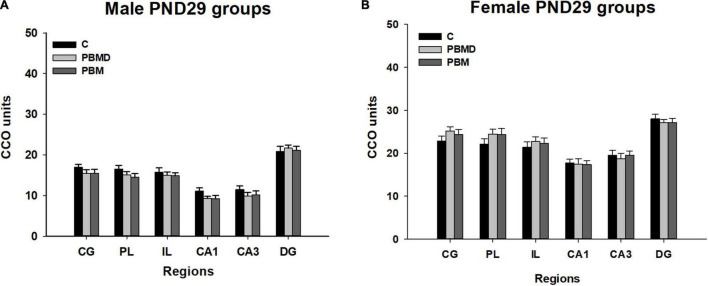
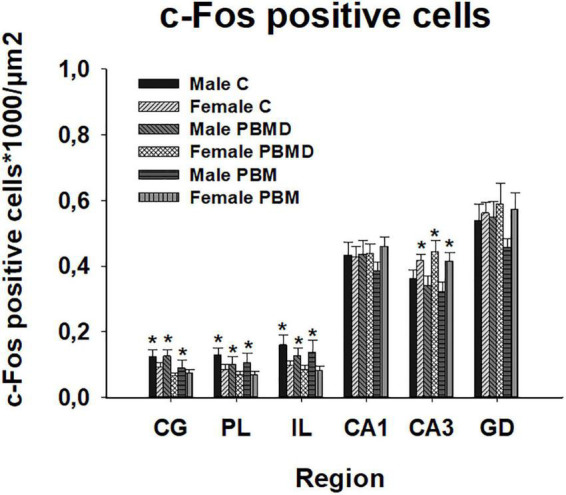
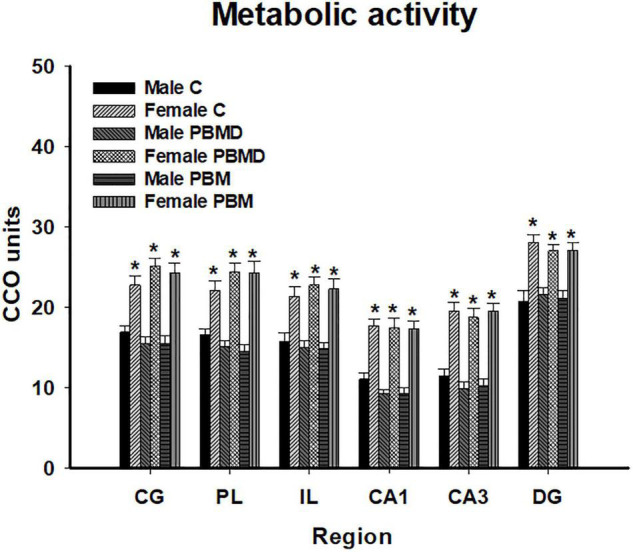
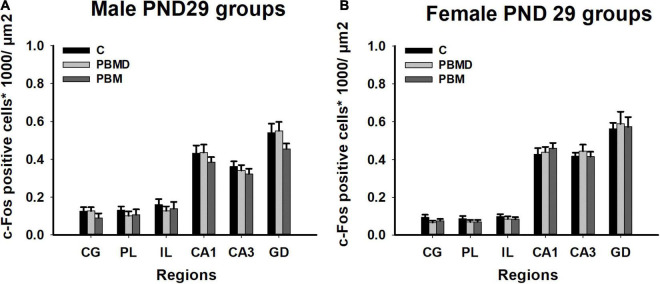
The role of light in our biological processes and systems is extensively known. In addition, the use of light devices has been introduced in the field of healthcare as an opportunity to administer power light at specific wavelengths to improve our body functions and counteract light deficiency. One of these techniques is photobiomodulation (PBM), which uses red to infrared light in a non-invasive way to stimulate, heal, regenerate, and protect tissue. The main proposed mechanism of action is the stimulation of the cytochrome c oxidase (CCO), the terminal enzyme in the mitochondrial electron transport chain. PBM has achieved positive effects on brain activity and behavioral function of several adult animal models of health and disease, the potential use of this technique in developing stages is not surprising. This research aims to examine the effects of PBM on the prefrontal cortex and hippocampus of 23 day-old healthy male ( = 31) and female ( = 30) Wistar rats. Three groups of each sex were used: a PBM group which received 5 days of PBM, a device group submitted to the same conditions but without light radiation, and a control basal group. CCO histochemistry and c-Fos immunostaining were used to analyze brain metabolic activity and immediate early genes activation, respectively. Results displayed no metabolic differences between the three groups in both sexes. The same results were found in the analysis of c-Fos positive cells, reporting no differences between groups. This research, in contrast to the PBM consequences reported in healthy adult subjects, showed a lack of PBM effects in the brain markers we examined in young healthy rat brains. At this stage, brain function, specifically brain mitochondrial function, is not disturbed so it could be that the action of PBM in the mitochondria may not be detectable using the analysis of CCO activity and c-Fos protein expression. Further studies are needed to examine in depth the effects of PBM in brain development, cognitive functions and postnatal disorders, along with the exploration of the optimal light parameters.
光在我们的生物过程和系统中的作用已广为人知。此外,光疗设备已被引入医疗保健领域,作为一种利用特定波长的光来改善身体机能和对抗光缺乏的手段。其中一种技术是光生物调节(PBM),它以非侵入性方式使用红光到红外光来刺激、愈合、再生和保护组织。主要提出的作用机制是刺激细胞色素c氧化酶(CCO),即线粒体电子传递链中的末端酶。PBM已在多种健康和疾病成年动物模型的脑活动和行为功能方面取得了积极效果,因此这项技术在发育阶段的潜在应用并不令人惊讶。本研究旨在探讨PBM对23日龄健康雄性(n = 31)和雌性(n = 30)Wistar大鼠前额叶皮质和海马体的影响。每组性别分为三组:接受5天PBM治疗的PBM组、处于相同条件但无光照辐射的设备组以及对照基础组。分别使用CCO组织化学和c-Fos免疫染色来分析脑代谢活性和即刻早期基因激活情况。结果显示,两性的三组之间在代谢方面没有差异。在对c-Fos阳性细胞的分析中也得到了相同的结果,各实验组之间无差异。与健康成年受试者中报道的PBM结果相反,本研究表明在我们所检测的年轻健康大鼠脑的脑标志物中,PBM没有产生影响。在这个阶段,脑功能,特别是脑线粒体功能没有受到干扰,所以可能是使用CCO活性分析和c-Fos蛋白表达无法检测到PBM在线粒体中的作用。需要进一步研究来深入探讨PBM在脑发育、认知功能和产后疾病方面的影响,同时探索最佳的光照参数。