Ding Dajiang, Mou Daolin, Zhu Heng, Jiang Xuemei, Che Lianqiang, Fang Zhengfeng, Xu Shengyu, Lin Yan, Zhuo Yong, Li Jian, Huang Chao, Zou Yuanfeng, Li Lixia, Wu De, Feng Bin
Animal Nutrition Institute, Sichuan Agricultural University, Chengdu, China.
Key Laboratory of Animal Disease-Resistant Nutrition of Ministry of Education, Sichuan Agricultural University, Chengdu, China.
Front Nutr. 2022 May 6;9:900421. doi: 10.3389/fnut.2022.900421. eCollection 2022.
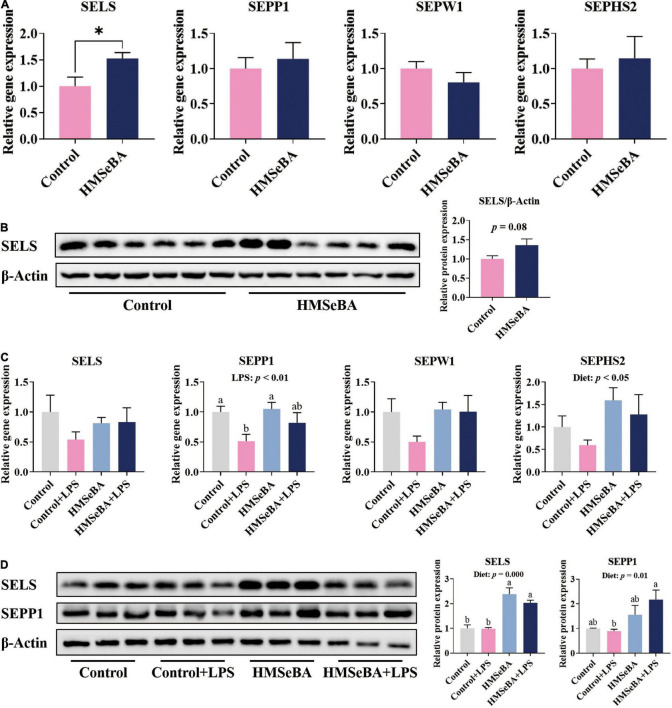
Endoplasmic reticulum (ER) stress, which can be induced by reactive oxygen species (ROS) and multiple factors, is associated with numerous intestinal diseases. The organic selenium source 2-hydroxy-4-methylselenobutanoic acid (HMSeBA), has been proved to decrease intestinal inflammation and autophagy by improving the expression of selenoproteins. However, it remains unclear whether HMSeBA could alleviate intestinal ER stress by decreasing excessive production of ROS products. This study was conducted to investigate the effect of maternal HMSeBA supplementation on the regulation of intestinal ER stress of their offspring and the regulatory mechanism. Sows were supplemented with HMSeBA during gestation and jejunal epithelial (IPEC-J2) cells were treatment with HMSeBA. Results showed that maternal HMSeBA supplementation significantly upregulated mRNA level of selenoprotein S (SELS) in the jejunum of newborn and weaned piglets compared with the control group, while decreased the gene expression and protein abundance of ER stress markers in the jejunum of LPS challenged weaned piglets. In addition, HMSeBA treatment significantly increased the expression of glutathione peroxidase 4 (GPX4) and SELS, while decreased ROS level and the expression of ER stress markers induced by hydrogen peroxide (HO) in IPEC-J2 cells. Furthermore, knockdown of GPX4 did not enhance the ERS signal induced by HO, but the lack of GPX4 would cause further deterioration of ER stress signal in the absence of SELS. In conclusion, maternal HMSeBA supplementation might alleviate ROS induced intestinal ER stress by improving the expression of SELS and GPX4 in their offspring. Thus, maternal HMSeBA supplementation might be benefit for the intestinal health of their offspring.
内质网(ER)应激可由活性氧(ROS)和多种因素诱导,与多种肠道疾病相关。有机硒源2-羟基-4-甲基硒代丁酸(HMSeBA)已被证明可通过改善硒蛋白的表达来减轻肠道炎症和自噬。然而,HMSeBA是否能通过减少ROS产物的过量产生来减轻肠道内质网应激仍不清楚。本研究旨在探讨母体补充HMSeBA对其后代肠道内质网应激调节的影响及其调控机制。母猪在妊娠期补充HMSeBA,并对空肠上皮细胞(IPEC-J2)进行HMSeBA处理。结果表明,与对照组相比,母体补充HMSeBA显著上调了新生和断奶仔猪空肠中硒蛋白S(SELS)的mRNA水平,同时降低了LPS攻击的断奶仔猪空肠中内质网应激标志物的基因表达和蛋白丰度。此外,HMSeBA处理显著增加了谷胱甘肽过氧化物酶4(GPX4)和SELS的表达,同时降低了IPEC-J2细胞中ROS水平以及过氧化氢(HO)诱导的内质网应激标志物的表达。此外,敲低GPX4并没有增强HO诱导的内质网应激信号,但在缺乏SELS的情况下,GPX4的缺失会导致内质网应激信号进一步恶化。总之,母体补充HMSeBA可能通过提高其后代中SELS和GPX4的表达来减轻ROS诱导的肠道内质网应激。因此,母体补充HMSeBA可能有利于其后代的肠道健康。