Ghaznavi Cyrus, Eguchi Akifumi, Tanoue Yuta, Yoneoka Daisuke, Kawashima Takayuki, Suzuki Motoi, Hashizume Masahiro, Nomura Shuhei
Department of Health Policy and Management, School of Medicine, Keio University, Tokyo, Japan.
Medical Education Program, Washington University School of Medicine in St Louis, Saint Louis, USA.
SSM Popul Health. 2022 May 10;18:101114. doi: 10.1016/j.ssmph.2022.101114. eCollection 2022 Jun.
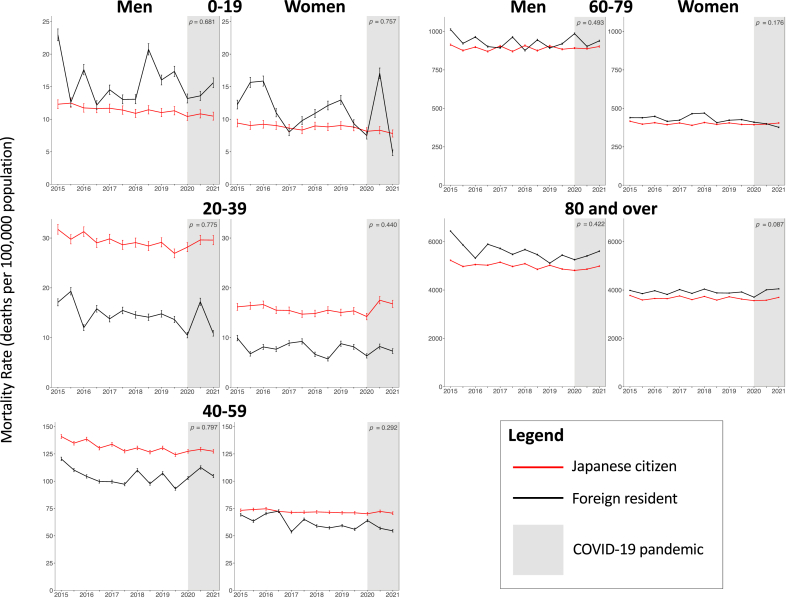
Immigrants in Japan face multiple health care challenges. There is limited research addressing how all-cause mortality differs between foreign residents and Japanese citizens, including the impact of the COVID-19 pandemic. We assessed whether all-cause mortality rates between Japanese citizens and foreign residents living in Japan differ, and whether these differentials changed after the start of the COVID-19 pandemic. We conducted a cross-sectional analysis using vital statistical data of all deaths among citizens and foreign residents that occurred within Japanese borders aggregated every 6 months between January 1, 2015 and June 30, 2021. Data were used to calculate sex-, region-, and 20-year age group-specific standardized mortality rates using the direct method based on the population distribution of Japanese citizens in 2021 by sex, region, and 20-year age groups. Chi-squared tests and linear regression were used to assess whether the pandemic was associated with changes in mortality rates among groups and changes in the mortality differentials between citizens and non-citizens, respectively. All-cause mortality increased monotonically with age for men and women. Men had higher mortality than women, regardless of age or nationality. All-cause mortality is lower among immigrants than Japanese citizens between the ages of 20-59, but higher under the age of 20 and over the age of 59. The pandemic was associated with significant changes in mortality in most groups, but no statistically significant changes in the mortality differentials between immigrants and Japanese citizens were detected. Young immigrants are generally healthier than their Japanese counterparts, in line with the healthy migrant hypothesis. Younger migrants are at higher risk of mortality, possibly due to increased vulnerability to psychologic stress. Older migrant mortality converged with citizen mortality, consistent with acculturation that occurs with longer duration of residence. The pandemic did not exacerbate health inequities for foreign residents with respect to mortality.
日本的移民面临着多重医疗保健挑战。关于外国居民和日本公民的全因死亡率差异,包括新冠疫情的影响,相关研究有限。我们评估了居住在日本的日本公民和外国居民之间的全因死亡率是否存在差异,以及在新冠疫情开始后这些差异是否发生了变化。我们使用了2015年1月1日至2021年6月30日期间每6个月汇总一次的日本境内公民和外国居民所有死亡的生命统计数据进行横断面分析。数据用于根据2021年日本公民按性别、地区和20岁年龄组的人口分布,采用直接法计算性别、地区和20岁年龄组特定的标准化死亡率。卡方检验和线性回归分别用于评估疫情是否与各群体死亡率的变化以及公民与非公民之间死亡率差异的变化相关。男性和女性的全因死亡率均随年龄单调增加。无论年龄或国籍如何,男性的死亡率都高于女性。20至59岁的移民全因死亡率低于日本公民,但20岁以下和59岁以上则更高。疫情与大多数群体的死亡率显著变化相关,但未检测到移民与日本公民之间死亡率差异有统计学意义的变化。年轻移民总体上比日本同龄人更健康,这与健康移民假说相符。年轻移民的死亡风险更高,可能是由于心理压力易感性增加。老年移民的死亡率与公民死亡率趋同,这与居住时间越长发生的文化适应一致。疫情在死亡率方面并未加剧外国居民的健康不平等。