da Silva Ramiro M, Megid Jane, Hampson Katie, Campos Aline Alves Scarpellini, Higashi Cintia S, Medeiros Fabíola S, Pereira Alexandra S, Benavides Julio A
Department of Veterinary Hygiene and Public Health, São Paulo State University, Botucatu, Brazil.
Institute of Biodiversity, Animal Health and Comparative Medicine, College of Medical, Veterinary and Life Sciences, University of Glasgow, Glasgow, United Kingdom.
Front Vet Sci. 2022 May 6;9:846994. doi: 10.3389/fvets.2022.846994. eCollection 2022.
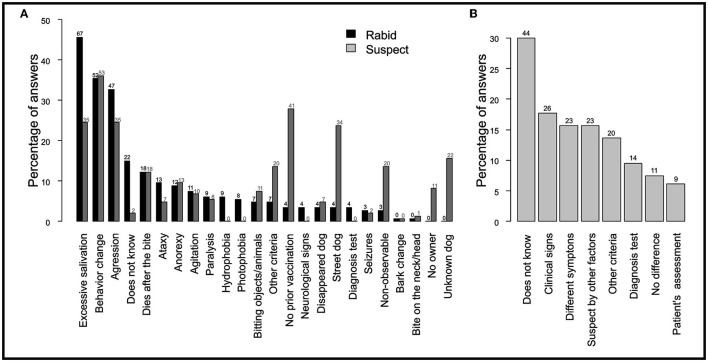
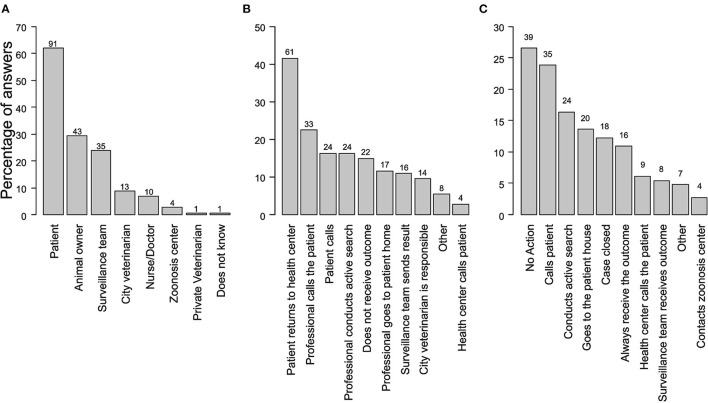
Post-exposure prophylaxis (PEP) is necessary to prevent the fatal onset of rabies but requires optimization to avoid overuse in populations at risk of rabies. In Brazil, the incidence of dog bites remains high, with almost half of dog-bite patients not receiving the PEP recommended by the Ministry of Health guidelines between 2008 and 2017. In this study, we aimed to identify the factors that limit the appropriate prescribing of PEP by interviewing health professionals responsible for PEP administration and completion of the 'Information System on Diseases of Compulsory Declaration' (SINAN) form reporting human anti-rabies care for patients seeking health care after a dog bite. We conducted 147 questionnaires (45 questions each) in three Brazilian states (i.e., Rio Grande do Sul, Santa Catarina, Rio Grande do Norte) including questions related to the criteria used by professionals to classify a dog as "suspect" or "rabid", knowledge on PEP prescription guidelines, SINAN and communication with veterinarians. Our analyses showed that most health professionals delivering PEP in these three states struggle to identify a rabies "suspect" dog according to the Ministry of Health guidelines, and to indicate the adequate PEP regimen, with only 11% of professionals prescribing the appropriate PEP under various dog-bite patient scenarios. PEP knowledge score was higher among professionals trained on PEP guidelines and working in facilities with the highest incidence of dog bites. In contrast, PEP knowledge scores did not vary significantly between states, and were not correlated to the professional's level of experience, the number of colleagues available at the health unit or the professional's confidence on prescribing appropriate PEP. Our results suggest that knowledge gaps in PEP administration among health professionals of Brazil can be reduced by implementing training programs to differentiate among rabies risk scenarios, prescribe the corresponding appropriate PEP and improve communication between health and veterinary authorities.
暴露后预防(PEP)对于预防狂犬病的致命发作是必要的,但需要进行优化以避免在有狂犬病风险的人群中过度使用。在巴西,犬咬伤的发生率仍然很高,在2008年至2017年期间,几乎一半的犬咬伤患者未接受卫生部指南推荐的PEP。在本研究中,我们旨在通过采访负责PEP管理的卫生专业人员以及填写“法定报告疾病信息系统”(SINAN)表格(该表格报告了犬咬伤后寻求医疗护理的患者的人类抗狂犬病护理情况)来确定限制PEP合理处方的因素。我们在巴西的三个州(即南里奥格兰德州、圣卡塔琳娜州、北大河州)进行了147份问卷(每份问卷45个问题),问题包括专业人员将狗分类为“可疑”或“狂犬病”所使用的标准、PEP处方指南知识、SINAN以及与兽医的沟通。我们的分析表明,在这三个州提供PEP的大多数卫生专业人员难以根据卫生部指南识别狂犬病“可疑”犬,也难以指出适当的PEP方案,在各种犬咬伤患者情况下,只有11%的专业人员开出了适当的PEP。在接受PEP指南培训并在犬咬伤发生率最高的机构工作的专业人员中,PEP知识得分更高。相比之下,各州之间的PEP知识得分没有显著差异,并且与专业人员的经验水平、卫生单位的同事数量或专业人员开具适当PEP的信心无关。我们的结果表明,通过实施培训计划以区分狂犬病风险情况、开出相应的适当PEP并改善卫生当局与兽医当局之间的沟通,可以减少巴西卫生专业人员在PEP管理方面的知识差距。