• 文献检索
  • 文档翻译
  • 深度研究
  • 学术资讯
  • Suppr Zotero 插件Zotero 插件
  • 邀请有礼
  • 套餐&价格
  • 历史记录
应用&插件
Suppr Zotero 插件Zotero 插件浏览器插件Mac 客户端Windows 客户端微信小程序
定价
高级版会员购买积分包购买API积分包
服务
文献检索文档翻译深度研究API 文档MCP 服务
关于我们
关于 Suppr公司介绍联系我们用户协议隐私条款
关注我们

Suppr 超能文献

核心技术专利:CN118964589B侵权必究
粤ICP备2023148730 号-1Suppr @ 2026

文献检索

告别复杂PubMed语法,用中文像聊天一样搜索,搜遍4000万医学文献。AI智能推荐,让科研检索更轻松。

立即免费搜索

文件翻译

保留排版,准确专业,支持PDF/Word/PPT等文件格式,支持 12+语言互译。

免费翻译文档

深度研究

AI帮你快速写综述,25分钟生成高质量综述,智能提取关键信息,辅助科研写作。

立即免费体验

2013年至2015年海地共和国评估咬人犬只狂犬病风险的回顾性队列研究。

Retrospective Cohort Study to Assess the Risk of Rabies in Biting Dogs, 2013⁻2015, Republic of Haiti.

作者信息

Medley Alexandra M, Millien Max Francois, Blanton Jesse D, Ma Xiaoyue, Augustin Pierre, Crowdis Kelly, Wallace Ryan M

机构信息

Centers for Disease Control and Prevention, Atlanta, GA 30329, USA.

Ministry of Agriculture and Natural Resources and Rural Development, Port-au-Prince, Haiti.

出版信息

Trop Med Infect Dis. 2017 Jun 12;2(2):14. doi: 10.3390/tropicalmed2020014.

DOI:10.3390/tropicalmed2020014
PMID:30270873
原文链接:https://pmc.ncbi.nlm.nih.gov/articles/PMC6082081/
Abstract

BACKGROUND

In canine rabies endemic countries the World Health Organization recommends post-exposure prophylaxis (PEP) be initiated immediately after exposure to an animal suspected to have rabies. Limited capacity in low and middle income countries to assess biting animals for rabies may result in the over prescription of rabies biologics. Few guidelines exist to determine the risk of whether a dog that has bitten someone is rabid. Given PEP cost and access limitations in many countries, accurate and timely assessment of dogs that have bitten people may reduce unwarranted PEP use and improve healthcare seeking behaviors.

METHODS

Haiti's animal rabies surveillance program utilizes veterinary professionals to conduct rabies assessments on reported biting dogs and records characteristics of the dog, health outcomes, and laboratory results in a national database. Characteristics of rabid dogs were assessed through a retrospective cohort study of biting dogs investigated during the period from January 2013⁻December 2015. 1409 biting dogs were analyzed; 1361 dogs that were determined to not have rabies were compared to 48 laboratory-confirmed rabid dogs. Rate ratios, sensitivity, specificity, positive predictive values, negative predictive values, likelihood ratios, quarantine survival of biting dogs, and a risk matrix were developed.

FINDINGS

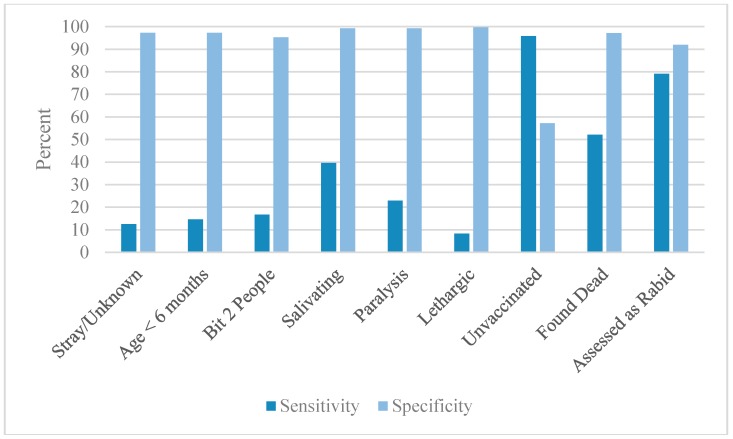
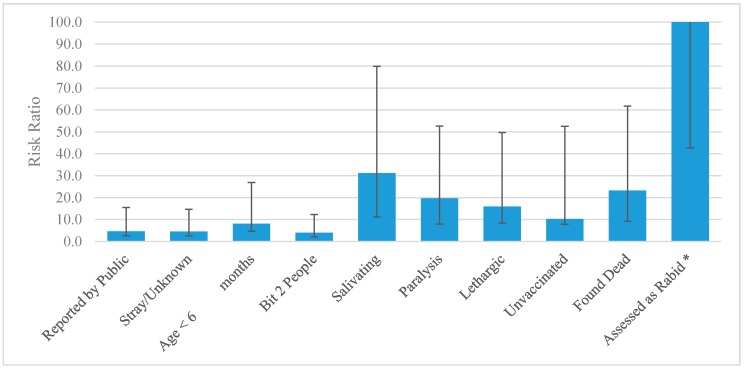
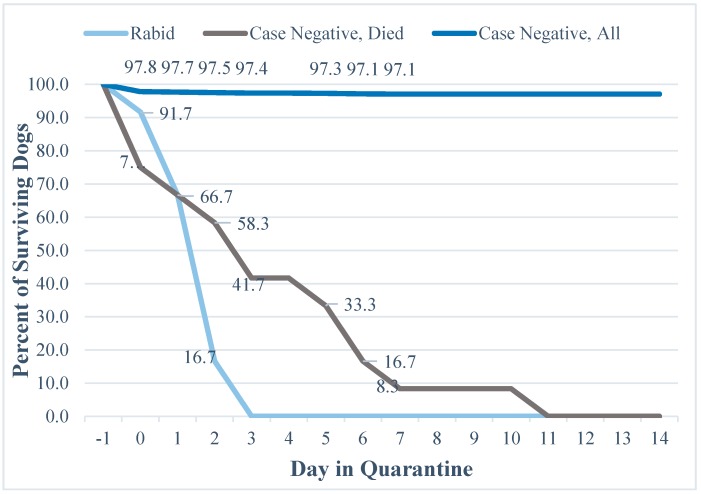
The assessor's determination that the animal likely had rabies was the most significant predictive factor for a rabid dog (RR = 413.4, 95% CI 57.33⁻2985, Sn = 79.17, Sp = 91.92). Clinical factors significantly associated with rabid dogs included hypersalivation, paralysis, and lethargy (RR = 31.2, 19.7, 15.4, respectively). Rabid dogs were 23.2 times more likely to be found dead at the time of the investigation compared to case negative dogs (95% CI 14.0⁻38.6). Rabid dogs were also significantly more likely to lack a history of rabies vaccination or be unowned (RR = 10.3 95% CI 2.5⁻42.3 and RR = 4.5 95% CI 2.0⁻10.1, respectively). Rabid dogs were four times more likely to have bitten multiple people (RR = 4.0 95% CI 1.9⁻8.3). Most rabid dogs died or were killed before quarantine (75%) and all died by day 3 of quarantine, compared to <1% of quarantined case-negatives. The greatest risk of death was predicted to be for persons bitten on the head or neck from symptomatic dogs. Bites from dogs deemed healthy by veterinary assessors and which were available for quarantine presented less than a 0.05% risk of rabies death to the victim.

CONCLUSIONS

Vaccination of all persons exposed to a suspected rabid dog is a highly effective approach to minimize human rabies deaths. However, this may place undue financial burden on bite victims that have had a low-risk exposure and over-prescription may contribute to regional supply shortages. The results here indicate that in a low-resource country such as Haiti, a well-trained veterinary assessor can provide an accurate risk assessment of biting dogs based on a standard case investigation protocol. In canine rabies endemic countries with limited access to PEP, or where PEP costs may cause undue burden on bite victims, structured risk assessments by trained professionals may be a reliable method of triaging PEP for bite victims. Evaluating rabies risk through a matrix of bite location and risk factor in the dog presents a clear delineation of high and low risk encounters and should be used to develop data-derived PEP recommendations.
https://cdn.ncbi.nlm.nih.gov/pmc/blobs/8c69/6082081/8aadb3a70116/tropicalmed-02-00014-g003.jpg
https://cdn.ncbi.nlm.nih.gov/pmc/blobs/8c69/6082081/2eb52e6c41f3/tropicalmed-02-00014-g001.jpg
https://cdn.ncbi.nlm.nih.gov/pmc/blobs/8c69/6082081/bd82d9b30667/tropicalmed-02-00014-g002.jpg
https://cdn.ncbi.nlm.nih.gov/pmc/blobs/8c69/6082081/8aadb3a70116/tropicalmed-02-00014-g003.jpg
https://cdn.ncbi.nlm.nih.gov/pmc/blobs/8c69/6082081/2eb52e6c41f3/tropicalmed-02-00014-g001.jpg
https://cdn.ncbi.nlm.nih.gov/pmc/blobs/8c69/6082081/bd82d9b30667/tropicalmed-02-00014-g002.jpg
https://cdn.ncbi.nlm.nih.gov/pmc/blobs/8c69/6082081/8aadb3a70116/tropicalmed-02-00014-g003.jpg
摘要

背景

在犬类狂犬病流行国家,世界卫生组织建议在接触疑似患有狂犬病的动物后立即开始暴露后预防(PEP)。低收入和中等收入国家评估咬人的动物是否感染狂犬病的能力有限,可能导致狂犬病生物制品的过度处方。几乎没有指南可用于确定咬人的狗是否感染狂犬病的风险。鉴于许多国家的PEP成本和获取限制,准确及时地评估咬人的狗可能会减少不必要的PEP使用,并改善寻求医疗行为。

方法

海地的动物狂犬病监测计划利用兽医专业人员对报告的咬人的狗进行狂犬病评估,并将狗的特征、健康结果和实验室结果记录在国家数据库中。通过对2013年1月至2015年12月期间调查的咬人的狗进行回顾性队列研究,评估狂犬病狗的特征。分析了1409只咬人的狗;将1361只被确定没有感染狂犬病的狗与48只实验室确诊的狂犬病狗进行比较。制定了率比、敏感性、特异性、阳性预测值、阴性预测值、似然比、咬人的狗的隔离存活率和风险矩阵。

结果

评估人员确定动物可能感染狂犬病是狂犬病狗最重要的预测因素(RR = 413.4,95% CI 57.33至2985,Sn = 79.17,Sp = 91.92)。与狂犬病狗显著相关的临床因素包括流涎过多、瘫痪和嗜睡(RR分别为31.2、19.7、15.4)。与非病例狗相比,在调查时发现狂犬病狗死亡的可能性高23.2倍(95% CI 14.0至38.6)。狂犬病狗也更有可能没有狂犬病疫苗接种史或无主(RR分别为10.3,95% CI 2.5至42.3和RR = 4.5,95% CI 2.0至10.1)。狂犬病狗咬伤多人的可能性高四倍(RR = 4.0,95% CI 1.9至8.3)。大多数狂犬病狗在隔离前死亡或被处死(75%),到隔离第3天全部死亡,而非病例狗隔离死亡的比例不到1%。预计头部或颈部被有症状的狗咬伤的人死亡风险最大。兽医评估人员认为健康且可进行隔离的狗咬伤造成受害者狂犬病死亡的风险低于0.05%。

结论

对所有接触疑似狂犬病狗的人进行疫苗接种是将人类狂犬病死亡降至最低的高效方法。然而,这可能会给低风险暴露的咬伤受害者带来不必要的经济负担,过度处方可能导致区域供应短缺。此处结果表明,在像海地这样的资源匮乏国家,训练有素的兽医评估人员可以根据标准病例调查方案对咬人的狗进行准确的风险评估。在获取PEP有限或PEP成本可能给咬伤受害者带来不必要负担的犬类狂犬病流行国家,由训练有素的专业人员进行结构化风险评估可能是为咬伤受害者分流PEP的可靠方法。通过狗的咬伤部位和风险因素矩阵评估狂犬病风险,清晰划分了高风险和低风险接触情况,应用于制定基于数据的PEP建议。

相似文献

1
Retrospective Cohort Study to Assess the Risk of Rabies in Biting Dogs, 2013⁻2015, Republic of Haiti.2013年至2015年海地共和国评估咬人犬只狂犬病风险的回顾性队列研究。
Trop Med Infect Dis. 2017 Jun 12;2(2):14. doi: 10.3390/tropicalmed2020014.
2
Quantifying the risk of rabies in biting dogs in Haiti.量化海地咬人的狗患狂犬病的风险。
Sci Rep. 2020 Jan 23;10(1):1062. doi: 10.1038/s41598-020-57908-9.
3
On the path to rabies elimination: The need for risk assessments to improve administration of post-exposure prophylaxis.迈向狂犬病消除之路:风险评估对于改进暴露后预防处置的必要性。
Vaccine. 2019 Oct 3;37 Suppl 1(Suppl 1):A64-A72. doi: 10.1016/j.vaccine.2018.11.066. Epub 2018 Dec 17.
4
Rabies post-exposure healthcare-seeking behaviors and perceptions: Results from a knowledge, attitudes, and practices survey, Uganda, 2013.狂犬病暴露后寻求医疗保健的行为和认知:来自 2013 年乌干达知识、态度和实践调查的结果。
PLoS One. 2021 Jun 2;16(6):e0251702. doi: 10.1371/journal.pone.0251702. eCollection 2021.
5
Epidemiology and surveillance of human animal-bite injuries and rabies post-exposure prophylaxis, in selected counties in Kenya, 2011-2016.肯尼亚部分县 2011-2016 年人间动物咬伤和狂犬病暴露后预防的流行病学和监测。
BMC Public Health. 2018 Aug 9;18(1):996. doi: 10.1186/s12889-018-5888-5.
6
Determinants of health seeking behaviour following rabies exposure in Ethiopia.埃塞俄比亚狂犬病暴露后就医行为的决定因素。
Zoonoses Public Health. 2018 Jun;65(4):443-453. doi: 10.1111/zph.12458. Epub 2018 Mar 10.
7
Establishment of a High Canine Rabies Burden in Haiti through the Implementation of a Novel Surveillance Program [corrected].通过实施一项新型监测计划在海地确立高犬类狂犬病负担[已修正]
PLoS Negl Trop Dis. 2015 Nov 24;9(11):e0004245. doi: 10.1371/journal.pntd.0004245. eCollection 2015 Nov.
8
Mixed methods to evaluate knowledge, attitudes and practices (KAP) towards rabies in central and remote communities of Moramanga district, Madagascar.采用混合方法评估马达加斯加莫拉芒加地区中心和偏远社区的狂犬病知识、态度和实践(KAP)。
PLoS Negl Trop Dis. 2024 Mar 29;18(3):e0012064. doi: 10.1371/journal.pntd.0012064. eCollection 2024 Mar.
9
Profile of dog bite victims in Jos Plateau State, Nigeria: a review of dog bite records (2006-2008).尼日利亚乔斯高原州犬咬伤受害者概况:犬咬伤记录回顾(2006 - 2008年)
Pan Afr Med J. 2014 Jul 21;18 Suppl 1(Suppl 1):12. doi: 10.11694/pamj.supp.2014.18.1.4341. eCollection 2014.
10
Determinants of health seeking behavior of animal bite victims in rabies endemic South Bhutan: a community-based contact-tracing survey.影响动物咬伤患者在南不丹狂犬病流行地区寻求医疗服务行为的因素:基于社区的接触者追踪调查。
BMC Public Health. 2019 Feb 27;19(1):237. doi: 10.1186/s12889-019-6559-x.

引用本文的文献

1
Optimizing dog population control strategies in Thailand using mathematical and economic modeling.运用数学和经济模型优化泰国的犬类种群控制策略。
PLoS Negl Trop Dis. 2025 Jul 3;19(7):e0013202. doi: 10.1371/journal.pntd.0013202. eCollection 2025 Jul.
2
The Challenge of Lyssavirus Infections in Domestic and Other Animals: A Mix of Virological Confusion, Consternation, Chagrin, and Curiosity.家猫和其他动物感染狂犬病病毒的挑战:病毒学上的困惑、惊愕、懊恼与好奇交织。
Pathogens. 2025 Jun 13;14(6):586. doi: 10.3390/pathogens14060586.
3
Combining genomics and epidemiology to investigate a zoonotic outbreak of rabies in Romblon Province, Philippines.

本文引用的文献

1
Elimination of Dog-Mediated Human Rabies Deaths by 2030: Needs Assessment and Alternatives for Progress Based on Dog Vaccination.到2030年消除犬介导的人类狂犬病死亡:基于犬类疫苗接种的需求评估与进展方案
Front Vet Sci. 2017 Feb 10;4:9. doi: 10.3389/fvets.2017.00009. eCollection 2017.
2
The SARE tool for rabies control: Current experience in Ethiopia.用于狂犬病防控的SARE工具:埃塞俄比亚的当前经验。
Antiviral Res. 2016 Nov;135:74-80. doi: 10.1016/j.antiviral.2016.09.011. Epub 2016 Oct 14.
3
2016: the beginning of the end of rabies?2016:狂犬病终结的开端?
结合基因组学和流行病学调查菲律宾朗芒芽地省的一次狂犬病动物疫情。
Nat Commun. 2024 Dec 30;15(1):10753. doi: 10.1038/s41467-024-54255-5.
4
A case-control study of risk factors for dog rabies in Northeast Tunisia.突尼斯东北部犬类狂犬病危险因素的病例对照研究。
Open Vet J. 2024 Nov;14(11):2745-2753. doi: 10.5455/OVJ.2024.v14.i11.3. Epub 2024 Nov 30.
5
Machine learning to improve the understanding of rabies epidemiology in low surveillance settings.机器学习提高低监测环境中狂犬病流行病学的理解。
Sci Rep. 2024 Oct 28;14(1):25851. doi: 10.1038/s41598-024-76089-3.
6
Factors associated with the rabies vaccination status of dogs in households in Beni City, D.R. Congo.与刚果民主共和国贝尼市家庭犬狂犬病疫苗接种状况相关的因素。
Onderstepoort J Vet Res. 2024 Aug 16;91(2):e1-e6. doi: 10.4102/ojvr.v91i2.2168.
7
Measuring the impact of an integrated bite case management program on the detection of canine rabies cases in Vietnam.测量综合噬齿动物病例管理项目对越南狂犬病犬病例检测的影响。
Front Public Health. 2023 Oct 18;11:1150228. doi: 10.3389/fpubh.2023.1150228. eCollection 2023.
8
The Use of Dog Collars Offers Significant Benefits to Rabies Vaccination Campaigns: The Case of Zanzibar, Tanzania.狗项圈的使用为狂犬病疫苗接种运动带来显著益处:以坦桑尼亚桑给巴尔岛为例
Trop Med Infect Dis. 2023 Aug 21;8(8):421. doi: 10.3390/tropicalmed8080421.
9
Risk of Rabies and Implications for Postexposure Prophylaxis Administration in the US.美国的狂犬病风险和对暴露后预防措施管理的影响。
JAMA Netw Open. 2023 Jun 1;6(6):e2317121. doi: 10.1001/jamanetworkopen.2023.17121.
10
Implementing a One Health Approach to Rabies Surveillance: Lessons From Integrated Bite Case Management.实施狂犬病监测的“同一健康”方法:综合咬伤病例管理的经验教训
Front Trop Dis. 2022 Jun 20;3:829132. doi: 10.3389/fitd.2022.829132.
Lancet Glob Health. 2016 Nov;4(11):e780-e781. doi: 10.1016/S2214-109X(16)30245-5. Epub 2016 Sep 28.
4
Establishment of a High Canine Rabies Burden in Haiti through the Implementation of a Novel Surveillance Program [corrected].通过实施一项新型监测计划在海地确立高犬类狂犬病负担[已修正]
PLoS Negl Trop Dis. 2015 Nov 24;9(11):e0004245. doi: 10.1371/journal.pntd.0004245. eCollection 2015 Nov.
5
Estimating the global burden of endemic canine rabies.估算地方性犬类狂犬病的全球负担。
PLoS Negl Trop Dis. 2015 Apr 16;9(4):e0003709. doi: 10.1371/journal.pntd.0003709. eCollection 2015 Apr.
6
Surveillance of Human Rabies by National Authorities--A Global Survey.各国当局对人类狂犬病的监测——一项全球调查。
Zoonoses Public Health. 2015 Nov;62(7):543-52. doi: 10.1111/zph.12183. Epub 2015 Feb 14.
7
Risk factors associated with mortality after Roux-en-Y gastric bypass surgery.胃旁路手术后死亡相关的风险因素。
Ann Surg. 2014 Jan;259(1):123-30. doi: 10.1097/SLA.0b013e31828a0ee4.
8
Hantavirus pulmonary syndrome clinical findings: evaluating a surveillance case definition.汉坦病毒肺综合征临床特征:评估监测病例定义。
Vector Borne Zoonotic Dis. 2012 May;12(5):393-9. doi: 10.1089/vbz.2011.0764. Epub 2012 Jan 3.
9
Postexposure prophylaxis for rabies in resource-limited/poor countries.资源有限/贫困国家的狂犬病暴露后预防。
Adv Virus Res. 2011;79:291-307. doi: 10.1016/B978-0-12-387040-7.00013-5.
10
Evaluation of cost-effective strategies for rabies post-exposure vaccination in low-income countries.评估低收入国家狂犬病暴露后预防接种的成本效益策略。
PLoS Negl Trop Dis. 2011 Mar 8;5(3):e982. doi: 10.1371/journal.pntd.0000982.