Trobisch Andreas, Schweintzger Nina A, Kohlfürst Daniela S, Sagmeister Manfred G, Sperl Matthias, Grisold Andrea J, Feierl Gebhard, Herberg Jethro A, Carrol Enitan D, Paulus Stephane C, Emonts Marieke, van der Flier Michiel, de Groot Ronald, Cebey-López Miriam, Rivero-Calle Irene, Boeddha Navin P, Agapow Paul-Michael, Secka Fatou, Anderson Suzanne T, Behrends Uta, Wintergerst Uwe, Reiter Karl, Martinon-Torres Federico, Levin Michael, Zenz Werner
Department of Pediatrics and Adolescent Medicine, Division of General Pediatrics, Medical University of Graz, Graz, Austria.
Division of Neonatology, Department of Pediatrics and Adolescent Medicine, Medical University of Graz, Graz, Austria.
Front Pediatr. 2022 May 4;10:744182. doi: 10.3389/fped.2022.744182. eCollection 2022.
Pediatric osteoarticular infections (POAIs) are serious diseases requiring early diagnosis and treatment.
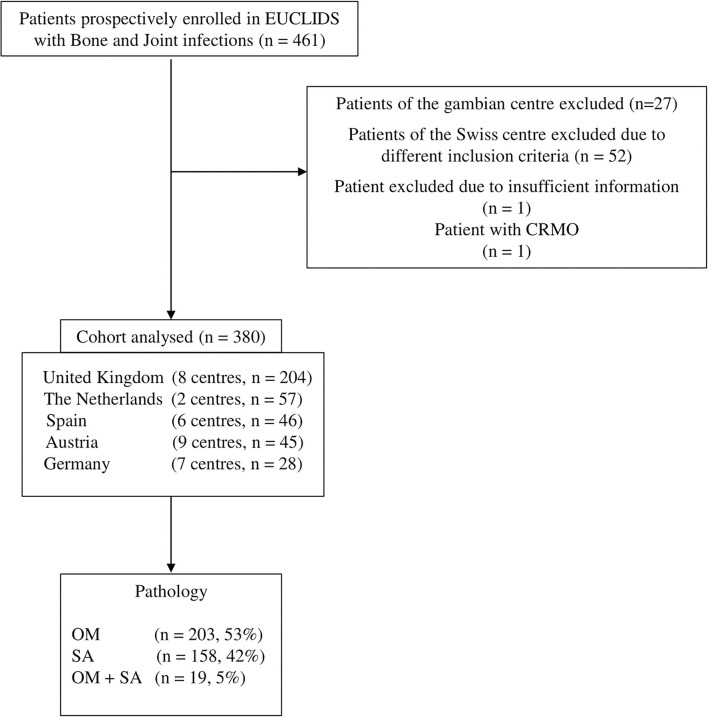
In this prospective multicenter cohort study, children with POAIs were selected from the European Union Childhood Life-threatening Infectious Diseases Study (EUCLIDS) database to analyze their demographic, clinical, and microbiological data.
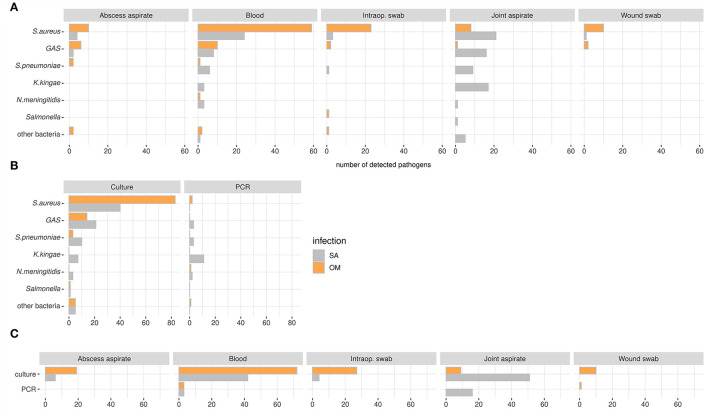
A cohort of 380 patients with POAIs, 203 with osteomyelitis (OM), 158 with septic arthritis (SA), and 19 with both OM and SA, was analyzed. Thirty-five patients were admitted to the Pediatric Intensive Care Unit; out of these, six suffered from shock, one needed an amputation of the right foot and of four left toes, and two had skin transplantation. According to the Pediatric Overall Performance Score, 36 (10.5%) showed a mild overall disability, 3 (0.8%) a moderate, and 1 (0.2%) a severe overall disability at discharge. A causative organism was detected in 65% (247/380) of patients. () was identified in 57.1% (141/247) of microbiological confirmed cases, including 1 (0.7%) methicillin-resistant (MRSA) and 6 (4.2%) Panton-Valentine leukocidin (PVL)-producing , followed by Group A (18.2%) and (8.9%). and PVL production in were less frequently reported than expected from the literature.
POAIs are associated with a substantial morbidity in European children, with being the major detected pathogen. In one-third of patients, no causative organism is identified. Our observations show an urgent need for the development of a vaccine against and for the development of new microbiologic diagnostic guidelines for POAIs in European pediatric hospitals.
儿童骨关节感染(POAI)是需要早期诊断和治疗的严重疾病。
在这项前瞻性多中心队列研究中,从欧盟儿童危及生命的传染病研究(EUCLIDS)数据库中选取患有POAI的儿童,分析其人口统计学、临床和微生物学数据。
分析了一组380例POAI患者,其中203例患有骨髓炎(OM),158例患有化脓性关节炎(SA),19例同时患有OM和SA。35例患者入住儿科重症监护病房;其中,6例发生休克,1例需要截肢右脚和4根左脚趾,2例进行了皮肤移植。根据儿童总体表现评分,36例(10.5%)出院时表现为轻度总体残疾,3例(0.8%)为中度,1例(0.2%)为重度总体残疾。65%(247/380)的患者检测到致病微生物。在微生物学确诊病例的57.1%(141/247)中鉴定出(),包括1例(0.7%)耐甲氧西林(MRSA)和6例(4.2%)产生杀白细胞素(PVL)的(),其次是A组(18.2%)和(8.9%)。与文献预期相比,()和PVL产生的报道频率较低。
POAI与欧洲儿童的高发病率相关,()是主要检测到的病原体。三分之一的患者未鉴定出致病微生物。我们的观察结果表明,迫切需要开发针对()的疫苗,并为欧洲儿科医院的POAI制定新的微生物诊断指南。