Roast Michael J, Eastwood Justin R, Aranzamendi Nataly Hidalgo, Fan Marie, Teunissen Niki, Verhulst Simon, Peters Anne
School of Biological Sciences, Monash University, Victoria 3800, Australia.
Groningen Institute for Evolutionary Life Sciences, University of Groningen, Nijenborgh 7, 9747 AG Groningen, The Netherlands.
R Soc Open Sci. 2022 Apr 27;9(4):212012. doi: 10.1098/rsos.212012. eCollection 2022 Apr.
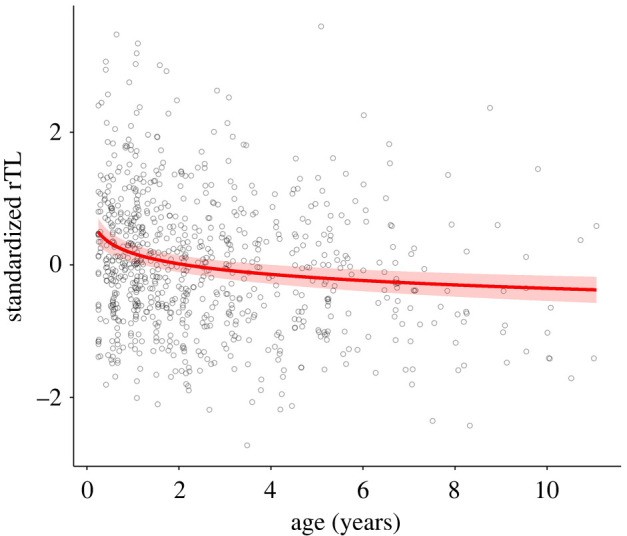
Telomere length (TL) shortens with age but telomere dynamics can relate to fitness components independent of age. Immune function often relates to such fitness components and can also interact with telomeres. Studying the link between TL and immune function may therefore help us understand telomere-fitness associations. We assessed the relationships between erythrocyte TL and four immune indices (haptoglobin, natural antibodies (NAbs), complement activity (CA) and heterophil-lymphocyte (HL) ratio; = 477-589), from known-aged individuals of a wild passerine (). As expected, we find that TL significantly declined with age. To verify whether associations between TL and immune function were independent of parallel age-related changes (e.g. immunosenescence), we statistically controlled for sampling age and used within-subject centring of TL to separate relationships within or between individuals. We found that TL positively predicted CA at the between-individual level (individuals with longer average TL had higher CA), but no other immune indices. By contrast, age predicted the levels of NAbs and HL ratio, allowing inference that respective associations between TL and age with immune indices are independent. Any links existing between TL and fitness are therefore unlikely to be strongly mediated by innate immune function, while TL and immune indices appear independent expressions of individual heterogeneity.
端粒长度(TL)会随着年龄增长而缩短,但端粒动态变化可能与独立于年龄的健康指标相关。免疫功能通常与这类健康指标有关,并且也能与端粒相互作用。因此,研究TL与免疫功能之间的联系或许有助于我们理解端粒-健康关联。我们评估了野生雀形目鸟类(样本量n = 477 - 589)已知年龄个体的红细胞TL与四项免疫指标(触珠蛋白、天然抗体(NAbs)、补体活性(CA)和异嗜性淋巴细胞(HL)比率)之间的关系。正如预期的那样,我们发现TL随年龄显著下降。为了验证TL与免疫功能之间的关联是否独立于与年龄相关的平行变化(例如免疫衰老),我们对采样年龄进行了统计控制,并使用TL的个体内中心化来区分个体内部或个体之间的关系。我们发现,在个体间水平上,TL能正向预测CA(平均TL较长的个体具有更高的CA),但与其他免疫指标无关。相比之下,年龄可预测NAbs水平和HL比率,这表明TL与年龄和免疫指标之间的各自关联是独立的。因此,TL与健康之间存在的任何联系不太可能由先天免疫功能强烈介导,而TL和免疫指标似乎是个体异质性的独立表现。