Biodemography of Aging Research Unit, Social Science Research Institute, Duke University, Durham, North Carolina.
Groningen Institute for Evolutionary Life Sciences, University of Groningen, the Netherlands.
JAMA Netw Open. 2020 Feb 5;3(2):e200023. doi: 10.1001/jamanetworkopen.2020.0023.
Leukocyte telomere length (LTL) is a trait associated with risk of cardiovascular disease and cancer, the 2 major disease categories that largely define longevity in the United States. However, it remains unclear whether LTL is associated with the human life span.
To examine whether LTL is associated with the life span of contemporary humans.
DESIGN, SETTING, AND PARTICIPANTS: This cohort study included 3259 adults of European ancestry from the Cardiovascular Health Study (CHS), Framingham Heart Study (FHS), and Women's Health Initiative (WHI). Leukocyte telomere length was measured in 1992 and 1997 in the CHS, from 1995 to 1998 in the FHS, and from 1993 to 1998 in the WHI. Data analysis was conducted from February 2017 to December 2019.
Death and LTL, measured by Southern blots of the terminal restriction fragments, were the main outcomes. Cause of death was adjudicated by end point committees.
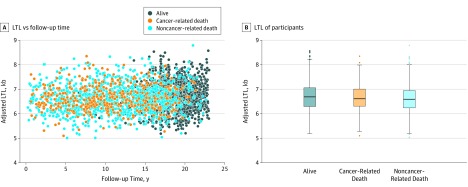
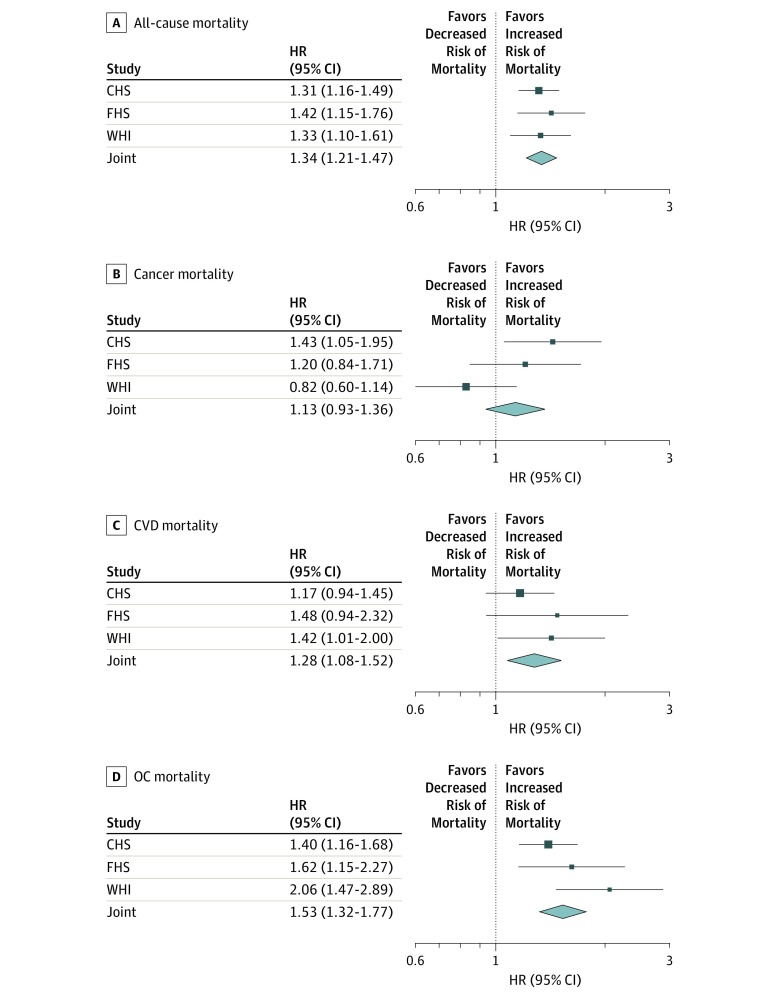
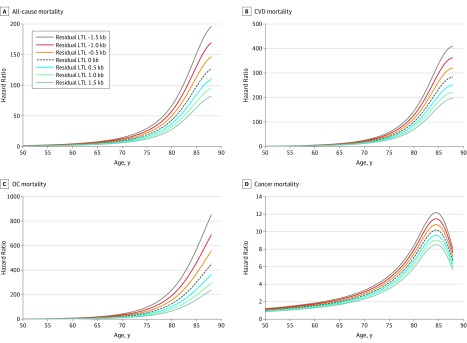
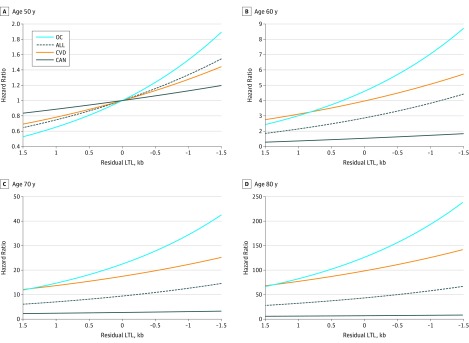
The analyzed sample included 3259 participants (2342 [71.9%] women), with a median (range) age of 69.0 (50.0-98.0) years at blood collection. The median (range) follow-up until death was 10.9 (0.2-23.0) years in CHS, 19.7 (3.4-23.0) years in FHS, and 16.6 (0.5-20.0) years in WHI. During follow-up, there were 1525 deaths (482 [31.6%] of cardiovascular disease; 373 [24.5%] of cancer, and 670 [43.9%] of other or unknown causes). Short LTL, expressed in residual LTL, was associated with increased mortality risk. Overall, the hazard ratio for all-cause mortality for a 1-kilobase decrease in LTL was 1.34 (95% CI, 1.21-1.47). This association was stronger for noncancer causes of death (cardiovascular death: hazard ratio, 1.28; 95% CI, 1.08-1.52; cancer: hazard ratio, 1.13; 95% CI, 0.93-1.36; and other causes: hazard ratio, 1.53; 95% CI, 1.32-1.77).
The results of this study indicate that LTL is associated with a natural life span limit in contemporary humans.
白细胞端粒长度 (LTL) 是与心血管疾病和癌症风险相关的特征,这是在美国定义长寿的两个主要疾病类别。然而,LTL 是否与人类寿命有关仍不清楚。
研究 LTL 是否与当代人类的寿命有关。
设计、地点和参与者:本队列研究纳入了来自心血管健康研究 (CHS)、弗雷明汉心脏研究 (FHS) 和妇女健康倡议 (WHI) 的 3259 名欧洲血统的成年人。LTL 于 1992 年和 1997 年在 CHS 中、1995 年至 1998 年在 FHS 中以及 1993 年至 1998 年在 WHI 中进行了测量。数据分析于 2017 年 2 月至 2019 年 12 月进行。
死亡和 LTL 通过端粒限制片段的 Southern 印迹进行测量,是主要结果。终点委员会对死因进行了裁决。
分析样本包括 3259 名参与者(2342 [71.9%] 名女性),采血时的中位(范围)年龄为 69.0(50.0-98.0)岁。CHS 中位(范围)随访至死亡时间为 10.9(0.2-23.0)年,FHS 为 19.7(3.4-23.0)年,WHI 为 16.6(0.5-20.0)年。随访期间,有 1525 人死亡(482 [31.6%] 死于心血管疾病;373 [24.5%] 死于癌症,670 [43.9%] 死于其他或未知原因)。LTL 短,用剩余 LTL 表示,与死亡率增加相关。总体而言,LTL 每减少 1 千碱基,全因死亡率的风险比为 1.34(95%CI,1.21-1.47)。这种关联在非癌症死亡原因中更强(心血管死亡:风险比,1.28;95%CI,1.08-1.52;癌症:风险比,1.13;95%CI,0.93-1.36;其他原因:风险比,1.53;95%CI,1.32-1.77)。
这项研究的结果表明,LTL 与当代人类的自然寿命限制有关。