Chen Hanxiao, Du Ze, Zhang Yaoyao, Li Mengling, Gao Rui, Qin Lang, Wang Hongjing
Department of Obstetrics and Gynaecology, West China Second University Hospital, Sichuan University, Chengdu, China.
Key Laboratory of Birth Defects and Related Diseases of Women and Children of the Ministry of Education, West China Second University Hospital, Sichuan University, Chengdu, China.
Front Genet. 2022 May 5;13:868408. doi: 10.3389/fgene.2022.868408. eCollection 2022.
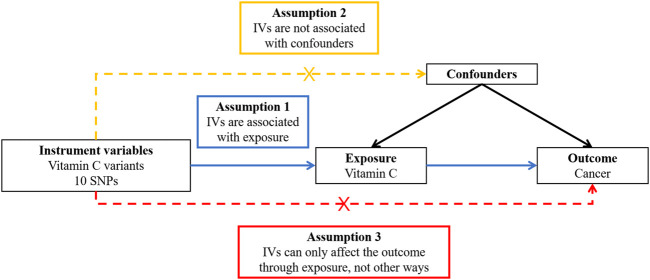
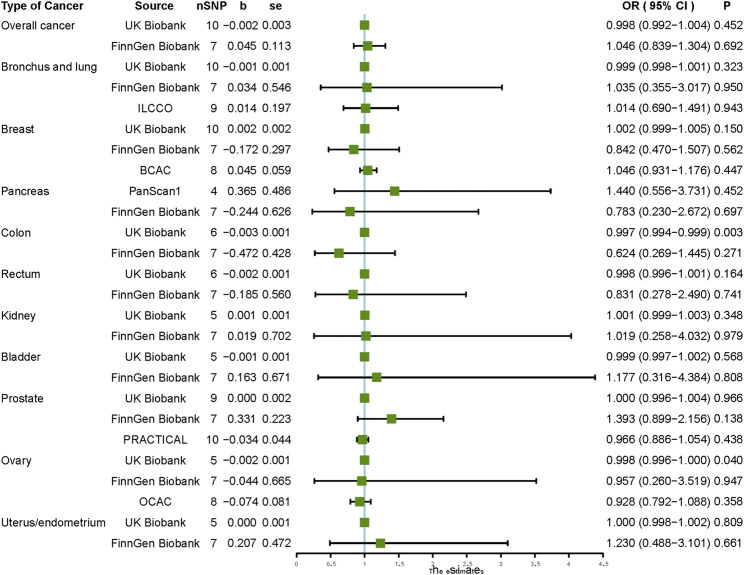
In recent years, many studies have indicated that vitamin C might be negatively associated with the risk of cancer, but the actual relationship between vitamin C and cancer remains ambivalent. Therefore, we utilized a two-sample Mendelian randomization (MR) study to explore the causal associations of genetically predicted vitamin C with the risk of a variety of cancers. Single-nucleotide polymorphisms (SNPs) associated with vitamin C at a significance level of < 5 × 10⁻⁸ and with a low level of linkage disequilibrium (LD) (r2 < 0.01) were selected from a genome-wide association study (GWAS) meta-analysis of plasmid concentration of vitamin C consisting of 52,018 individuals. The data of the GWAS outcomes were obtained from United Kingdom Biobank, FinnGen Biobank and the datasets of corresponding consortia. In the inverse-variance weight (IVW) method, our results did not support the causal association of genetically predicted vitamin C with the risk of overall cancer and 14 specific types of cancer. Similar results were observed in sensitivity analyses where the weighted median and MR-Egger methods were adopted, and heterogeneity and pleiotropy were not observed in statistical models. Therefore, our study suggested that vitamin C was not causally associated with the risk of cancer. Further studies are warranted to discover the potential protective and therapeutic effects of vitamin C on cancer, and its underlying mechanisms.
近年来,许多研究表明维生素C可能与癌症风险呈负相关,但维生素C与癌症之间的实际关系仍不明确。因此,我们利用两样本孟德尔随机化(MR)研究来探讨基因预测的维生素C与多种癌症风险之间的因果关系。从一项包含52018名个体的维生素C血浆浓度全基因组关联研究(GWAS)荟萃分析中,选取了与维生素C相关且显著性水平<5×10⁻⁸、连锁不平衡水平低(r2<0.01)的单核苷酸多态性(SNP)。GWAS结果的数据来自英国生物银行、芬兰基因库以及相应联盟的数据集。在逆方差加权(IVW)方法中,我们的结果不支持基因预测的维生素C与总体癌症风险以及14种特定癌症类型之间存在因果关系。在采用加权中位数和MR-Egger方法的敏感性分析中也观察到了类似结果,并且在统计模型中未观察到异质性和多效性。因此,我们的研究表明维生素C与癌症风险不存在因果关系。有必要进一步开展研究以发现维生素C对癌症的潜在保护和治疗作用及其潜在机制。