Khaild Sufian M, Fagir Amro M, Taha Ziryab I, Elshareef Awadelkareem A, Mohammed Mohammed H, Saeed Khalda M, Elagib Elnour M, Ibrahim Elwalied M, William Jimmy
Internal Medicine, Nile Valley University, Atbara, SDN.
Internal Medicine, Al Ain Hospital, Abu Dhabi, ARE.
Cureus. 2022 Apr 18;14(4):e24248. doi: 10.7759/cureus.24248. eCollection 2022 Apr.
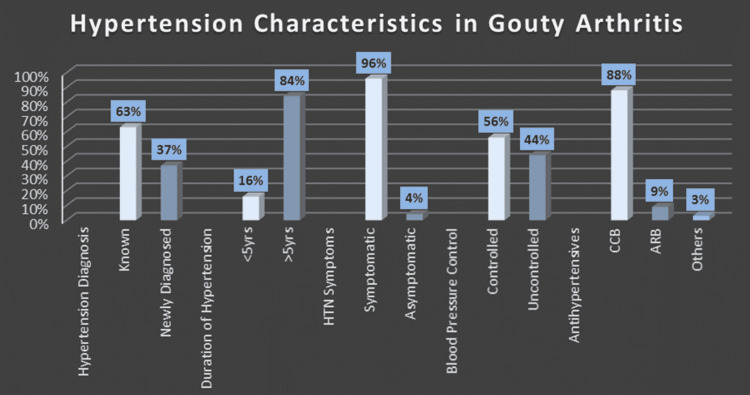
Background In this study, we aimed to study the frequency of hypertension in Sudanese patients with gouty arthritis attending the largest three tertiary hospitals in Khartoum and correlate it with serum uric acid levels. Methodology An observational, descriptive, cross-sectional, hospital-based study was conducted in rheumatology clinics in Khartoum state, Sudan, from August 2020 to January 2021 involving 100 participants. Data were collected, prepared, and analyzed using SPSS version 25.0 (IBM Corp., Armonk, NY, USA). Results In this study, 100 participants were enrolled. The majority were males (79%), with 45% of the participants in the age group of 61-75 years. Overall, 89% of participants had symptoms of gouty arthritis, with the knee being the most common joint affected in 27% of participants. Most participants had a uric acid level above the target (6 mg/dL). The most frequently used uric acid lowering agent was found to be allopurinol in 85% of the patients. Furthermore, among those with gouty arthritis, 51% had hypertension with nearly half being insufficiently controlled. The frequency of undiagnosed hypertension among the participants was found to be 19%, which was statistically significant among gouty arthritis patients (p-value < 0.0001). Upon further analysis of our hypertensive participants, 79.5% of males (n = 35) had high blood pressure levels, which was statistically significant as well (p-value = 0.005), with the highest prevalence being among the age group of 61-75 years. Of those who were hypertensive, 51% had a history of concomitant comorbidity. Overall, 90% of the hypertensive participants (n = 40) had joint symptoms. Moreover, serum uric acid level was above the target in 93% of the participants. Conclusions Hypertension was found to be the most frequently recognized comorbidity in gouty arthritic patients, with more than a third remaining undiagnosed. Moreover, the male gender was a significant risk factor for hypertension among the gouty arthritis participants. Nevertheless, most patients with high blood pressure levels had concurrent elevated uric acid levels.
背景 在本研究中,我们旨在研究喀土穆最大的三家三级医院中痛风性关节炎苏丹患者的高血压发病率,并将其与血清尿酸水平相关联。
方法 2020年8月至2021年1月,在苏丹喀土穆州的风湿病诊所进行了一项基于医院的观察性、描述性横断面研究,涉及100名参与者。使用SPSS 25.0版(美国纽约州阿蒙克市IBM公司)收集、整理和分析数据。
结果 本研究共纳入100名参与者。大多数为男性(79%),45%的参与者年龄在61 - 75岁之间。总体而言,89%的参与者有痛风性关节炎症状,膝关节是最常受累的关节,占27%的参与者。大多数参与者的尿酸水平高于目标值(6mg/dL)。发现85%的患者最常使用的降尿酸药物是别嘌醇。此外,在痛风性关节炎患者中,51%患有高血压,近一半控制不佳。参与者中未诊断出的高血压发病率为19%,在痛风性关节炎患者中具有统计学意义(p值<0.0001)。对高血压参与者进一步分析发现,79.5%的男性(n = 35)血压水平高,这也具有统计学意义(p值 = 0.005),患病率最高的是61 - 75岁年龄组。在高血压患者中,51%有合并症病史。总体而言,90%的高血压参与者(n = 40)有关节症状。此外,93%的参与者血清尿酸水平高于目标值。
结论 高血压是痛风性关节炎患者中最常被认识到的合并症,超过三分之一未被诊断。此外,男性是痛风性关节炎参与者中高血压的重要危险因素。然而,大多数高血压患者同时尿酸水平升高。