Department of Pharmacology & Therapeutics, Roswell Park Comprehensive Cancer Center, Buffalo, New York, USA.
Canget BioTekpharma LLC, Buffalo, New York, USA.
Clin Transl Med. 2022 May;12(5):e881. doi: 10.1002/ctm2.881.
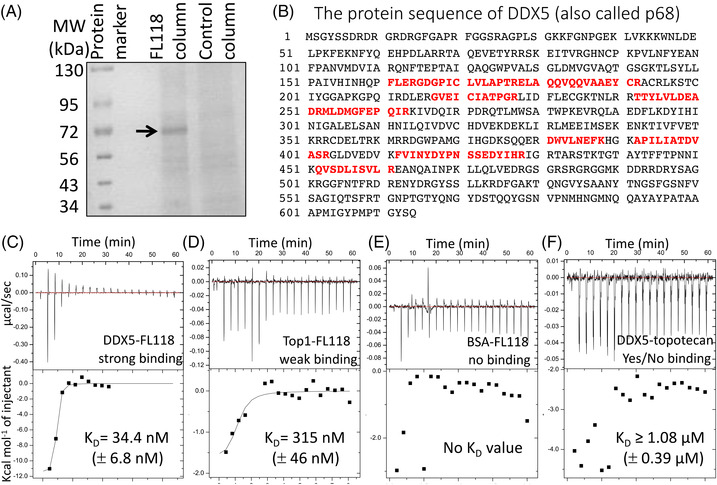
Pancreatic ductal adenocarcinoma (PDAC), a difficult-to-treat cancer, is expected to become the second-largest cause of cancer-related deaths by 2030, while colorectal cancer (CRC) is the third most common cancer and the third leading cause of cancer deaths. Currently, there is no effective treatment for PDAC patients. The development of novel agents to effectively treat these cancers remains an unmet clinical need. FL118, a novel anticancer small molecule, exhibits high efficacy against cancers; however, the direct biochemical target of FL118 is unknown.
FL118 affinity purification, mass spectrometry, Nanosep centrifugal device and isothermal titration calorimetry were used for identifying and confirming FL118 binding to DDX5/p68 and its binding affinity. Immunoprecipitation (IP), western blots, real-time reverse transcription PCR, gene silencing, overexpression (OE) and knockout (KO) were used for analysing gene/protein function and expression. Chromatin IP was used for analysing protein-DNA interactions. The 3-[4,5-dimethylthiazol-2-yl]-2,5-diphenyltetrazolium bromid assay and human PDAC/CRC cell/tumour models were used for determining PDAC/CRC cell/tumour in vitro and in vivo growth.
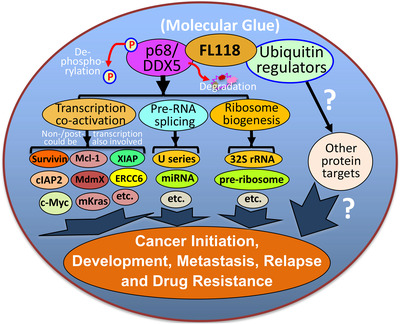
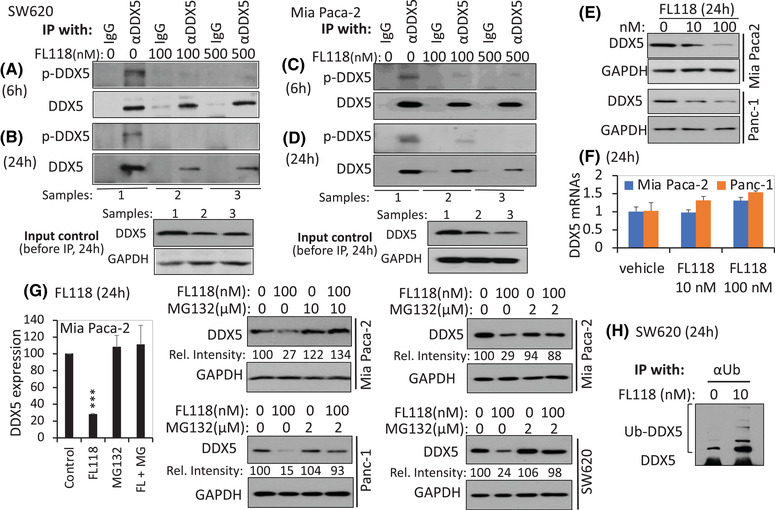
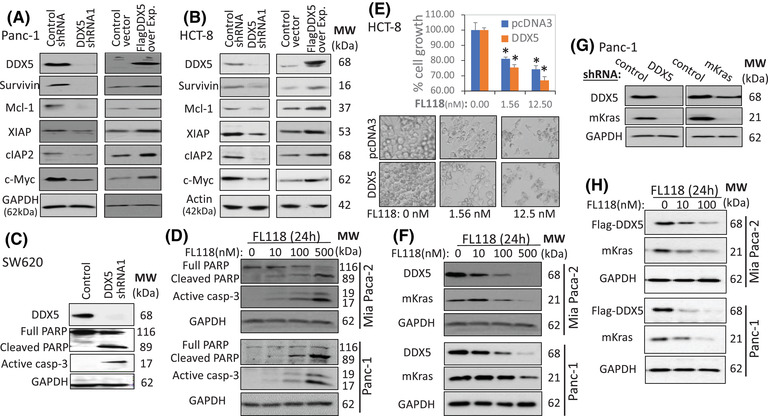
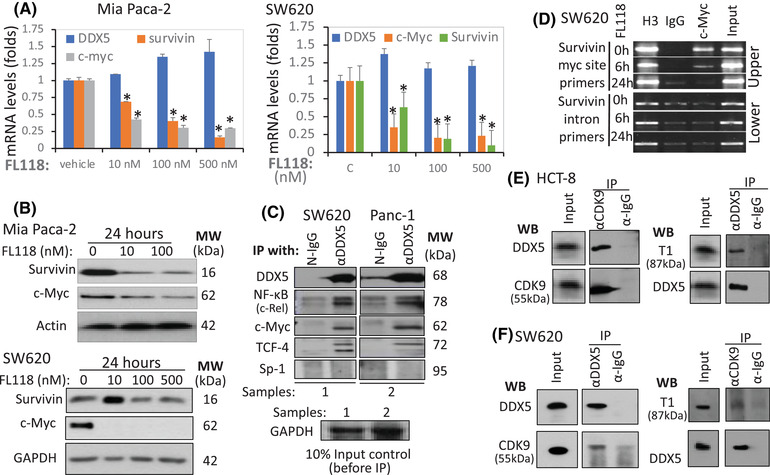
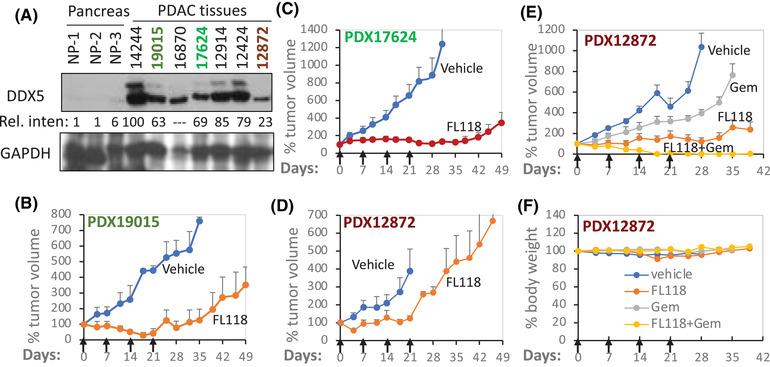
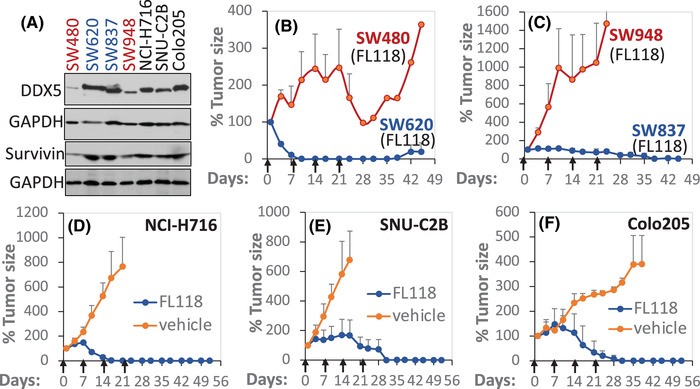
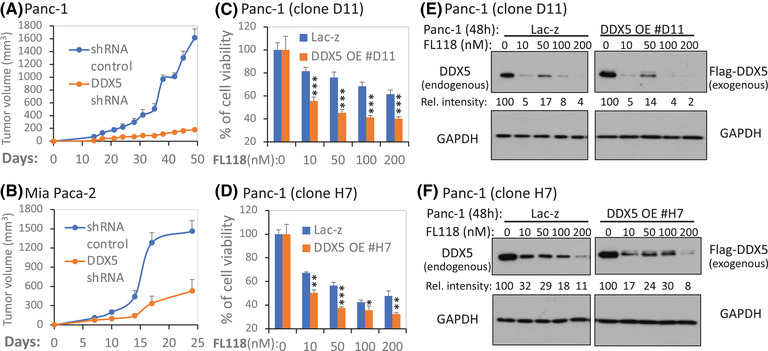
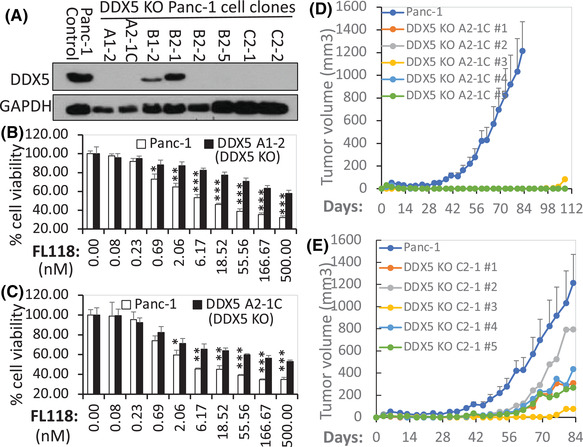
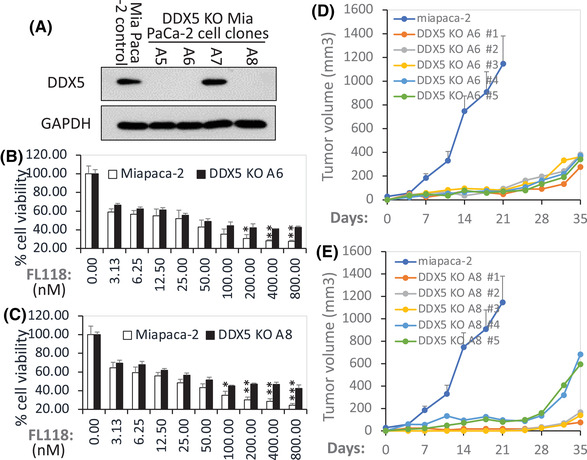
We discovered that FL118 strongly binds to dephosphorylates and degrades the DDX5 oncoprotein via the proteasome degradation pathway without decreasing DDX5 mRNA. Silencing and OE of DDX5 indicated that DDX5 is a master regulator for controlling the expression of multiple oncogenic proteins, including survivin, Mcl-1, XIAP, cIAP2, c-Myc and mutant Kras. Genetic manipulation of DDX5 in PDAC cells affects tumour growth. PDAC cells with DDX5 KO are resistant to FL118 treatment. Our human tumour animal model studies further indicated that FL118 exhibits high efficacy to eliminate human PDAC and CRC tumours that have a high expression of DDX5, while FL118 exhibits less effectiveness in PDAC and CRC tumours with low DDX5 expression.
DDX5 is a bona fide FL118 direct target and can act as a biomarker for predicting PDAC and CRC tumour sensitivity to FL118. This would greatly impact FL118 precision medicine for patients with advanced PDAC or advanced CRC in the clinic. FL118 may act as a 'molecular glue degrader' to directly glue DDX5 and ubiquitination regulators together to degrade DDX5.
胰腺癌(PDAC)是一种难以治疗的癌症,预计到 2030 年将成为癌症相关死亡的第二大原因,而结直肠癌(CRC)是第三大常见癌症和第三大癌症死亡原因。目前,PDAC 患者没有有效的治疗方法。开发有效的新型药物来治疗这些癌症仍然是一个未满足的临床需求。FL118 是一种新型抗癌小分子,对癌症具有很高的疗效;然而,FL118 的直接生化靶点尚不清楚。
使用 FL118 亲和纯化、质谱、Nanosep 离心装置和等温滴定量热法鉴定和确认 FL118 与 DDX5/p68 的结合及其结合亲和力。免疫沉淀(IP)、western blot、实时逆转录 PCR、基因沉默、过表达(OE)和敲除(KO)用于分析基因/蛋白功能和表达。染色质免疫沉淀用于分析蛋白-DNA 相互作用。3-[4,5-二甲基噻唑-2-基]-2,5-二苯基四氮唑溴盐(MTT)测定法和人 PDAC/CRC 细胞/肿瘤模型用于确定 PDAC/CRC 细胞/肿瘤的体外和体内生长。
我们发现,FL118 可强烈结合去磷酸化并通过蛋白酶体降解途径降解 DDX5 癌蛋白,而不降低 DDX5 mRNA。DDX5 的沉默和 OE 表明,DDX5 是控制多种致癌蛋白表达的主调控因子,包括 survivin、Mcl-1、XIAP、cIAP2、c-Myc 和突变型 Kras。PDAC 细胞中 DDX5 的遗传操作会影响肿瘤生长。DDX5 KO 的 PDAC 细胞对 FL118 治疗具有抗性。我们的人类肿瘤动物模型研究进一步表明,FL118 对消除高表达 DDX5 的人 PDAC 和 CRC 肿瘤具有很高的疗效,而在 DDX5 表达低的 PDAC 和 CRC 肿瘤中,FL118 的疗效较低。
DDX5 是 FL118 的真正直接靶点,可以作为预测 PDAC 和 CRC 肿瘤对 FL118 敏感性的生物标志物。这将极大地影响 FL118 在临床中用于治疗晚期 PDAC 或晚期 CRC 患者的精准医学。FL118 可能作为一种“分子胶降解剂”,直接将 DDX5 和泛素化调节剂粘在一起,从而降解 DDX5。