Department of Anaesthesiology and Intensive Care Medicine, Hôpital Nord, Hôpitaux Universitaires de Marseille, Aix Marseille University, Marseille, France.
Centre for Cardiovascular and Nutrition Research (C2VN), INRA, Aix Marseille Université, INSERM, Marseille, France.
BJS Open. 2022 May 2;6(3). doi: 10.1093/bjsopen/zrac063.
Physiotherapy is a major cornerstone of enhanced rehabilitation after surgery (ERAS) and reduces the development of atelectasis after thoracic surgery. By initiating physiotherapy in the post-anaesthesia care unit (PACU), the aim was to evaluate whether the ultra-early initiation of rehabilitation (in the first hour following tracheal extubation) would improve the outcomes of patients undergoing elective thoracic surgery.
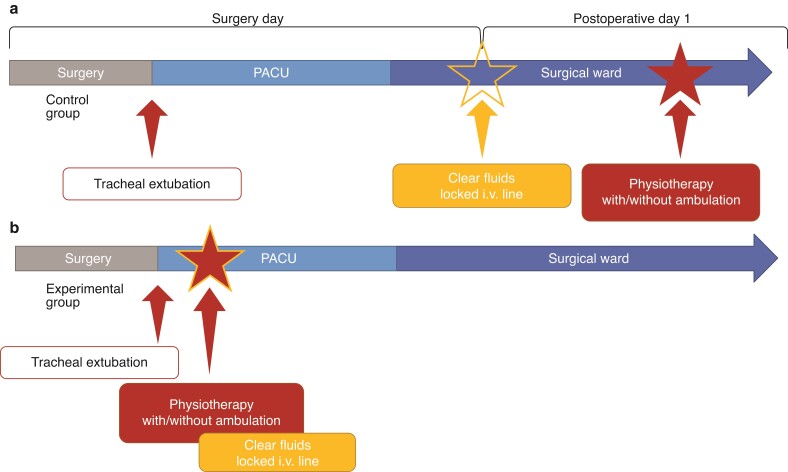
A case-control study with a before-and-after design was conducted. From a historical control group, patients were paired at a 3:1 ratio with an intervention group. This group consisted of patients treated with the ultra-early rehabilitation programme after elective thoracic surgery (clear fluids, physiotherapy, and ambulation). The primary outcome was the incidence of postoperative atelectasis and/or pneumonia during the hospital stay.
After pairing, 675 patients were allocated to the historical control group and 225 patients to the intervention group. A significant decrease in the incidence of postoperative atelectasis and/or pneumonia was found in the latter (11.4 versus 6.7 per cent respectively; P = 0.042) and remained significant on multivariate analysis (OR 0.53, 95 per cent c.i. 0.26 to 0.98; P = 0.045). A subgroup analysis of the intervention group showed that early ambulation during the PACU stay was associated with a further significant decrease in the incidence of postoperative atelectasis and/or pneumonia (2.2 versus 9.5 per cent; P = 0.012).
Ultra-early rehabilitation in the PACU was associated with a decrease in the incidence of postoperative atelectasis and/or pneumonia after major elective thoracic surgery.
物理疗法是增强手术后康复(ERAS)的重要基石,可减少胸外科手术后肺不张的发生。通过在麻醉后护理单元(PACU)启动物理疗法,目的是评估在气管拔管后第一小时内开始康复治疗是否会改善择期胸外科手术患者的结局。
采用前后对照设计的病例对照研究。从历史对照组中,以 3:1 的比例与干预组进行配对。该组由接受择期胸外科手术后超早期康复计划(清亮液体、物理治疗和步行)的患者组成。主要结局是住院期间术后肺不张和/或肺炎的发生率。
配对后,675 例患者被分配到历史对照组,225 例患者被分配到干预组。发现后者术后肺不张和/或肺炎的发生率显著降低(分别为 11.4%和 6.7%;P=0.042),且在多变量分析中仍然显著(OR 0.53,95%置信区间 0.26 至 0.98;P=0.045)。干预组的亚组分析显示,PACU 住院期间早期活动与术后肺不张和/或肺炎发生率的进一步显著降低相关(2.2%和 9.5%;P=0.012)。
PACU 中的超早期康复与大型择期胸外科手术后肺不张和/或肺炎发生率的降低有关。