Department of Otorhinolaryngology-Head - Neck Surgery and Audiology, Copenhagen Hearing and Balance Centre, Copenhagen, Denmark; Copenhagen Academy for Medical Education and Simulation (CAMES), The Capital Region of Denmark, Denmark.
Copenhagen Academy for Medical Education and Simulation (CAMES), The Capital Region of Denmark, Denmark.
J Int Adv Otol. 2022 May;18(3):219-224. doi: 10.5152/iao.2022.21429.
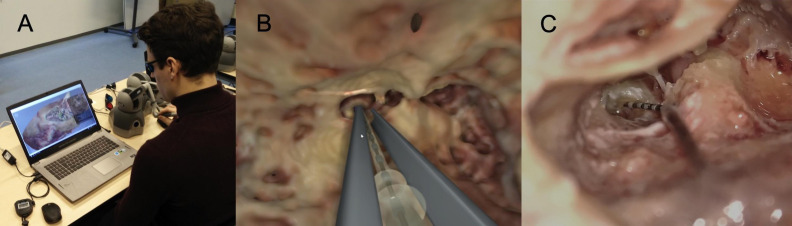
Cochlear implantation requires excellent surgical skills; virtual reality simulation training is an effective method for acquiring basic competency in temporal bone surgery before progression to cadaver dissection. However, cochlear implantation virtual reality simulation training remains largely unexplored and only one simulator currently supports the training of the cochlear implantation electrode insertion. Here, we aim to evaluate the effect of cochlear implantation virtual reality simulation training on subsequent cadaver dissection performance and self-directedness.
This was a randomized, controlled trial. Eighteen otolaryngology residents were randomized to either mastoidectomy including cochlear implantation virtual reality simulation training (intervention) or mastoidectomy virtual reality simulation training alone (controls) before cadaver cochlear implantation surgery. Surgical performance was evaluated by two blinded expert raters using a validated, structured assess- ment tool. The need for supervision (reflecting self-directedness) was assessed via post-dissection questionnaires.
The intervention group achieved a mean score of 22.9 points of a maximum of 44 points, which was 5.4% higher than the control group's 21.8 points (P = .51). On average, the intervention group required assistance 1.3 times during cadaver drilling; this was 41% more frequent in the control group who received assistance 1.9 times (P = .21).
Cochlear implantation virtual reality simulation training is feasible in the context of a cadaver dissection course. The addition of cochlear implantation virtual reality training to basic mastoidectomy virtual reality simulation training did not lead to a significant improvement of performance or self-directedness in this study. Our findings suggest that learning an advanced temporal bone procedure such as cochlear implantation surgery requires much more training than learning mastoidectomy.
人工耳蜗植入需要精湛的手术技能;虚拟现实模拟训练是在进行尸体解剖之前获得颞骨手术基本能力的有效方法。然而,人工耳蜗植入虚拟现实模拟训练在很大程度上仍未得到探索,目前只有一种模拟器支持人工耳蜗植入电极插入的训练。在这里,我们旨在评估人工耳蜗植入虚拟现实模拟训练对随后的尸体解剖表现和自我指导的影响。
这是一项随机对照试验。18 名耳鼻喉科住院医师被随机分为乳突切除术(包括人工耳蜗植入虚拟现实模拟训练)或乳突切除术虚拟现实模拟训练(对照组),然后进行尸体耳蜗植入手术。手术表现由两名盲法专家评估者使用经过验证的结构化评估工具进行评估。通过术后问卷调查评估监督需求(反映自我指导能力)。
干预组的平均得分为 44 分中的 22.9 分,比对照组的 21.8 分高 5.4%(P=.51)。平均而言,干预组在尸体钻孔过程中需要协助 1.3 次;对照组需要协助 1.9 次,频率高 41%(P=.21)。
在尸体解剖课程中,人工耳蜗植入虚拟现实模拟训练是可行的。在基本乳突切除术虚拟现实模拟训练中加入人工耳蜗植入虚拟现实培训并没有导致在本研究中表现或自我指导能力的显著提高。我们的研究结果表明,学习人工耳蜗植入等高级颞骨手术需要比学习乳突切除术更多的训练。