Concheri Stefano, Brotto Davide, Ariano Marzia, Daloiso Antonio, Di Pasquale Fiasca Valerio Maria, Sorrentino Flavia, Coppadoro Beatrice, Trevisi Patrizia, Zanoletti Elisabetta, Franchella Sebastiano
Department of Neurosciences, Section of Otolaryngology, Azienda Ospedale-Università Padova, 35121 Padua, Italy.
Pediatric Hematology Oncology Unit, Department of Woman's and Child's Health, Azienda Ospedale-Università di Padova, 35122 Padua, Italy.
Audiol Res. 2024 Feb 22;14(2):227-238. doi: 10.3390/audiolres14020021.
The objectives were to present the real-time estimated values of cochlear implant (CI) electrode insertion speed (IS) during intraoperative sessions using the Cochlear Nucleus SmartNav System to assess whether this measure affected CI outcomes and to determine whether real-time feedback assists expert surgeons in achieving slow insertion.
The IS was measured in 52 consecutive patients (65 implanted ears) using the CI632 electrode. The IS values were analyzed in relation to procedure repetition over time, NRT ratio, and CI audiological outcomes.
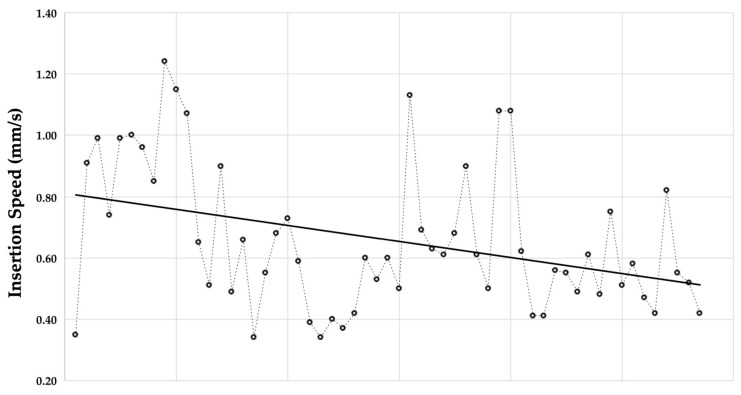
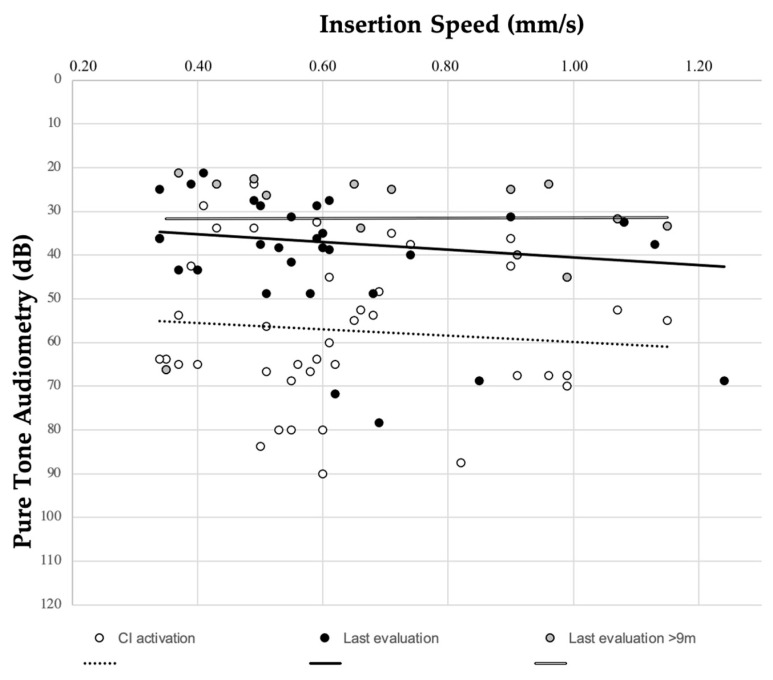
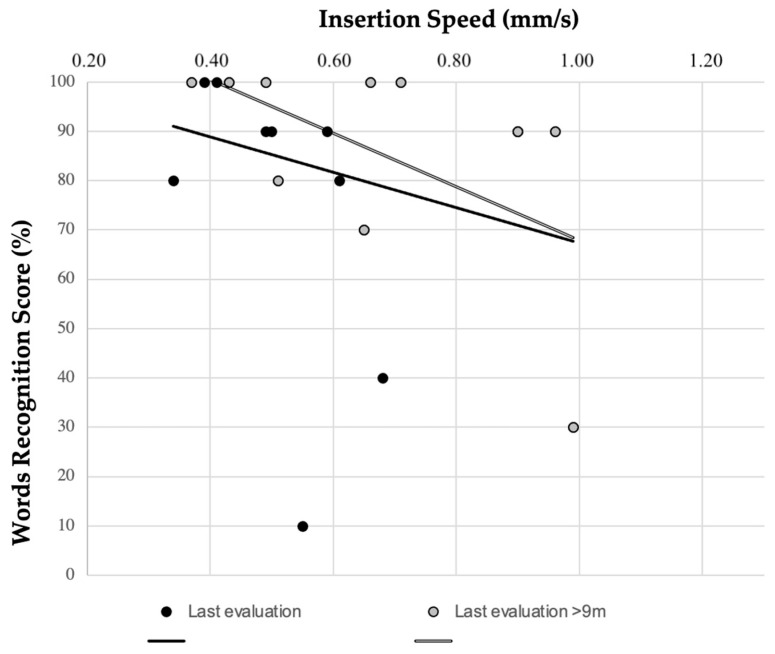
The average IS was 0.64 mm/s (SD = 0.24); minimum and maximum values were 0.23 and 1.24 mm/s, respectively. The IS significantly decreased with each array insertion by the operator ( = 0.006), and the mean decreased by 24% between the first and last third of procedures; however, this reduction fell within the error range of SmartNav for IS (+/-0.48 mm/s). No correlation was found between IS and the NRT ratio ( = 0.51), pure-tone audiometry (PTA) at CI activation ( = 0.506), and PTA ( = 0.94) or word recognition score ( = 0.231) at last evaluation.
The estimated IS reported by SmartNav did not result in a clinically significant reduction in insertion speed or an improvement in CI hearing outcomes. Real-time feedback of IS could potentially be used for training, but its effectiveness requires confirmation through additional studies and more accurate tools. Implementation of IS assessment in clinical practice will enable comparisons between measurement techniques and between manual and robot-assisted insertions. This will help define the optimal IS range to achieve better cochlear implant (CI) outcomes.
本研究旨在呈现术中使用科利耳公司的SmartNav系统时,人工耳蜗(CI)电极插入速度(IS)的实时估计值,以评估该指标是否会影响CI手术效果,并确定实时反馈是否有助于专家外科医生实现缓慢插入。
使用CI632电极对52例连续患者(65只植入耳)的IS进行测量。分析IS值与手术重复次数、NRT比率和CI听力学结果之间的关系。
平均IS为0.64 mm/s(标准差=0.24);最小值和最大值分别为0.23和1.24 mm/s。随着术者每次插入电极阵列,IS显著降低(P = 0.006),在手术的前三分之一和后三分之一之间,平均值下降了24%;然而,这种下降幅度落在SmartNav系统对IS的误差范围内(±0.48 mm/s)。未发现IS与NRT比率(P = 0.51)、CI开机时的纯音听力测定(PTA)(P = 0.506)以及最后一次评估时的PTA(P = 0.94)或单词识别得分(P = 0.231)之间存在相关性。
SmartNav系统报告的估计IS并未导致插入速度在临床上显著降低,也未改善CI的听力结果。IS的实时反馈可能可用于培训,但其有效性需要通过更多研究和更精确的工具来证实。在临床实践中实施IS评估将有助于比较测量技术以及手动插入与机器人辅助插入之间的差异。这将有助于确定实现更好人工耳蜗(CI)效果的最佳IS范围。