Boo Sun-Jin, Piao Mei Jing, Kang Kyoung Ah, Zhen Ao Xuan, Fernando Pincha Devage Sameera Madushan, Herath Herath Mudiyanselage Udari Lakmini, Lee Seung Joo, Song Seung Eun, Hyun Jin Won
Department of Internal Medicine, Jeju National University Hospital, College of Medicine, Jeju National University, Jeju 63241, Republic of Korea.
Department of Biochemistry, College of Medicine, Jeju National University, Jeju 63243, Republic of Korea.
Biomol Ther (Seoul). 2022 Sep 1;30(5):447-454. doi: 10.4062/biomolther.2022.028. Epub 2022 May 25.
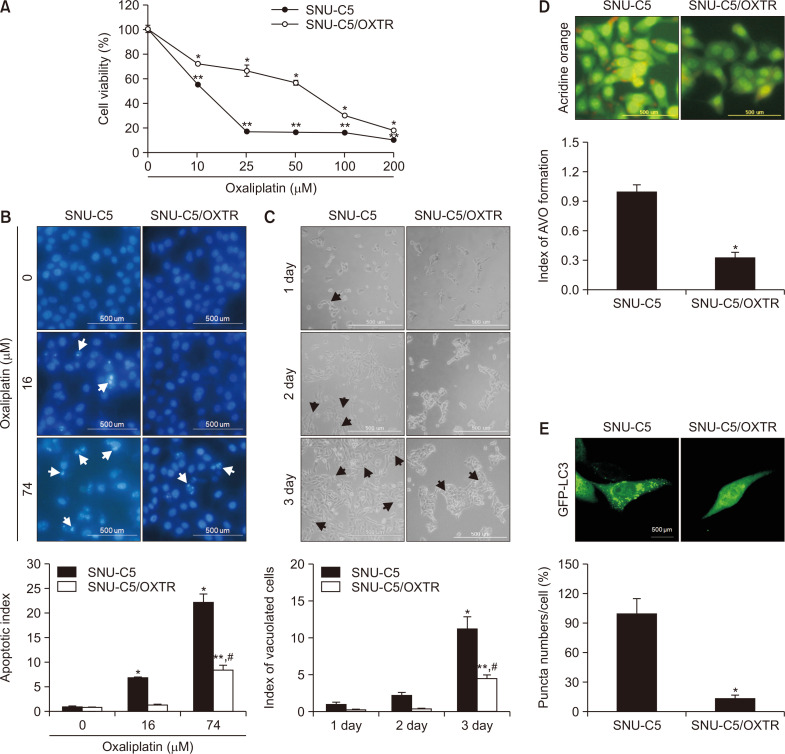
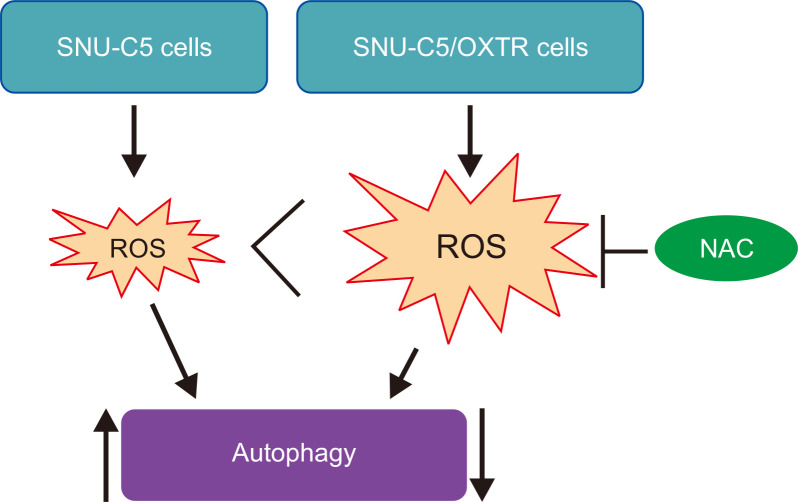
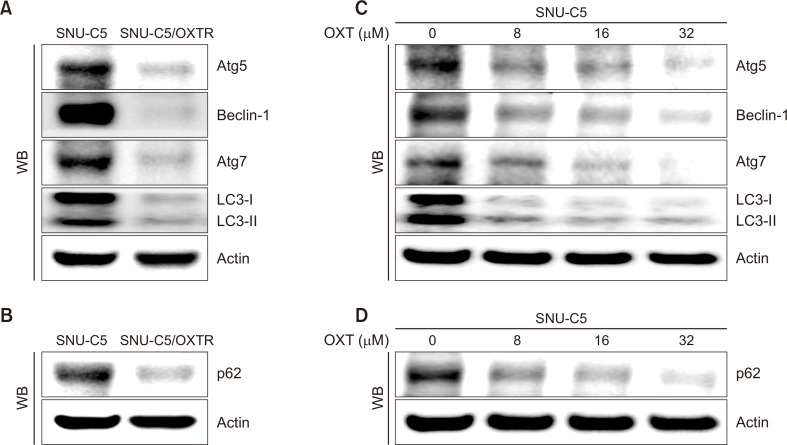
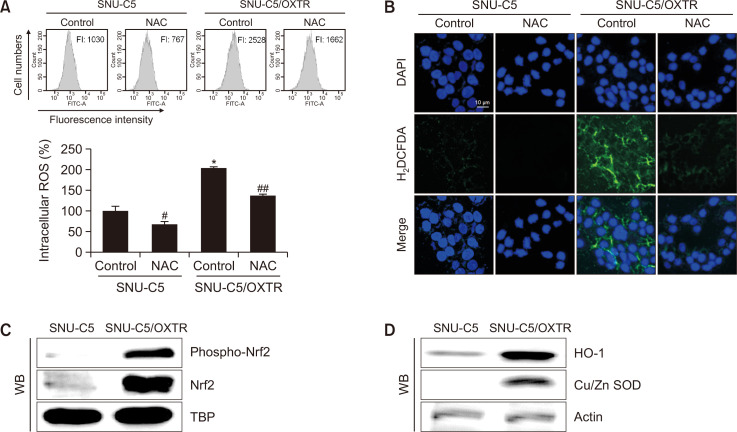
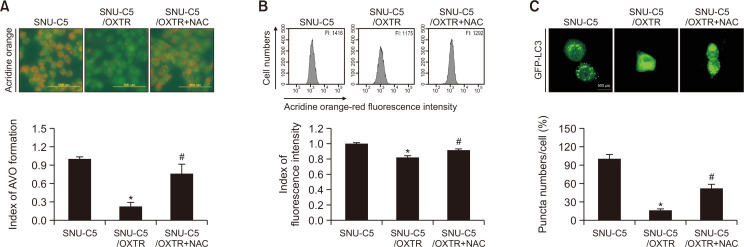
Few studies have evaluated the role of autophagy in the development of oxaliplatin (OXT) resistance in colon cancer cells. In this study, we compared the role of autophagy between SNU-C5 colon cancer cells and OXT-resistant SNU-C5 (SNU-C5/OXTR) cells. At the same concentration of OXT, the cytotoxicity of OXT or apoptosis was significantly reduced in SNU-C5/OXTR cells compared with that in SNU-C5 cells. Compared with SNU-C5 cells, SNU-C5/OXTR cells exhibited low levels of autophagy. The expression level of important autophagy proteins, such as autophagy-related protein 5 (Atg5), beclin-1, Atg7, microtubule-associated proteins 1A/1B light chain 3B I (LC3-I), and LC3-II, was significantly lower in SNU-C5/OXTR cells than that in SNU-C5 cells. The expression level of the autophagy-essential protein p62 was also lower in SNU-C5/OXTR cells than in SNU-C5 cells. In SNUC5/ OXTR cells, the production of intracellular reactive oxygen species (ROS) was significantly higher than that in SNU-C5 cells, and treatment with the ROS scavenger N-acetylcysteine restored the reduced autophagy levels. Furthermore, the expression of antioxidant-related nuclear factor erythroid 2-related factor 2 transcription factor, heme oxygenase-1, and Cu/Zn superoxide dismutase were also significantly increased in SNU-C5/OXTR cells. These findings suggest that autophagy is significantly reduced in SNU-C5/OXTR cells compared with SNU-C5 cells, which may be related to the production of ROS in OXT-resistant cells.
很少有研究评估自噬在结肠癌细胞对奥沙利铂(OXT)耐药性发展中的作用。在本研究中,我们比较了自噬在SNU-C5结肠癌细胞和奥沙利铂耐药的SNU-C5(SNU-C5/OXTR)细胞中的作用。在相同浓度的奥沙利铂下,与SNU-C5细胞相比,SNU-C5/OXTR细胞中奥沙利铂的细胞毒性或凋亡显著降低。与SNU-C5细胞相比,SNU-C5/OXTR细胞表现出自噬水平较低。重要的自噬蛋白,如自噬相关蛋白5(Atg5)、贝林1、Atg7、微管相关蛋白1A/1B轻链3B I(LC3-I)和LC3-II的表达水平在SNU-C5/OXTR细胞中显著低于SNU-C5细胞。自噬必需蛋白p62的表达水平在SNU-C5/OXTR细胞中也低于SNU-C5细胞。在SNUC5/OXTR细胞中,细胞内活性氧(ROS)的产生显著高于SNU-C5细胞,用ROS清除剂N-乙酰半胱氨酸处理可恢复降低的自噬水平。此外,抗氧化相关核因子红细胞2相关因子2转录因子、血红素加氧酶-1和铜/锌超氧化物歧化酶的表达在SNU-C5/OXTR细胞中也显著增加。这些发现表明,与SNU-C5细胞相比,SNU-C5/OXTR细胞中的自噬显著降低,这可能与耐药细胞中ROS的产生有关。