Biosciences, College of Life and Environmental Sciences, University of Exeter, Exeter, EX4 4QD, UK.
Grupo Interdisciplinar de Sistemas Complejos, Departamento de Matemáticas, Universidad Carlos III de Madrid, 28911, Leganés, Spain.
Nat Commun. 2022 May 25;13(1):2917. doi: 10.1038/s41467-022-30635-7.
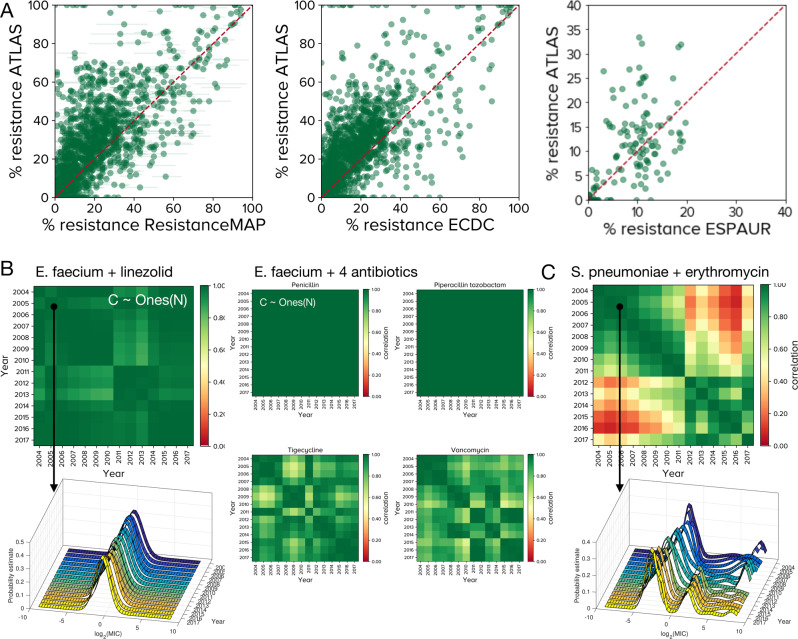
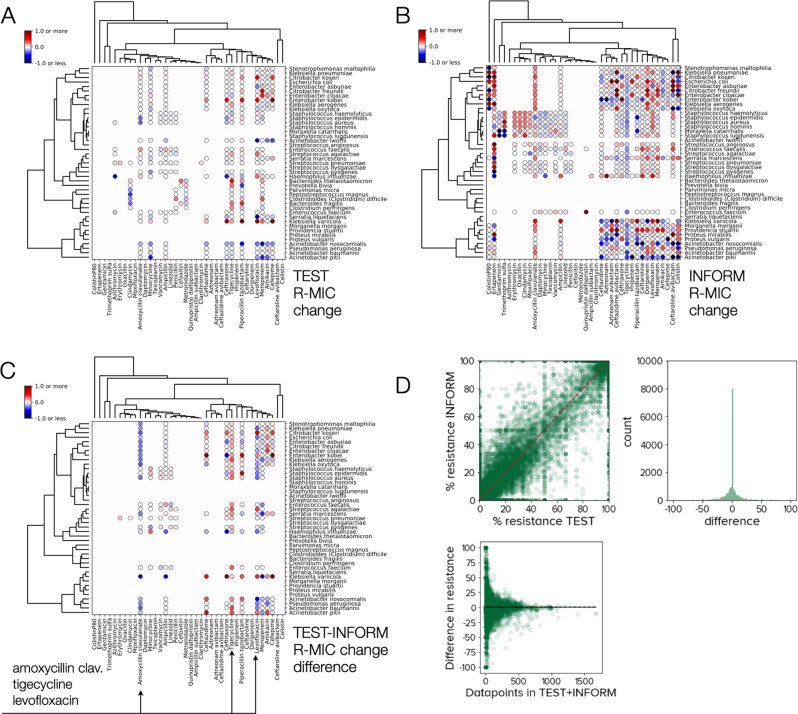
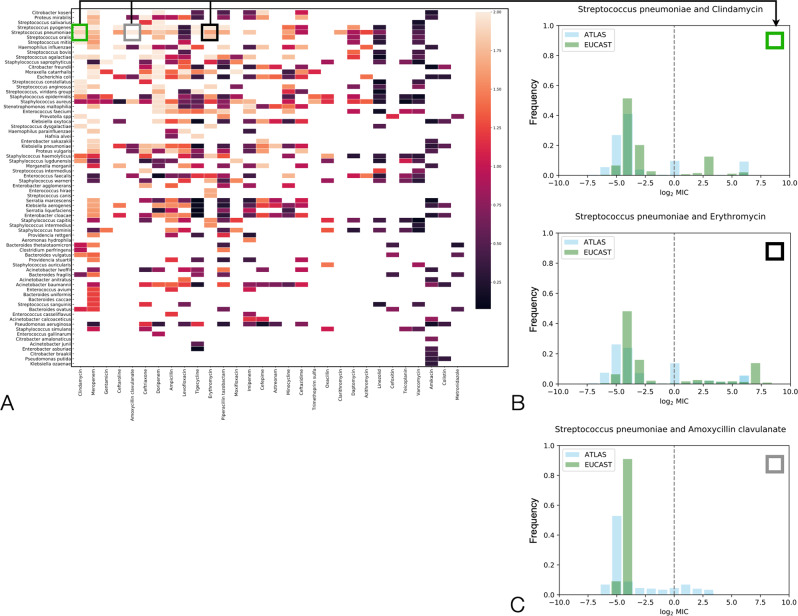
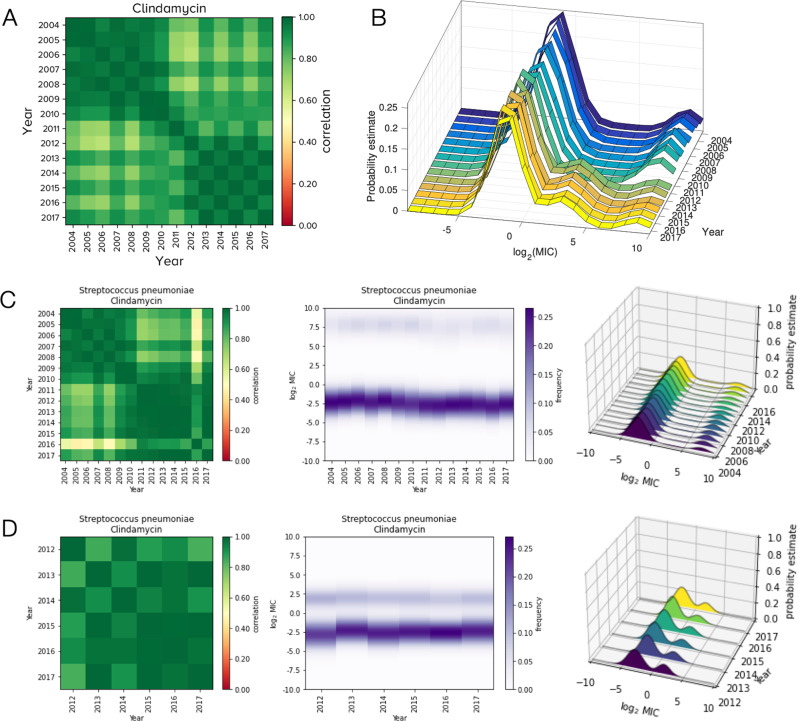
Antibiotic resistance represents a growing medical concern where raw, clinical datasets are under-exploited as a means to track the scale of the problem. We therefore sought patterns of antibiotic resistance in the Antimicrobial Testing Leadership and Surveillance (ATLAS) database. ATLAS holds 6.5M minimal inhibitory concentrations (MICs) for 3,919 pathogen-antibiotic pairs isolated from 633k patients in 70 countries between 2004 and 2017. We show most pairs form coherent, although not stationary, timeseries whose frequencies of resistance are higher than other databases, although we identified no systematic bias towards including more resistant strains in ATLAS. We sought data anomalies whereby MICs could shift for methodological and not clinical or microbiological reasons and found artefacts in over 100 pathogen-antibiotic pairs. Using an information-optimal clustering methodology to classify pathogens into low and high antibiotic susceptibilities, we used ATLAS to predict changes in resistance. Dynamics of the latter exhibit complex patterns with MIC increases, and some decreases, whereby subpopulations' MICs can diverge. We also identify pathogens at risk of developing clinical resistance in the near future.
抗生素耐药性是一个日益严重的医学问题,目前原始的临床数据集尚未得到充分利用,无法追踪这一问题的严重程度。因此,我们在抗菌药物测试领导与监测(ATLAS)数据库中寻找抗生素耐药模式。ATLAS 数据库包含了 2004 年至 2017 年间从 70 个国家的 63.3 万名患者中分离出的 3919 种病原体-抗生素对的 650 万最小抑菌浓度(MIC)数据。我们发现,大多数对形成了连贯的(尽管不是稳定的)时间序列,其耐药频率高于其他数据库,但我们并未发现 ATLAS 系统地偏向于包含更多耐药菌株。我们还寻找了 MIC 可能因方法学而非临床或微生物学原因而发生变化的异常数据,结果发现有 100 多对病原体-抗生素存在异常。我们使用信息最优聚类方法将病原体分为低和高抗生素敏感性,并用 ATLAS 来预测耐药性的变化。后者的动态表现出复杂的模式,MIC 增加和某些减少,其中亚群的 MIC 可以发散。我们还确定了一些在不久的将来可能会出现临床耐药性的病原体。