Liu Tiejun, Wang Xin, Guo Wei, Shao Fei, Li Zitong, Zhou Yang, Zhao Zhihong, Xue Liyan, Feng Xiaoli, Li Yin, Tan Fengwei, Zhang Kai, Xue Qi, Gao Shugeng, Gao Yibo, He Jie
Department of Thoracic Surgery, National Cancer Center/National Clinical Research Center for Cancer/Cancer Hospital, Chinese Academy of Medical Sciences and Peking Union Medical College, Beijing, China.
Cancer Institute of the Affiliated Hospital of Qingdao University, Qingdao Cancer Institute, Qingdao, China.
Front Oncol. 2022 May 9;12:824354. doi: 10.3389/fonc.2022.824354. eCollection 2022.
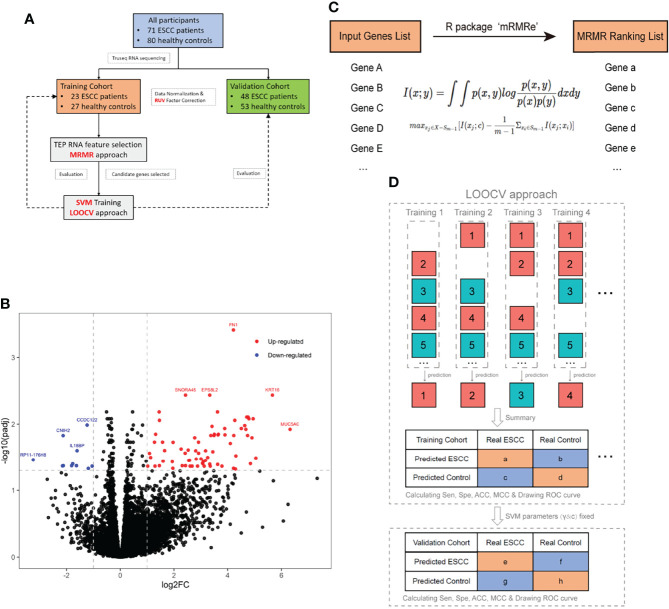
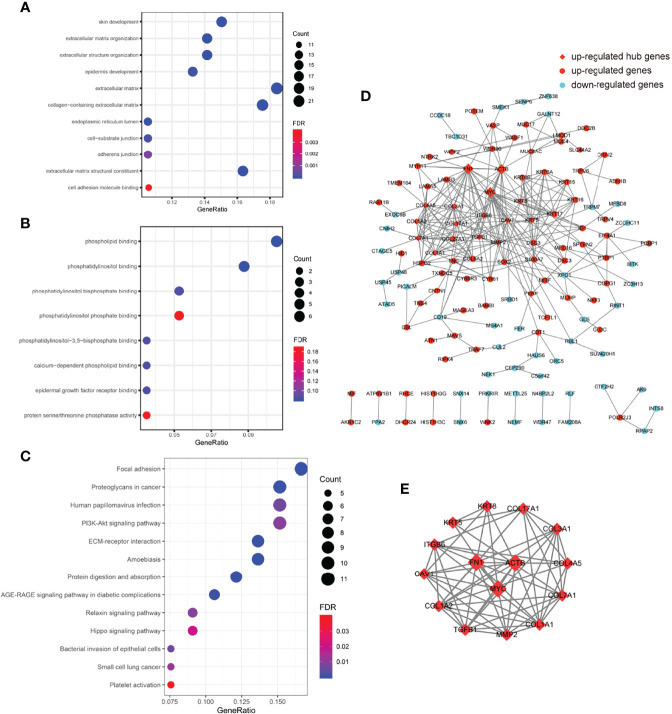
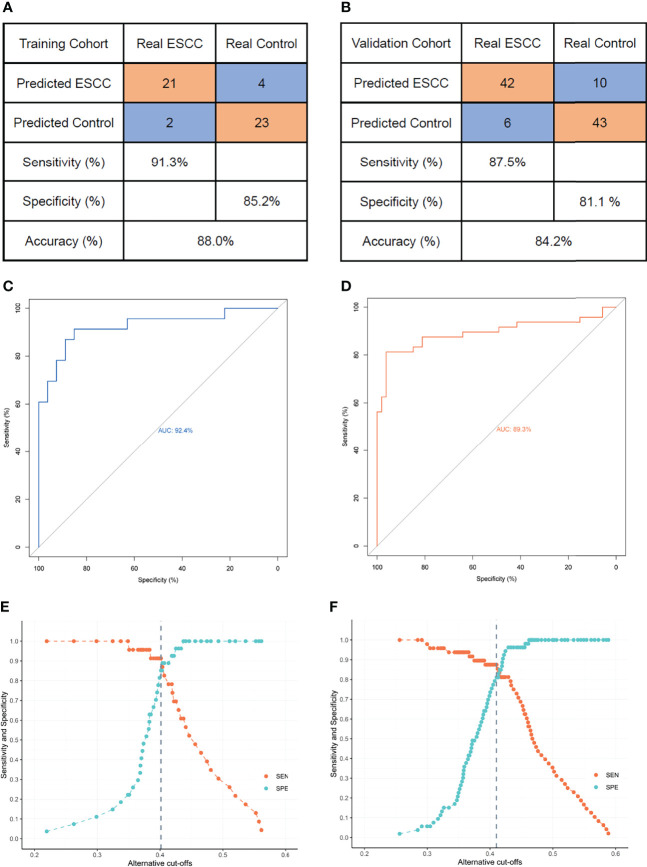
There is no cost-effective, accurate, and non-invasive method for the detection of esophageal squamous cell carcinoma (ESCC) in clinical practice. We aimed to investigate the diagnostic potential of tumor-educated platelets in ESCC. In this study, seventy-one ESCC patients and eighty healthy individuals were enrolled and divided into a training cohort (23 patients and 27 healthy individuals) and a validation cohort (48 patients and 53 healthy individuals). Next-generation RNA sequencing was performed on platelets isolated from peripheral blood of all participants, and a support vector machine/leave-one-out cross validation (SVM/LOOCV) approach was used for binary classification. A diagnostic signature composed of , and discriminated ESCC patients from healthy individuals with 91.3% sensitivity and 85.2% specificity in the training cohort and 87.5% sensitivity and 81.1% specificity in the validation cohort. The AUC was 0.924 (95% CI, 0.845-0.956) and 0.893 (95% CI, 0.821-0.966), respectively, in the training cohort and validation cohort. This 3-gene platelet RNA signature could effectively discriminate ESCC from healthy control. Our data highlighted the potential of tumor-educated platelets for the noninvasive diagnosis of ESCC. Moreover, we found that keratin and collagen protein families and ECM-related pathways might be involved in tumor progression and metastasis of ESCC, which might provide insights to understand ESCC pathobiology and advance novel therapeutics.
在临床实践中,尚无经济高效、准确且无创的方法用于检测食管鳞状细胞癌(ESCC)。我们旨在研究肿瘤诱导血小板在ESCC中的诊断潜力。在本研究中,纳入了71例ESCC患者和80名健康个体,并将其分为训练队列(23例患者和27名健康个体)和验证队列(48例患者和53名健康个体)。对从所有参与者外周血中分离的血小板进行了新一代RNA测序,并采用支持向量机/留一法交叉验证(SVM/LOOCV)方法进行二元分类。由 、 和 组成的诊断特征在训练队列中以91.3%的灵敏度和85.2%的特异性区分ESCC患者与健康个体,在验证队列中以87.5%的灵敏度和81.1%的特异性区分。训练队列和验证队列中的AUC分别为0.924(95%CI,0.845 - 0.956)和0.893(95%CI,0.821 - 0.966)。这种三基因血小板RNA特征可有效区分ESCC与健康对照。我们的数据突出了肿瘤诱导血小板在ESCC无创诊断中的潜力。此外,我们发现角蛋白和胶原蛋白家族以及ECM相关途径可能参与ESCC的肿瘤进展和转移,这可能为理解ESCC病理生物学和推进新型治疗方法提供见解。