Milne-Ives Madison, Fraser Lorna K, Khan Asiya, Walker David, van Velthoven Michelle Helena, May Jon, Wolfe Ingrid, Harding Tracey, Meinert Edward
Centre for Health Technology, University of Plymouth, Plymouth, United Kingdom.
Department of Health Sciences, University of York, York, United Kingdom.
JMIR Res Protoc. 2022 May 26;11(5):e35738. doi: 10.2196/35738.
Multimorbidity, which is associated with significant negative outcomes for individuals and health care systems, is increasing in the United Kingdom. However, there is a lack of knowledge about the risk factors (including health, behavior, and environment) for multimorbidity over time. An interdisciplinary approach is essential, as data science, artificial intelligence, and engineering concepts (digital twins) can identify key risk factors throughout the life course, potentially enabling personalized simulation of life-course risk for the development of multimorbidity. Predicting the risk of developing clusters of health conditions before they occur would add clinical value by enabling targeted early preventive interventions, advancing personalized care to improve outcomes, and reducing the burden on health care systems.
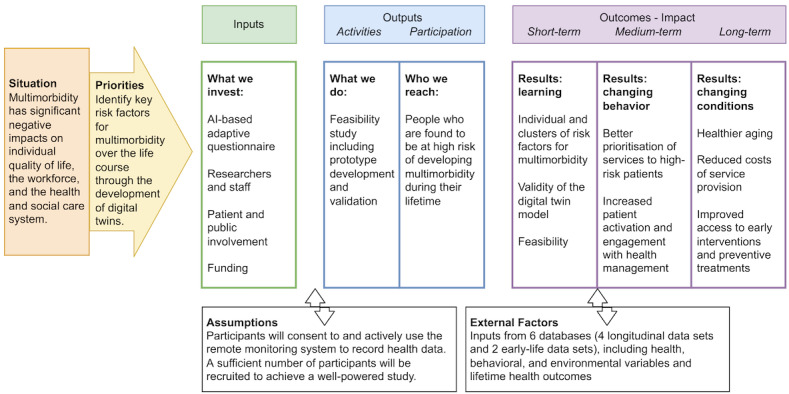
This study aims to identify key risk factors that predict multimorbidity throughout the life course by developing an intelligent agent using digital twins so that early interventions can be delivered to improve health outcomes. The objectives of this study are to identify key predictors of lifetime risk of multimorbidity, create a series of simulated computational digital twins that predict risk levels for specific clusters of factors, and test the feasibility of the system.
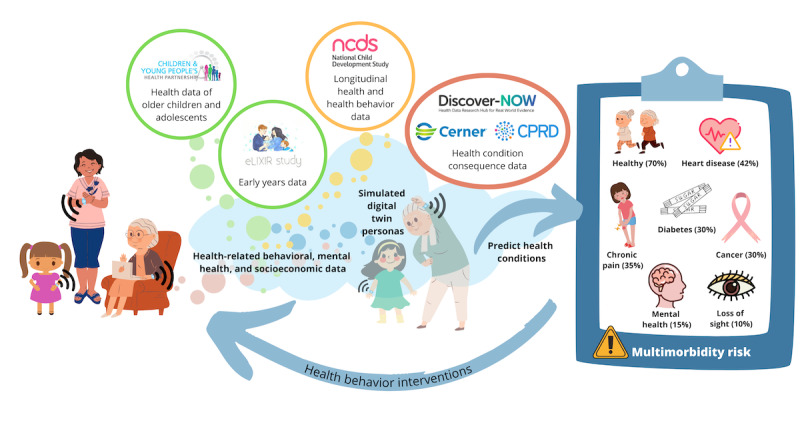
This study will use machine learning to develop digital twins by identifying key risk factors throughout the life course that predict the risk of later multimorbidity. The first stage of the development will be the training of a base predictive model. Data from the National Child Development Study, the North West London Integrated Care Record, the Clinical Practice Research Datalink, and Cerner's Real World Data will be split into subsets for training and validation, which will be done following the k-fold cross-validation procedure and assessed with the Prediction Model Risk of Bias Assessment Tool (PROBAST). In addition, 2 data sets-the Early-Life Data Cross-linkage in Research study and the Children and Young People's Health Partnership randomized controlled trial-will be used to develop a series of digital twin personas that simulate clusters of factors to predict different risk levels of developing multimorbidity.
The expected results are a validated model, a series of digital twin personas, and a proof-of-concept assessment.
Digital twins could provide an individualized early warning system that predicts the risk of future health conditions and recommends the most effective intervention to minimize that risk. These insights could significantly improve an individual's quality of life and healthy life expectancy and reduce population-level health burdens.
INTERNATIONAL REGISTERED REPORT IDENTIFIER (IRRID): PRR1-10.2196/35738.
多病共存现象在英国日益增多,这给个人和医疗保健系统带来了重大负面后果。然而,随着时间的推移,人们对多病共存的风险因素(包括健康、行为和环境)缺乏了解。采用跨学科方法至关重要,因为数据科学、人工智能和工程概念(数字孪生)可以识别生命历程中的关键风险因素,从而有可能实现对多病共存发展的生命历程风险进行个性化模拟。在健康状况集群出现之前预测其发生风险,通过实施有针对性的早期预防干预措施、推进个性化医疗以改善治疗效果以及减轻医疗保健系统的负担,将增加临床价值。
本研究旨在通过使用数字孪生开发智能代理来识别预测生命历程中多病共存的关键风险因素,以便能够提供早期干预措施来改善健康结果。本研究的目标是确定多病共存终身风险的关键预测因素,创建一系列模拟计算数字孪生,预测特定因素集群的风险水平,并测试该系统的可行性。
本研究将使用机器学习,通过识别生命历程中预测后期多病共存风险的关键风险因素来开发数字孪生。开发的第一阶段将是训练一个基础预测模型。来自全国儿童发展研究、伦敦西北部综合医疗记录、临床实践研究数据链和erner真实世界数据的数据将被分成子集用于训练和验证,这将按照k折交叉验证程序进行,并使用预测模型偏倚风险评估工具(PROBAST)进行评估。此外,将使用两个数据集——研究中的早期生命数据交叉链接和儿童与青少年健康伙伴关系随机对照试验——来开发一系列数字孪生角色,模拟因素集群以预测发展为多病共存的不同风险水平。
预期结果是一个经过验证的模型、一系列数字孪生角色和一个概念验证评估。
数字孪生可以提供一个个性化的早期预警系统,预测未来健康状况的风险,并推荐最有效的干预措施以最小化该风险。这些见解可以显著提高个人的生活质量和健康预期寿命,并减轻人群层面的健康负担。
国际注册报告标识符(IRRID):PRR1-10.2196/35738。