Dipartimento di Ingegneria dell'Informazione, Università di Pisa, via G. Caruso 16, Pisa, 56122, Italy.
Department of Medical and Surgical Sciences for Children & Adults, University-Hospital of Modena and Reggio Emilia, Via del Pozzo 71, Modena, 41124, Italy.
Adv Sci (Weinh). 2022 Aug;9(22):e2202062. doi: 10.1002/advs.202202062. Epub 2022 May 26.
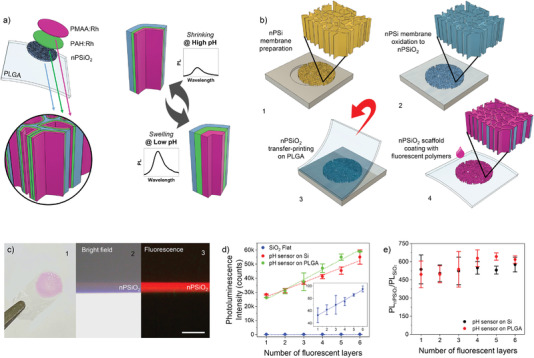
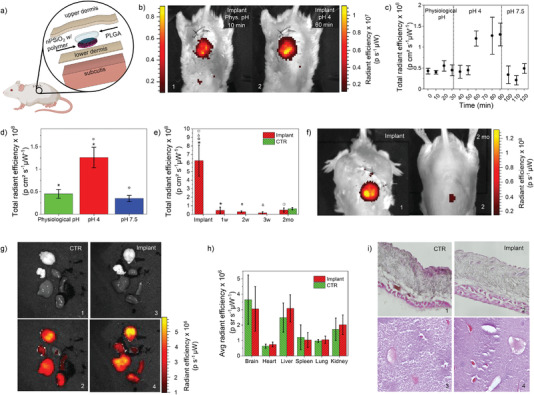
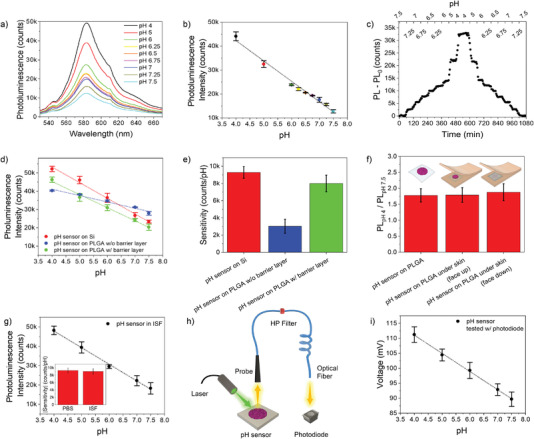
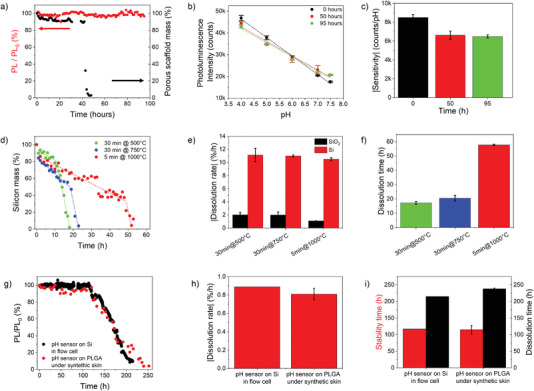
Here, the authors report on the manufacturing and in vivo assessment of a bioresorbable nanostructured pH sensor. The sensor consists of a micrometer-thick porous silica membrane conformably coated layer-by-layer with a nanometer-thick multilayer stack of two polyelectrolytes labeled with a pH-insensitive fluorophore. The sensor fluorescence changes linearly with the pH value in the range 4 to 7.5 upon swelling/shrinking of the polymer multilayer and enables performing real-time measurements of the pH level with high stability, reproducibility, and accuracy, over 100 h of continuous operation. In vivo studies carried out implanting the sensor in the subcutis on the back of mice confirm real-time monitoring of the local pH level through skin. Full degradation of the pH sensor occurs in one week from implant in the animal model, and its biocompatibility after 2 months is confirmed by histological and fluorescence analyses. The proposed approach can be extended to the detection of other (bio)markers in vivo by engineering the functionality of one (at least) of the polyelectrolytes with suitable receptors, thus paving the way to implantable bioresorbable chemical sensors.
本文报道了一种可生物降解的纳米结构 pH 传感器的制造和体内评估。该传感器由一层微米厚的多孔硅膜组成,通过层层自组装技术,纳米厚度的多层聚合物堆叠被具有 pH 不敏感荧光团的两种聚电解质标记。当聚合物多层溶胀/收缩时,传感器的荧光强度随 pH 值在 4 到 7.5 范围内呈线性变化,能够在 100 小时的连续操作中进行高稳定性、重现性和准确性的实时 pH 值测量。通过在小鼠背部皮下植入传感器进行的体内研究证实,通过皮肤可以实时监测局部 pH 值。在动物模型中,植入后一周内 pH 传感器完全降解,两个月后的组织学和荧光分析证实了其生物相容性。通过用合适的受体工程化至少一种聚电解质的功能,该方法可以扩展到体内其他(生物)标志物的检测,从而为可植入的生物可降解化学传感器铺平了道路。