Cooks Eric J, Duke Kyle A, Neil Jordan M, Vilaro Melissa J, Wilson-Howard Danyell, Modave Francois, George Thomas J, Odedina Folakemi T, Lok Benjamin C, Carek Peter, Laber Eric B, Davidian Marie, Krieger Janice L
STEM Translational Communication Center, College of Journalism and Communications, University of Florida, Gainesville, FL, USA.
Department of Statistics, North Carolina State University, Raleigh, NC, USA.
J Clin Transl Sci. 2022 Apr 8;6(1):e48. doi: 10.1017/cts.2022.386. eCollection 2022.
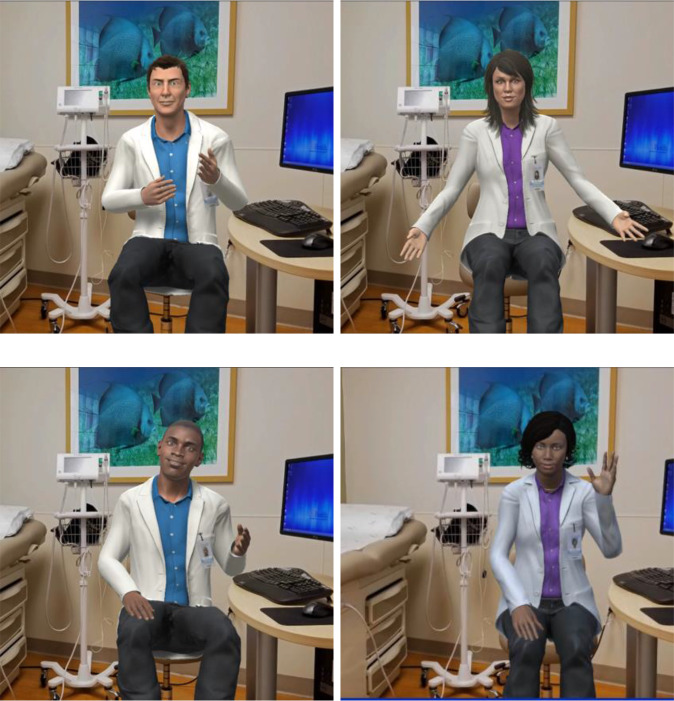
Racial disparities in colorectal cancer (CRC) can be addressed through increased adherence to screening guidelines. In real-life encounters, patients may be more willing to follow screening recommendations delivered by a race concordant clinician. The growth of telehealth to deliver care provides an opportunity to explore whether these effects translate to a virtual setting. The primary purpose of this pilot study is to explore the relationships between virtual clinician (VC) characteristics and CRC screening intentions after engagement with a telehealth intervention leveraging technology to deliver tailored CRC prevention messaging.
Using a posttest-only design with three factors (VC race-matching, VC gender, intervention type), participants ( = 2267) were randomised to one of eight intervention treatments. Participants self-reported perceptions and behavioral intentions.
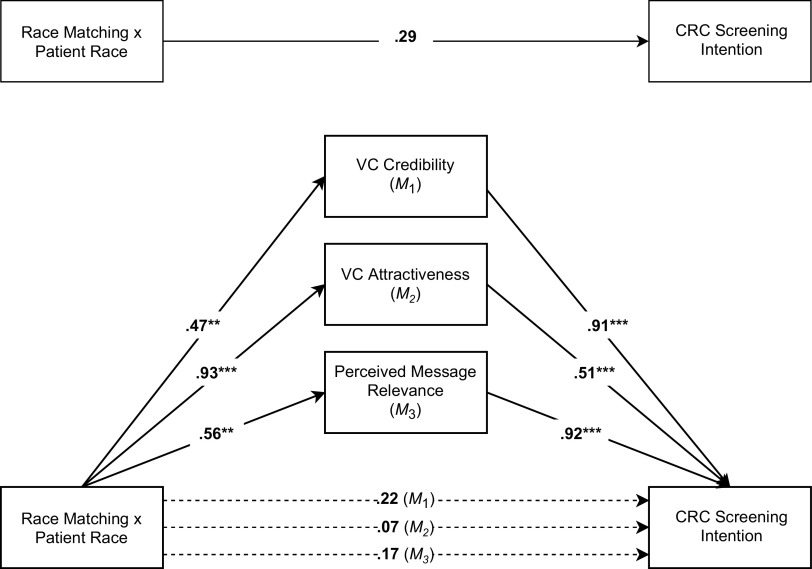
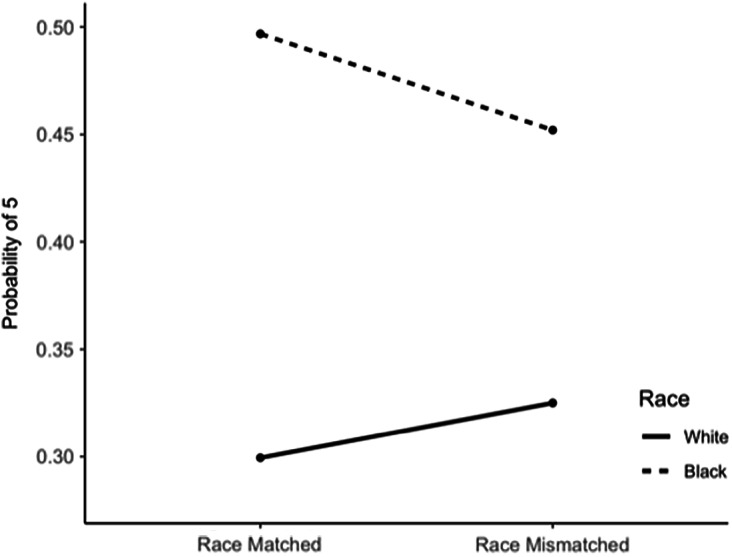
The benefits of matching participants with a racially similar VC trended positive but did not reach statistical significance. Specifically, race-matching positively influenced screening intentions for Black participants but not for Whites ( = 0.29, = 0.10). Importantly, perceptions of credibility, attractiveness, and message relevance significantly influenced screening intentions and the relationship with race-matching.
To reduce racial CRC screening disparities, investments are needed to identify patient-focused interventions to address structural barriers to screening. This study suggests that telehealth interventions that match Black patients with a Black VC can enhance perceptions of credibility and message relevance, which may then improve screening intentions. Future research is needed to examine how to increase VC credibility and attractiveness, as well as message relevance without race-matching.
通过提高对筛查指南的依从性,可以解决结直肠癌(CRC)中的种族差异问题。在现实生活中,患者可能更愿意遵循由种族匹配的临床医生提供的筛查建议。远程医疗提供护理的发展为探索这些影响是否能转化到虚拟环境中提供了一个机会。这项试点研究的主要目的是探讨在参与一项利用技术提供量身定制的CRC预防信息的远程医疗干预后,虚拟临床医生(VC)特征与CRC筛查意向之间的关系。
采用仅进行后测的设计,包含三个因素(VC种族匹配、VC性别、干预类型),参与者(n = 2267)被随机分配到八种干预治疗中的一种。参与者自我报告认知和行为意向。
将参与者与种族相似的VC进行匹配的益处呈积极趋势,但未达到统计学显著性。具体而言,种族匹配对黑人参与者的筛查意向有积极影响,但对白人参与者没有影响(β = 0.29,p = 0.10)。重要的是,对可信度、吸引力和信息相关性的认知显著影响筛查意向以及与种族匹配的关系。
为了减少CRC筛查中的种族差异,需要进行投资,以确定以患者为中心的干预措施,以解决筛查的结构性障碍。这项研究表明,将黑人患者与黑人VC匹配的远程医疗干预可以增强对可信度和信息相关性的认知,进而可能改善筛查意向。未来需要研究如何在不进行种族匹配的情况下提高VC的可信度和吸引力以及信息相关性。