Division of Cardiology, Department of Medicine, Duke University School of Medicine, Durham, North Carolina, USA.
Division of Nephrology, Department of Medicine, Duke University School of Medicine, Durham, North Carolina, USA.
J Am Med Inform Assoc. 2020 Jun 1;27(6):957-962. doi: 10.1093/jamia/ocaa067.
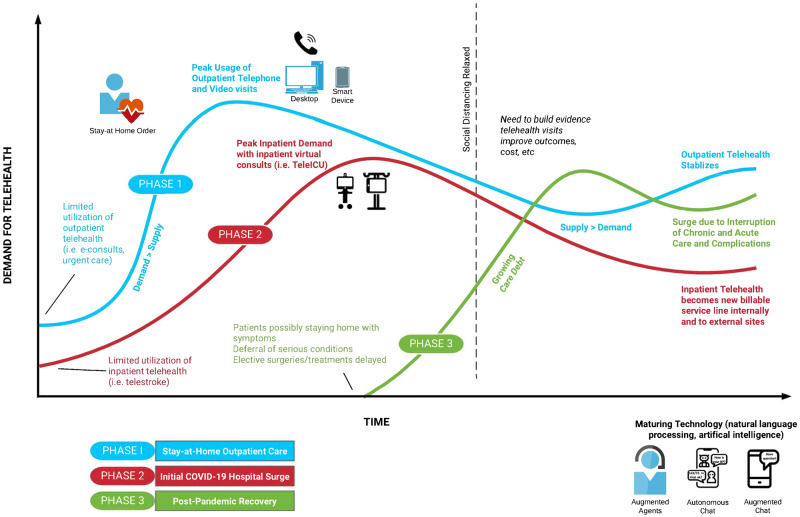
The novel coronavirus disease-19 (COVID-19) pandemic has altered our economy, society, and healthcare system. While this crisis has presented the U.S. healthcare delivery system with unprecedented challenges, the pandemic has catalyzed rapid adoption of telehealth, or the entire spectrum of activities used to deliver care at a distance. Using examples reported by U.S. healthcare organizations, including ours, we describe the role that telehealth has played in transforming healthcare delivery during the 3 phases of the U.S. COVID-19 pandemic: (1) stay-at-home outpatient care, (2) initial COVID-19 hospital surge, and (3) postpandemic recovery. Within each of these 3 phases, we examine how people, process, and technology work together to support a successful telehealth transformation. Whether healthcare enterprises are ready or not, the new reality is that virtual care has arrived.
新型冠状病毒病-19(COVID-19)大流行改变了我们的经济、社会和医疗体系。虽然这场危机给美国医疗服务体系带来了前所未有的挑战,但它也促使远程医疗(即通过远程手段提供医疗服务的全部活动)迅速普及。我们将通过包括我们在内的美国医疗机构报告的案例,描述远程医疗在美国 COVID-19 大流行的三个阶段(1:居家门诊护理;2:COVID-19 医院初期激增;3:大流行后恢复)中在医疗服务提供方面所发挥的作用。在这三个阶段中的每一个阶段,我们都将研究人员、流程和技术如何协同工作以支持远程医疗的成功转型。无论医疗保健企业是否已经做好准备,虚拟护理已经成为现实。