Faculty of Education, Beijing Normal University, Beijing, China.
Office of Physical Education, Soochow University, Taipei City, Taiwan.
Front Public Health. 2022 May 10;10:847672. doi: 10.3389/fpubh.2022.847672. eCollection 2022.
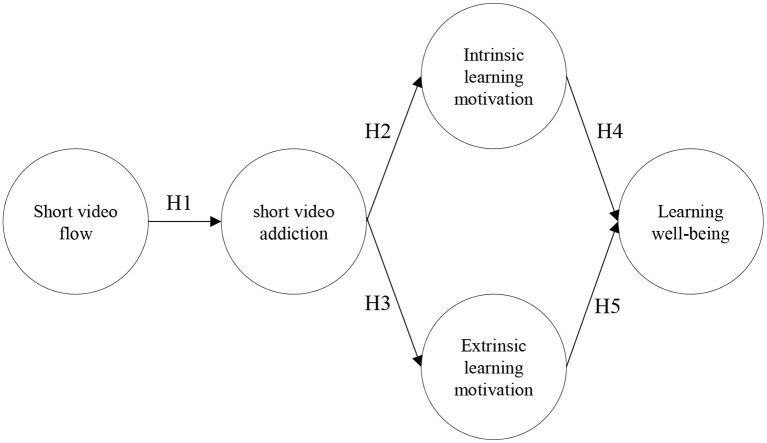
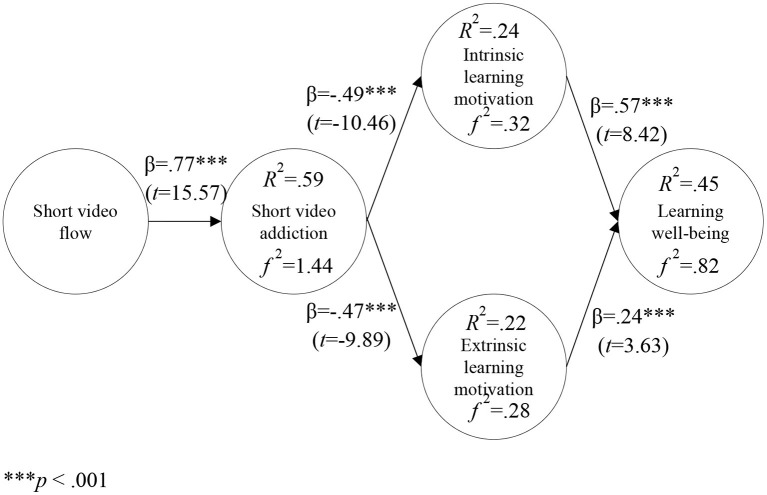
While media use can be beneficial in some ways, excessive use of media has led to growing concerns about its potential negative consequences. With the popularity of Chinese video applications (apps) such as DouYin, TikTok, Kwai, and other short video apps sweeping through schools around the world. Due to the diversity and immersion principle of short videos, their popularity continues to grow, and the phenomenon of students being addicted to short videos also brings many hidden dangers to the learning effect. Among other things, the problem of excessive use of the Internet among Chinese youth has led the government to propose a series of control policies to strengthen the monitoring of harmful habits of youth in the use of online applications. In addition, the problem of youth addiction to short videos has become a major concern for education experts and the general public, thus demonstrating that short video addiction is indeed an ongoing research issue. Therefore, this study aimed to understand the causes of short-form video addiction and its impact on the psychology of learning, and to investigate the relationship between short-form video flow experience, short-form video addiction, intrinsic and extrinsic learning motivation, and learning well-being from the perspectives of flow experience theory and micro ecological systems. The questionnaire was sent instant messaging software such as QQ and WeChat, and university students from vocational colleges in China were invited to complete the questionnaire. A total of 517 valid data were collected, including 222 (42.9%) were male students and 295 (57.1%) were female students. The collected questionnaires were analyzed for reliability and validity after removing incomplete data, followed by structural equation modeling for model verification. The findings showed that: (1) short video flow experience had a positive effect on short video addiction; (2) short video addiction had a negative effect on intrinsic and extrinsic learning motivation; (3) intrinsic and extrinsic learning motivation had a positive effect on learning well-being; (4) short video flow experience had an indirect negative effect on intrinsic and extrinsic learning motivation; (5) short video flow and short video addiction had indirect negative effects on learning well-being. According to the results, it is clear that addiction to short videos has a negative impact on learners' learning motivation and positive psychology of learning, so parents and teachers should effectively guide students to use short video apps in a self-controlled way.
虽然媒体的使用在某些方面可能是有益的,但过度使用媒体也引起了人们对其潜在负面影响的关注。随着抖音、TikTok、快手等中国短视频应用在全球学校的普及,由于短视频的多样性和沉浸原则,它们的受欢迎程度持续上升,学生沉迷短视频的现象也给学习效果带来了许多隐患。除其他外,中国青年过度使用互联网的问题导致政府提出了一系列控制政策,以加强对青年在使用在线应用程序时不良习惯的监控。此外,青年对短视频的上瘾问题已经成为教育专家和公众的主要关注点,这表明短视频上瘾确实是一个正在进行的研究问题。因此,本研究旨在了解短视频成瘾的原因及其对学习心理的影响,并从流畅体验理论和微观生态系统的角度研究短视频流畅体验、短视频成瘾、内在和外在学习动机与学习幸福感之间的关系。通过 QQ 和微信等即时通讯软件向大学生发放问卷,邀请中国职业院校的大学生填写问卷。共收集了 517 份有效数据,其中男生 222 人(占 42.9%),女生 295 人(占 57.1%)。在剔除不完整数据后,对收集到的问卷进行了可靠性和有效性分析,然后进行了结构方程模型验证。研究结果表明:(1)短视频流畅体验对短视频成瘾有正向影响;(2)短视频成瘾对内在和外在学习动机有负向影响;(3)内在和外在学习动机对学习幸福感有正向影响;(4)短视频流畅体验对内在和外在学习动机有间接负向影响;(5)短视频流畅体验和短视频成瘾对学习幸福感有间接负向影响。根据研究结果,可以清楚地看出,短视频成瘾对学习者的学习动机和积极的学习心理有负面影响,因此家长和教师应该有效地引导学生以自我控制的方式使用短视频应用程序。