• 文献检索
  • 文档翻译
  • 深度研究
  • 学术资讯
  • Suppr Zotero 插件Zotero 插件
  • 邀请有礼
  • 套餐&价格
  • 历史记录
应用&插件
Suppr Zotero 插件Zotero 插件浏览器插件Mac 客户端Windows 客户端微信小程序
定价
高级版会员购买积分包购买API积分包
服务
文献检索文档翻译深度研究API 文档MCP 服务
关于我们
关于 Suppr公司介绍联系我们用户协议隐私条款
关注我们

Suppr 超能文献

核心技术专利:CN118964589B侵权必究
粤ICP备2023148730 号-1Suppr @ 2026

文献检索

告别复杂PubMed语法,用中文像聊天一样搜索,搜遍4000万医学文献。AI智能推荐,让科研检索更轻松。

立即免费搜索

文件翻译

保留排版,准确专业,支持PDF/Word/PPT等文件格式,支持 12+语言互译。

免费翻译文档

深度研究

AI帮你快速写综述,25分钟生成高质量综述,智能提取关键信息,辅助科研写作。

立即免费体验

新冠疫情前后中国中小学生的网络成瘾和心理困扰:潜在类别分析。

Internet addiction and psychological distress among Chinese schoolchildren before and during the COVID-19 outbreak: A latent class analysis.

机构信息

1 Chinese Academy of Education Big Data, Qufu Normal University, Qufu, China.

2 School of Physical Therapy and Graduate Institute of Rehabilitation Science, College of Medicine, Chang Gung University, Taoyuan, Taiwan.

出版信息

J Behav Addict. 2021 Sep 15;10(3):731-746. doi: 10.1556/2006.2021.00052.

DOI:10.1556/2006.2021.00052
PMID:34529588
原文链接:https://pmc.ncbi.nlm.nih.gov/articles/PMC8997210/
Abstract

BACKGROUND AND AIMS

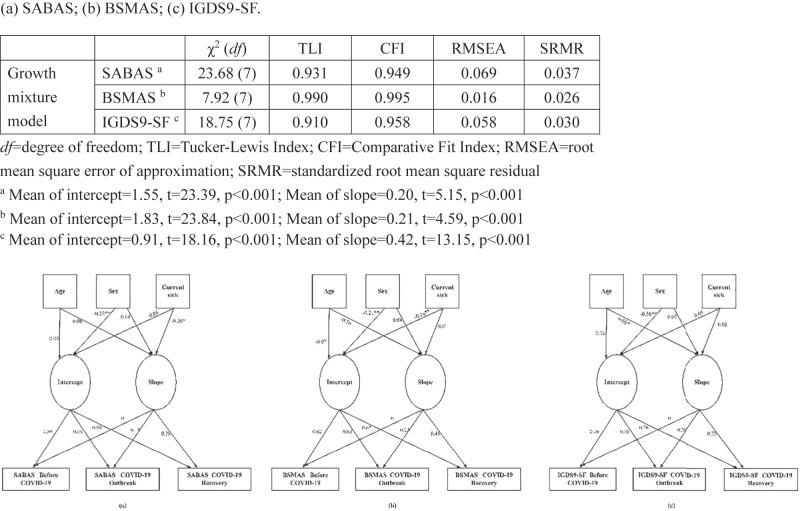
The present longitudinal study examined the changes in problematic internet use (problematic smartphone use, problematic social media use, and problematic gaming) and changes in COVID-19-related psychological distress (fear of COVID-19 and worry concerning COVID-19) across three time-points (before the COVID-19 outbreak, during the initial stages of the COVID-19 outbreak, and during the COVID-19 outbreak recovery period).

METHODS

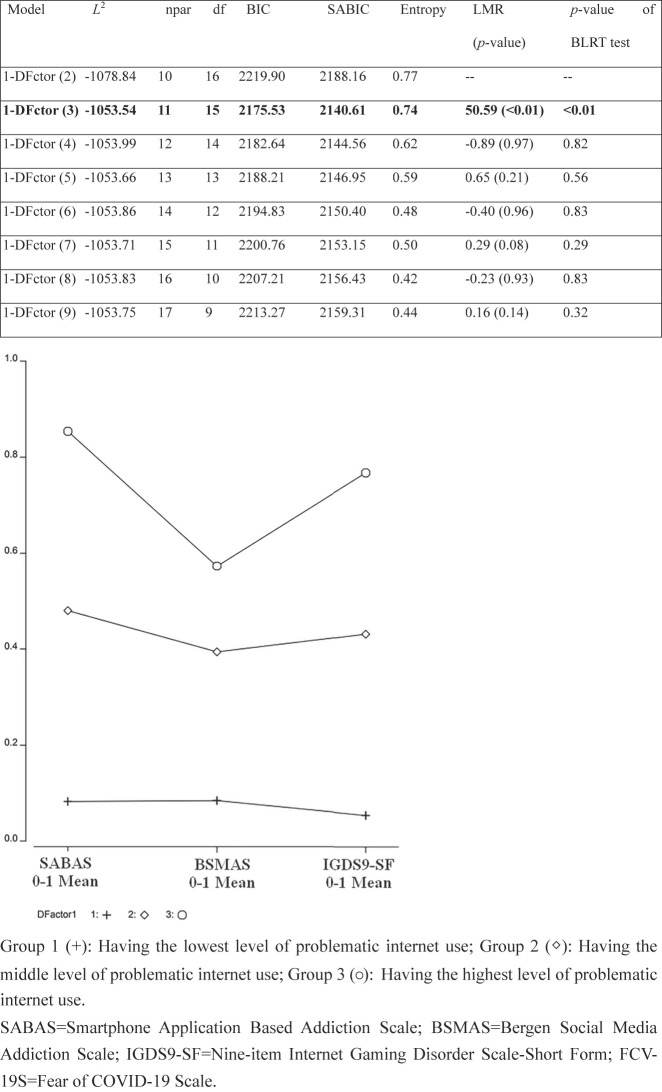
A total of 504 Chinese schoolchildren completed measures concerning problematic internet use and psychological distress across three time-points. Latent class analysis (LCA) was used to classify participants into three groups of problematic internet use comprising Group 1 (lowest level), Group 2 (moderate level), and Group 3 (highest level).

RESULTS

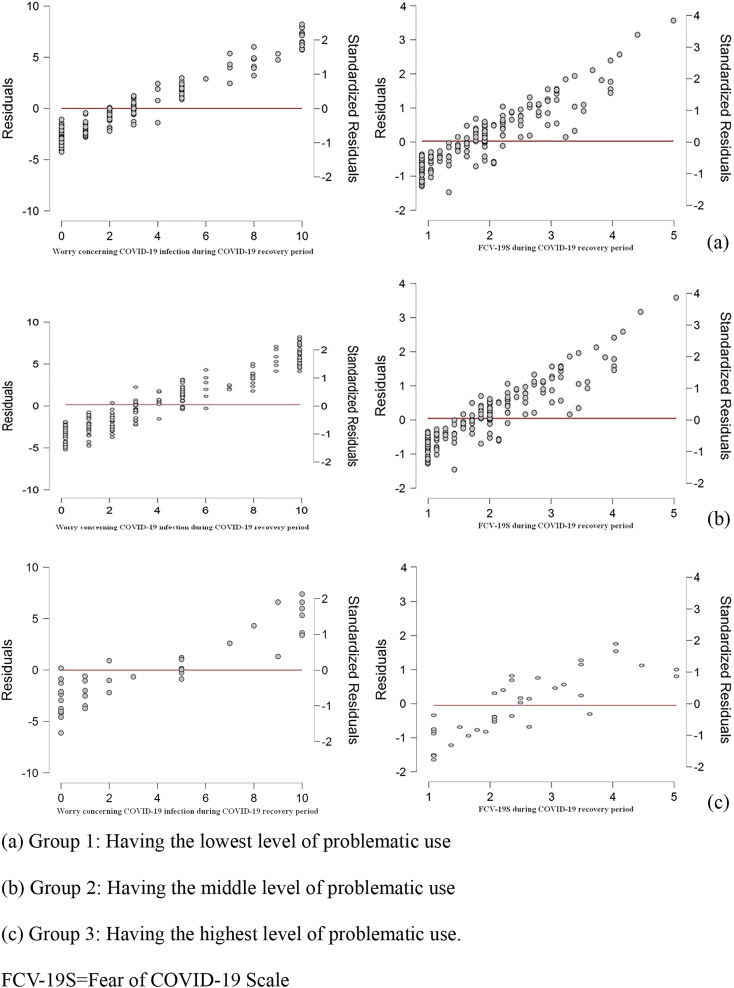
Statistical analyses showed that as problematic use of internet-related activities declined among Group 3 participants across the three time points, participants in Group 1 and Group 2 had increased problematic use of internet-related activities. Although there was no between-group difference in relation to worrying concerning COVID-19 infection, Groups 2 and 3 had significantly higher levels of fear of COVID-19 than Group 1 during the COVID-19 recovery period. Regression analysis showed that change in problematic internet use predicted fear of COVID-19 during the recovery period.

CONCLUSION

The varied levels of problematic internet use among schoolchildren reflect different changing trends of additive behaviors during COVID-19 outbreak and recovery periods.

摘要

背景和目的

本纵向研究考察了在三个时间点(新冠疫情爆发前、新冠疫情爆发初期和新冠疫情恢复期),问题性互联网使用(问题性智能手机使用、问题性社交媒体使用和问题性游戏)和与新冠疫情相关的心理困扰(对新冠病毒的恐惧和对新冠病毒的担忧)的变化情况。

方法

共有 504 名中国学童在三个时间点完成了关于问题性互联网使用和心理困扰的测量。潜类别分析(LCA)用于将参与者分为三组问题性互联网使用,包括第 1 组(最低水平)、第 2 组(中等水平)和第 3 组(最高水平)。

结果

统计分析表明,随着第 3 组参与者在三个时间点上网相关活动的问题性使用减少,第 1 组和第 2 组参与者的上网相关活动问题性使用增加。尽管在对新冠病毒感染的担忧方面,各组之间没有差异,但在新冠疫情恢复期,第 2 组和第 3 组的对新冠病毒的恐惧程度明显高于第 1 组。回归分析表明,问题性互联网使用的变化预测了恢复期对新冠病毒的恐惧。

结论

学童中不同程度的问题性互联网使用反映了在新冠疫情爆发和恢复期期间,附加行为的不同变化趋势。
https://cdn.ncbi.nlm.nih.gov/pmc/blobs/3ee0/8997210/abad8fb644f3/jba-10-731-g003.jpg
https://cdn.ncbi.nlm.nih.gov/pmc/blobs/3ee0/8997210/3136c16919c8/jba-10-731-g001.jpg
https://cdn.ncbi.nlm.nih.gov/pmc/blobs/3ee0/8997210/1a5e9043cc80/jba-10-731-g002.jpg
https://cdn.ncbi.nlm.nih.gov/pmc/blobs/3ee0/8997210/abad8fb644f3/jba-10-731-g003.jpg
https://cdn.ncbi.nlm.nih.gov/pmc/blobs/3ee0/8997210/3136c16919c8/jba-10-731-g001.jpg
https://cdn.ncbi.nlm.nih.gov/pmc/blobs/3ee0/8997210/1a5e9043cc80/jba-10-731-g002.jpg
https://cdn.ncbi.nlm.nih.gov/pmc/blobs/3ee0/8997210/abad8fb644f3/jba-10-731-g003.jpg

相似文献

1
Internet addiction and psychological distress among Chinese schoolchildren before and during the COVID-19 outbreak: A latent class analysis.新冠疫情前后中国中小学生的网络成瘾和心理困扰:潜在类别分析。
J Behav Addict. 2021 Sep 15;10(3):731-746. doi: 10.1556/2006.2021.00052.
2
Problematic internet-related behaviors mediate the associations between levels of internet engagement and distress among schoolchildren during COVID-19 lockdown: A longitudinal structural equation modeling study.网络成瘾行为在新冠疫情封锁期间儿童的网络使用水平与困扰之间的关系中起中介作用:一项纵向结构方程模型研究。
J Behav Addict. 2021 Feb 10;10(1):135-148. doi: 10.1556/2006.2021.00006.
3
Internet-Related Behaviors and Psychological Distress Among Schoolchildren During the COVID-19 School Hiatus.新冠疫情学校停课后,中小学生的网络相关行为与心理困扰。
Cyberpsychol Behav Soc Netw. 2021 Oct;24(10):654-663. doi: 10.1089/cyber.2020.0497. Epub 2021 Apr 20.
4
Psychological distress and internet-related behaviors between schoolchildren with and without overweight during the COVID-19 outbreak.新冠疫情期间,超重和非超重学龄儿童的心理困扰和网络相关行为比较。
Int J Obes (Lond). 2021 Mar;45(3):677-686. doi: 10.1038/s41366-021-00741-5. Epub 2021 Jan 25.
5
The Relationship Between Children's Problematic Internet-related Behaviors and Psychological Distress During the Onset of the COVID-19 Pandemic: A Longitudinal Study.新冠疫情期间儿童问题性互联网使用行为与心理困扰的关系:一项纵向研究。
J Addict Med. 2022;16(2):e73-e80. doi: 10.1097/ADM.0000000000000845.
6
Comparing generalized and specific problematic smartphone/internet use: Longitudinal relationships between smartphone application-based addiction and social media addiction and psychological distress.比较广义和狭义的智能手机/网络使用问题:基于智能手机应用的成瘾和社交媒体成瘾与心理困扰之间的纵向关系。
J Behav Addict. 2020 Jun 26;9(2):410-419. doi: 10.1556/2006.2020.00023. Print 2020 Jun.
7
Rates and psychological stress predictors of problematic internet use (PIU) during the COVID-19 pandemic in a racially diverse sample of young adults.在一个种族多样化的年轻成年人样本中,COVID-19 大流行期间出现问题性互联网使用 (PIU) 的比率和心理压力预测因素。
Anxiety Stress Coping. 2024 Nov;37(6):775-793. doi: 10.1080/10615806.2024.2383766. Epub 2024 Jul 31.
8
Psychological distress and internet addiction following the COVID-19 outbreak: Fear of missing out and boredom proneness as mediators.新冠疫情后心理困扰和网络成瘾:错过恐惧和无聊易感性作为中介因素。
Arch Psychiatr Nurs. 2022 Oct;40:8-14. doi: 10.1016/j.apnu.2022.03.007. Epub 2022 Mar 20.
9
COVID-19-Related Social Isolation Predispose to Problematic Internet and Online Video Gaming Use in Italy.意大利的研究表明,新冠疫情相关的社交隔离可能导致人们出现网络成瘾和在线游戏成瘾问题。
Int J Environ Res Public Health. 2022 Jan 29;19(3):1539. doi: 10.3390/ijerph19031539.
10
Examining the Associations between COVID-19-Related Psychological Distress, Social Media Addiction, COVID-19-Related Burnout, and Depression among School Principals and Teachers through Structural Equation Modeling.通过结构方程模型检验中学校长和教师的 COVID-19 相关心理困扰、社交媒体成瘾、COVID-19 相关倦怠与抑郁之间的关联。
Int J Environ Res Public Health. 2022 Feb 10;19(4):1951. doi: 10.3390/ijerph19041951.

引用本文的文献

1
The Longitudinal Effect of Psychological Distress on Internet Addiction Symptoms Among Chinese College Students: Cross-Lagged Panel Network Analysis.心理困扰对中国大学生网络成瘾症状的纵向影响:交叉滞后面板网络分析
J Med Internet Res. 2025 May 2;27:e70680. doi: 10.2196/70680.
2
Digital Media Usage Trends Among Children Aged 8-11 Years Before and After the COVID-19.新冠疫情前后8至11岁儿童的数字媒体使用趋势
Psychiatry Investig. 2025 Apr;22(4):375-381. doi: 10.30773/pi.2024.0109. Epub 2025 Apr 11.
3
Internet addiction among adolescents during the COVID-19 pandemic: Associations with sociodemographic and psychological distress.

本文引用的文献

1
Internet-Related Behaviors and Psychological Distress Among Schoolchildren During the COVID-19 School Hiatus.新冠疫情学校停课后,中小学生的网络相关行为与心理困扰。
Cyberpsychol Behav Soc Netw. 2021 Oct;24(10):654-663. doi: 10.1089/cyber.2020.0497. Epub 2021 Apr 20.
2
The Relationship Between Children's Problematic Internet-related Behaviors and Psychological Distress During the Onset of the COVID-19 Pandemic: A Longitudinal Study.新冠疫情期间儿童问题性互联网使用行为与心理困扰的关系:一项纵向研究。
J Addict Med. 2022;16(2):e73-e80. doi: 10.1097/ADM.0000000000000845.
3
Fear of COVID-19 Scale (FCV-19S) across countries: Measurement invariance issues.
青少年在 COVID-19 大流行期间的网络成瘾:与社会人口统计学和心理困扰的关联。
PeerJ. 2024 Jun 28;12:e17489. doi: 10.7717/peerj.17489. eCollection 2024.
4
Prevalence of smartphone addiction and its relation with psychological distress and internet gaming disorder among medical college students.医学生智能手机成瘾与心理困扰及网络成瘾障碍的相关性研究。
Front Public Health. 2024 Jun 3;12:1362121. doi: 10.3389/fpubh.2024.1362121. eCollection 2024.
5
Game-related behaviors among children and adolescents after school closure during the COVID-19 pandemic: A cross-sectional study.新冠疫情期间学校关闭后儿童和青少年的游戏相关行为:一项横断面研究。
PCN Rep. 2022 Aug 29;1(3):e37. doi: 10.1002/pcn5.37. eCollection 2022 Sep.
6
Effects of Long COVID on Psycho-Physical Conditions in the Italian Population: A Statistical and Large Language Model Combined Description.长期新冠对意大利人群心理生理状况的影响:统计与大语言模型相结合的描述
Eur J Investig Health Psychol Educ. 2024 Apr 27;14(5):1153-1170. doi: 10.3390/ejihpe14050076.
7
Relationship between loneliness and internet addiction: a meta-analysis.孤独感与网瘾的关系:一项荟萃分析。
BMC Public Health. 2024 Mar 19;24(1):858. doi: 10.1186/s12889-024-18366-4.
8
Parental intention on getting children COVID-19 vaccinations: Invariance evaluation across parenting roles and COVID-19-like symptoms experiences among Iranians during the pandemic period.父母让子女接种 COVID-19 疫苗的意愿:在大流行期间,伊朗父母在不同育儿角色和 COVID-19 样症状体验方面的不变性评估。
Hum Vaccin Immunother. 2024 Dec 31;20(1):2325230. doi: 10.1080/21645515.2024.2325230. Epub 2024 Mar 6.
9
Confounding analysis with gaming aspects in predicting psychological distress of esports players.对电竞选手心理困扰进行游戏因素混杂分析预测。
Psych J. 2024 Aug;13(4):541-551. doi: 10.1002/pchj.728. Epub 2024 Feb 1.
10
Problematic Use of Internet Among Indonesia University Students: Psychometric Evaluation of Bergen Social Media Addiction Scale and Internet Gaming Disorder Scale-Short Form.印度尼西亚大学生互联网使用问题:卑尔根社交媒体成瘾量表和互联网游戏障碍量表简版的心理测量评估
Psychiatry Investig. 2023 Dec;20(12):1103-1111. doi: 10.30773/pi.2022.0304. Epub 2023 Dec 18.
新冠恐惧量表(FCV-19S)在各国的应用:测量不变性问题。
Nurs Open. 2021 Jul;8(4):1892-1908. doi: 10.1002/nop2.855. Epub 2021 Mar 21.
4
Psychological distress associated with the COVID-19 lockdown: A two-wave network analysis.与 COVID-19 封锁相关的心理困扰:两波网络分析。
J Affect Disord. 2021 Apr 1;284:18-26. doi: 10.1016/j.jad.2021.02.016. Epub 2021 Feb 5.
5
Psychological distress and internet-related behaviors between schoolchildren with and without overweight during the COVID-19 outbreak.新冠疫情期间,超重和非超重学龄儿童的心理困扰和网络相关行为比较。
Int J Obes (Lond). 2021 Mar;45(3):677-686. doi: 10.1038/s41366-021-00741-5. Epub 2021 Jan 25.
6
The Association Between Health Status and Insomnia, Mental Health, and Preventive Behaviors: The Mediating Role of Fear of COVID-19.健康状况与失眠、心理健康及预防行为之间的关联:对新冠病毒的恐惧的中介作用
Gerontol Geriatr Med. 2020 Oct 26;6:2333721420966081. doi: 10.1177/2333721420966081. eCollection 2020 Jan-Dec.
7
Systematic Review of the Literature About the Effects of the COVID-19 Pandemic on the Lives of School Children.关于新冠疫情对学童生活影响的文献系统综述
Front Psychol. 2020 Oct 14;11:569348. doi: 10.3389/fpsyg.2020.569348. eCollection 2020.
8
Internet gaming as a coping method among schizophrenic patients facing psychological distress.网络成瘾作为精神分裂症患者面对心理困扰时的一种应对方法。
J Behav Addict. 2020 Nov 30;9(4):1022-1031. doi: 10.1556/2006.2020.00081.
9
Depression, anxiety, and stress mediate the associations between internet gaming disorder, insomnia, and quality of life during the COVID-19 outbreak.在新冠疫情期间,抑郁、焦虑和压力介导了网络游戏障碍、失眠与生活质量之间的关联。
Addict Behav Rep. 2020 Dec;12:100307. doi: 10.1016/j.abrep.2020.100307. Epub 2020 Oct 22.
10
The Impact of Physical Distancing and Associated Factors Towards Internet Addiction Among Adults in Indonesia During COVID-19 Pandemic: A Nationwide Web-Based Study.新冠疫情期间身体距离措施及相关因素对印度尼西亚成年人网络成瘾的影响:一项基于网络的全国性研究
Front Psychiatry. 2020 Sep 3;11:580977. doi: 10.3389/fpsyt.2020.580977. eCollection 2020.