Meth Elisa M S, van Egmond Lieve T, Moulin Thiago C, Cedernaes Jonathan, Rosqvist Fredrik, Benedict Christian
Department of Surgical Sciences, Uppsala University, Uppsala, Sweden.
Department of Experimental Medical Science, Lund University, Lund, Sweden.
Front Nutr. 2022 May 10;9:889926. doi: 10.3389/fnut.2022.889926. eCollection 2022.
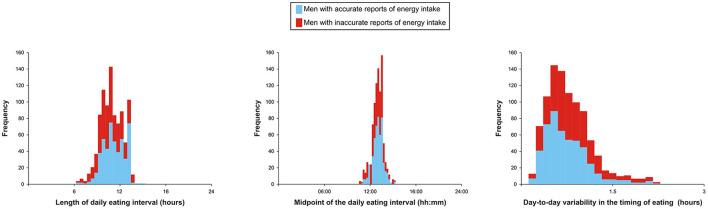
Meal timing has significant effects on health. However, whether meal timing is associated with the risk of developing and dying of cancer is not well-researched in humans. In the present study, we used data from 941 community-dwelling men aged 71 years who participated in the Uppsala Longitudinal Study of Adult Men to examine the association of meal timing with cancer morbidity and fatal cancer. The following meal timing variables were derived from 7-day food diaries: (i) daily eating duration, i.e., the time between the first and last eating episode of an arbitrary day; (ii) the calorically weighted midpoint of the daily eating interval, a proxy of when the eating window typically occurs during an arbitrary day; and (iii) the day-to-day variability in the timing of eating. We also assessed the reported daily energy intake reliability using the Goldberg method. During a mean observational period of 13.4 years, 277 men (29.4%) were diagnosed with cancer. Furthermore, 191 men (20%) died from cancer during 14.7 years of follow-up. As shown by Cox regression adjusted for potential confounders (e.g., smoking status and daily energy intake), men with reliable dietary reports whose daily eating intervals were on average 13 h long had a 2.3-fold greater fatal cancer risk than men whose daily eating windows were on average about 11 h long. We also found that men with an average day-to-day variability in the timing of eating of 48 to 74 min had a 2- to 2.2-fold higher fatal cancer risk than those with the lowest average day-to-day variability in the timing of eating (i.e., 23 min). No clear associations were found in men with inadequate dietary reports, emphasizing the need to consider the reliability of dietary records in nutritional epidemiology. To fully unlock its potential, studies are needed to test whether recommendations to time-restrict the 24-h eating interval and reduce day-to-day variability in the timing of eating can meaningfully alter the risk of death due to cancer.
进餐时间对健康有重大影响。然而,进餐时间与患癌风险及癌症致死风险之间的关联在人类研究中尚未得到充分探究。在本研究中,我们使用了来自941名71岁社区男性的数据,这些男性参与了乌普萨拉成年男性纵向研究,以检验进餐时间与癌症发病率及致命性癌症之间的关联。以下进餐时间变量源自7天的饮食日记:(i)每日进食时长,即任意一天中第一餐与最后一餐之间的时间;(ii)每日进食间隔的热量加权中点,可作为任意一天中进食窗口通常出现时间的替代指标;(iii)进食时间的每日变化。我们还使用戈德堡方法评估了报告的每日能量摄入可靠性。在平均13.4年的观察期内,277名男性(29.4%)被诊断患有癌症。此外,在14.7年的随访期间,191名男性(20%)死于癌症。经潜在混杂因素(如吸烟状况和每日能量摄入)调整后的Cox回归分析显示,饮食报告可靠且每日进食间隔平均为13小时的男性,其致命性癌症风险比每日进食窗口平均约为11小时的男性高2.3倍。我们还发现,进食时间每日平均变化在48至74分钟的男性,其致命性癌症风险比进食时间每日平均变化最低(即23分钟)的男性高2至2.2倍。在饮食报告不充分的男性中未发现明确关联,这凸显了在营养流行病学中考虑饮食记录可靠性的必要性。为了充分发挥其潜力,需要开展研究来检验限制24小时进食间隔时间及减少进食时间每日变化的建议是否能切实改变癌症致死风险。