Van Cutsem Jeroen, Pattyn Nathalie, Mairesse Olivier, Delwiche Bérénice, Fernandez Tellez Helio, Van Puyvelde Martine, Lacroix Emilie, McDonnell Adam C, Eiken Ola, Mekjavic Igor B
VIPER Research Unit, Royal Military Academy, Brussels, Belgium.
Human Physiology and Sports Physiotherapy Research Group, Vrije Universiteit Brussel, Brussels, Belgium.
Front Neurosci. 2022 May 10;16:852741. doi: 10.3389/fnins.2022.852741. eCollection 2022.
Hypobaric hypoxic habitats are currently being touted as a potential solution to minimise decompression procedures in preparation for extra vehicular activities during future space missions. Since astronauts will live in hypoxic environments for the duration of such missions, the present study sought to elucidate the separate and combined effects of inactivity [simulated with the experimental bed rest (BR) model] and hypoxia on sleep characteristics in women.
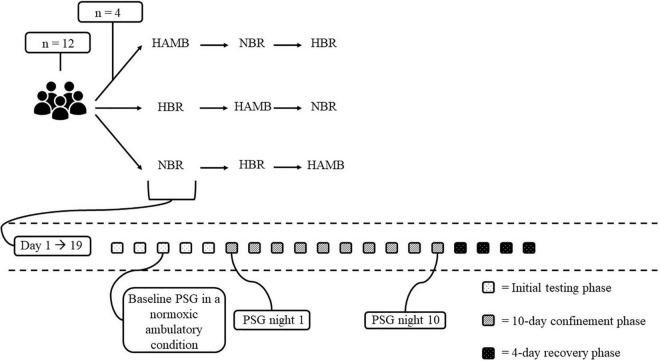
Twelve women (Age = 27 ± 3 year) took part in three 10-day interventions, in a repeated measures cross-over counterbalanced design: (1) normobaric normoxic BR (NBR), (2) normobaric hypoxic BR (HBR; simulated altitude of 4,000 m), and (3) normobaric hypoxic ambulatory (HAMB; 4,000 m) confinement, during which sleep was assessed on night 1 and night 10 with polysomnography. In addition, one baseline sleep assessment was performed. This baseline assessment, although lacking a confinement aspect, was included statistically as a fourth comparison (i.e., pseudo normobaric normoxic ambulatory; pNAMB) in the present study.
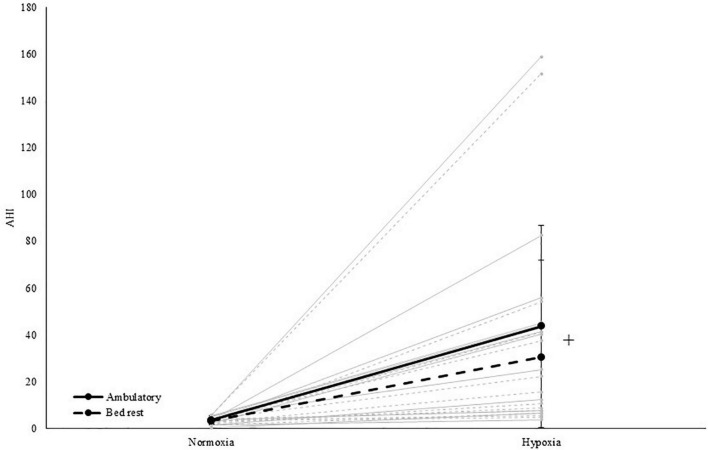
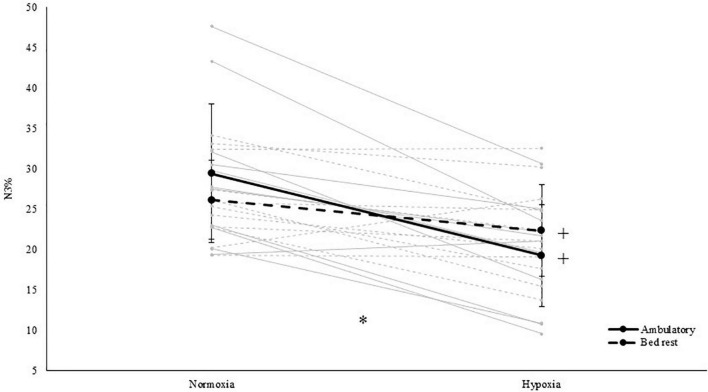
Hypoxia decreased sleep efficiency ( = 0.019), increased N1% sleep ( = 0.030), decreased N3 sleep duration ( = 0.003), and increased apnea hypopnea index ( < 0.001). BR impaired sleep maintenance, efficiency, and architecture [e.g., N2% sleep increased ( = 0.033)]. Specifically, for N3% sleep, the effects of partial pressure of oxygen and activity interacted. Hypoxia decreased N3% sleep both when active (pNAMB vs HAMB; < 0.001) and inactive (NBR vs HBR; = 0.021), however, this decrease was attenuated in the inactive state (-3.8%) compared to the active state (-10.2%).
A 10-day exposure to hypoxia and BR negatively impacted sleep on multiple levels as in macrostructure, microstructure and respiratory functioning. Interestingly, hypoxia appeared to have less adverse effects on sleep macrostructure while the participants were inactive (bed ridden) compared to when ambulatory. Data were missing to some extent (i.e., 20.8%). Therefore, multiple imputation was used, and our results should be considered as exploratory.
目前,低压低氧环境被视为一种潜在的解决方案,可尽量减少未来太空任务期间舱外活动准备过程中的减压程序。由于宇航员在这类任务期间将长期生活在低氧环境中,本研究旨在阐明不活动状态(用实验性卧床休息(BR)模型模拟)和低氧对女性睡眠特征的单独及联合影响。
12名女性(年龄 = 27 ± 3岁)参与了三项为期10天的干预,采用重复测量交叉平衡设计:(1)常压常氧卧床休息(NBR),(2)常压低氧卧床休息(HBR;模拟海拔4000米),以及(3)常压低氧活动受限(HAMB;4000米),在此期间,在第1天和第10天通过多导睡眠图评估睡眠情况。此外,还进行了一次基线睡眠评估。本次基线评估虽然缺少受限这一方面,但在本研究中作为第四个比较(即假常压常氧活动;pNAMB)纳入统计分析。
低氧降低了睡眠效率( = 0.019),增加了N1期睡眠比例( = 0.030),缩短了N3期睡眠时间( = 0.003),并增加了呼吸暂停低通气指数( < 0.001)。卧床休息损害了睡眠维持、效率和结构[例如,N2期睡眠比例增加( = 0.033)]。具体而言,对于N3期睡眠比例,氧分压和活动的影响存在交互作用。低氧在活动状态(pNAMB与HAMB比较; < 0.001)和不活动状态(NBR与HBR比较; = 0.021)下均降低了N3期睡眠比例,然而,与活动状态(-10.2%)相比,不活动状态下这种降低幅度有所减弱(-3.8%)。
为期10天的低氧和卧床休息暴露在多个层面(如宏观结构、微观结构和呼吸功能)对睡眠产生了负面影响。有趣的是,与活动时相比,参与者不活动(卧床)时低氧对睡眠宏观结构的不良影响似乎较小。数据在一定程度上缺失(即20.8%)。因此,采用了多重填补法,我们的结果应被视为探索性的。