Grupo de Investigación en Alimentación y Nutrición Humana (GIANH), Escuela Superior Politécnica de Chimborazo, Riobamba, 060101, Ecuador.
Grupo de investigación en Nutrición, Dietética, Biotecnología y Análisis de Alimentos (GINDBA), Universidad Estatal de Milagro, 091050, Ecuador.
Clin Nutr ESPEN. 2022 Jun;49:314-318. doi: 10.1016/j.clnesp.2022.03.030. Epub 2022 Apr 20.
Stress-related to self-isolation during the COVID-19 pandemic has shown a strong correlation with issues in the diet and health of the population. In this study, we aimed to relate the perceived stress of a group of Ecuadorian adults with emotional eating.
Cross-sectional design study. We applied validated questionnaires of perceived stress and emotional eating to adults of both sexes who virtually completed a form between the months of January and March 2021. The analyzes were carried out using Chi2 statistical tests, Student's t-tests and a multiple linear regression model., the analyzes were performed using the statistical software R.
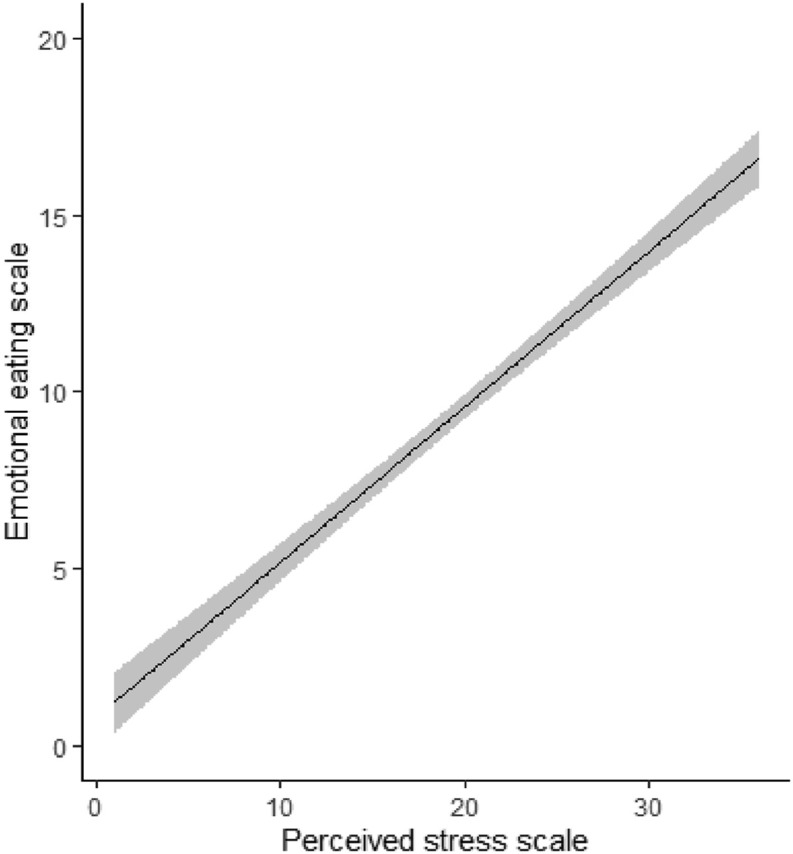
The sample was composed of 2333 participants, the median age was 25 years (interquartile range 21-37 years). Females reported more perceived stress than males (77.91% vs. 22.09%). Nearly 64% of participants who displayed perceived stress were emotional eaters. A statistically significant association was found between the emotional eating score and perceived stress (p < 0.001), the effect was an elevation of 0.44 points in the emotional eating score for each stress point perceived. For each unit increase in BMI the emotional eating score increased 0.26 units (p < 0.001) and for each unit increase in age the emotional eating score decreased by 0.27 units (p = 0.03).
It is concluded that stress is associated to emotional eating. Dietary intake that responds to emotions and not to physiological hunger may have long-term problems related to unhealthy diet. It is recommended to consider stress and emotional eating in the nutritional care process of people.
在 COVID-19 大流行期间,与自我隔离相关的压力与人口饮食和健康问题密切相关。在这项研究中,我们旨在将一组厄瓜多尔成年人的感知压力与情绪化进食联系起来。
横断面设计研究。我们对男女两性成年人应用经过验证的感知压力和情绪化进食问卷,他们在 2021 年 1 月至 3 月期间在线填写了一份表格。使用卡方统计检验、学生 t 检验和多元线性回归模型进行分析。使用 R 统计软件进行分析。
样本由 2333 名参与者组成,中位数年龄为 25 岁(四分位距 21-37 岁)。女性报告的感知压力高于男性(77.91%比 22.09%)。近 64%的感知压力较大的参与者是情绪化进食者。情绪性进食评分与感知压力之间存在统计学显著关联(p<0.001),每增加 1 个感知压力点,情绪性进食评分平均增加 0.44 分。BMI 每增加 1 个单位,情绪性进食评分增加 0.26 个单位(p<0.001),年龄每增加 1 个单位,情绪性进食评分减少 0.27 个单位(p=0.03)。
结论是压力与情绪化进食有关。对情绪而不是生理饥饿做出反应的饮食摄入可能会导致与不健康饮食相关的长期问题。建议在对人们进行营养护理过程中考虑压力和情绪化进食。