Elhady Sameh S, Abdelhameed Reda F A, Mehanna Eman T, Wahba Alaa Samir, Elfaky Mahmoud A, Koshak Abdulrahman E, Noor Ahmad O, Bogari Hanin A, Malatani Rania T, Goda Marwa S
Department of Natural Products, Faculty of Pharmacy, King Abdulaziz University, Jeddah 21589, Saudi Arabia.
Department of Pharmacognosy, Faculty of Pharmacy, Galala University, New Galala 43713, Egypt.
Antioxidants (Basel). 2022 Apr 22;11(5):819. doi: 10.3390/antiox11050819.
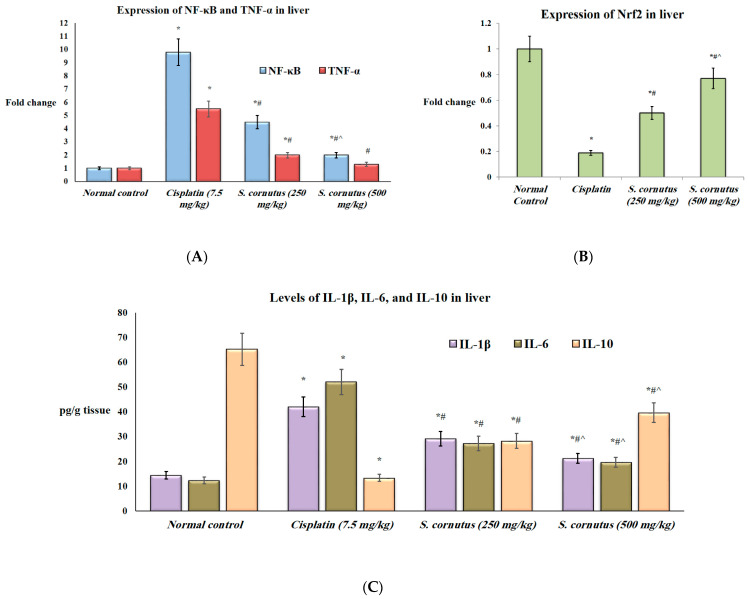
(Asteraceae) is a wild. edible plant that represents a plentiful source of polyphenolic compounds. For the first time, the metabolic analysis profiling demonstrated the presence of anthocyanidin glycosides, coumarins, flavonoids and their corresponding glycosides, and phenolic acids. The total phenolic compounds were determined to be 206.28 ± 14.64 mg gallic acid equivalent/gm, while flavonoids were determined to be 45.56 ± 1.78 mg quercetin equivalent/gm. The crude extract of exhibited a significant 1,1-diphenyl-2-picrylhydrazyl free radical scavenging effect with half-maximal inhibitory concentration (IC) of 16.10 ± 2.14 µg/mL compared to ascorbic acid as a standard (10.64 ± 0.82 µg/mL). In vitro total antioxidant capacity and ferric reducing power capacity assays revealed a promising reducing potential of extract. Therefore, the possible protective effects of against hepatic and renal toxicity induced by cisplatin in experimental mice were investigated. significantly ameliorated the cisplatin-induced disturbances in liver and kidney functions and oxidative stress, decreased MDA, ROS, and NO levels, and restored CAT and SOD activities. Besides, it reversed cisplatin-driven upregulation in inflammatory markers, including iNOS, IL-6, and IL-1β levels and NF-κB and TNF-α expression, and elevated anti-inflammatory IL-10 levels and Nrf2 expression. Additionally, the extract mitigated cisplatin alteration in apoptotic (Bax and caspase-3) and anti-apoptotic (Bcl-2) proteins. Interestingly, hepatic, and renal histopathology revealed the protective impacts of against -induced pathological changes. Our findings guarantee a protective effect of against cisplatin-induced hepatic and renal damage via modulating oxidative stress, inflammation, and apoptotic pathways.
菊科植物是一种野生可食用植物,是多酚类化合物的丰富来源。首次通过代谢分析谱证明了花青素苷、香豆素、黄酮类及其相应糖苷和酚酸的存在。总酚化合物含量测定为206.28±14.64毫克没食子酸当量/克,而黄酮类化合物含量测定为45.56±1.78毫克槲皮素当量/克。与作为标准的抗坏血酸(10.64±0.82微克/毫升)相比,该植物的粗提物表现出显著的1,1-二苯基-2-苦基肼自由基清除作用,半数抑制浓度(IC)为16.10±2.14微克/毫升。体外总抗氧化能力和铁还原能力测定显示该植物提取物具有良好的还原潜力。因此,研究了该植物对实验小鼠顺铂诱导的肝毒性和肾毒性的可能保护作用。该植物显著改善了顺铂诱导的肝功能和肾功能紊乱以及氧化应激,降低了丙二醛、活性氧和一氧化氮水平,并恢复了过氧化氢酶和超氧化物歧化酶活性。此外,它逆转了顺铂驱动的炎症标志物上调,包括诱导型一氧化氮合酶、白细胞介素-6和白细胞介素-1β水平以及核因子-κB和肿瘤坏死因子-α表达,并提高了抗炎性白细胞介素-10水平和核因子E2相关因子2表达。此外,该提取物减轻了顺铂对凋亡(Bax和半胱天冬酶-3)和抗凋亡(Bcl-2)蛋白的改变。有趣的是,肝脏和肾脏组织病理学显示该植物对顺铂诱导的病理变化具有保护作用。我们的研究结果证实了该植物通过调节氧化应激、炎症和凋亡途径对顺铂诱导的肝损伤和肾损伤具有保护作用。