
经颅直流电刺激效应的个体间差异:关于稳定、可变和情境因素贡献的叙述性综述
Inter-Individual Variability in tDCS Effects: A Narrative Review on the Contribution of Stable, Variable, and Contextual Factors.
作者信息
Vergallito Alessandra, Feroldi Sarah, Pisoni Alberto, Romero Lauro Leonor J
机构信息
Department of Psychology & NeuroMi, University of Milano Bicocca, 20126 Milano, Italy.
School of Medicine and Surgery, University of Milano-Bicocca, 20854 Monza, Italy.
出版信息
Brain Sci. 2022 Apr 20;12(5):522. doi: 10.3390/brainsci12050522.
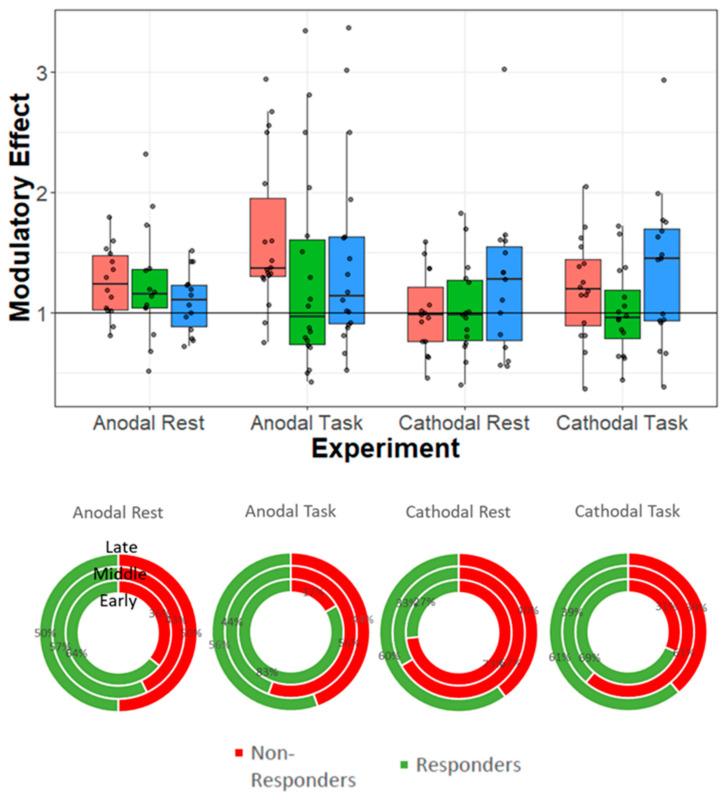
Due to its safety, portability, and cheapness, transcranial direct current stimulation (tDCS) use largely increased in research and clinical settings. Despite tDCS's wide application, previous works pointed out inconsistent and low replicable results, sometimes leading to extreme conclusions about tDCS's ineffectiveness in modulating behavioral performance across cognitive domains. Traditionally, this variability has been linked to significant differences in the stimulation protocols across studies, including stimulation parameters, target regions, and electrodes montage. Here, we reviewed and discussed evidence of heterogeneity emerging at the intra-study level, namely inter-individual differences that may influence the response to tDCS within each study. This source of variability has been largely neglected by literature, being results mainly analyzed at the group level. Previous research, however, highlighted that only a half-or less-of studies' participants could be classified as responders, being affected by tDCS in the expected direction. Stable and variable inter-individual differences, such as morphological and genetic features vs. hormonal/exogenous substance consumption, partially account for this heterogeneity. Moreover, variability comes from experiments' contextual elements, such as participants' engagement/baseline capacity and individual task difficulty. We concluded that increasing knowledge on inter-dividual differences rather than undermining tDCS effectiveness could enhance protocols' efficiency and reproducibility.
由于其安全性、便携性和低成本,经颅直流电刺激(tDCS)在研究和临床环境中的使用大幅增加。尽管tDCS应用广泛,但先前的研究指出其结果不一致且可重复性低,有时甚至得出关于tDCS在调节跨认知领域行为表现方面无效的极端结论。传统上,这种变异性与各研究中刺激方案的显著差异有关,包括刺激参数、目标区域和电极配置。在此,我们回顾并讨论了研究内部层面出现的异质性证据,即个体间差异,这些差异可能会影响每项研究中对tDCS的反应。这种变异性来源在很大程度上被文献所忽视,因为结果主要是在组水平上进行分析的。然而,先前的研究强调,只有一半或更少的研究参与者可被归类为反应者,即受到tDCS预期方向的影响。稳定和可变的个体间差异,如形态和遗传特征与激素/外源性物质消耗,部分解释了这种异质性。此外,变异性还来自实验的背景因素,如参与者的参与度/基线能力和个体任务难度。我们得出结论,增加对个体间差异的了解而非削弱tDCS的有效性,可以提高方案的效率和可重复性。
 Zotero 插件