Department of Periodontology, Faculty of Dentistry, Kanagawa Dental University, 82 Inaoka-cho, Yokosuka 238-8580, Japan.
Departments of Periodontology and Research Institute of Oral Science, Nihon University School of Dentistry at Matsudo, 2-870-1 Sakaecho-nishi, Matsudo 271-8587, Japan.
Biomolecules. 2022 May 18;12(5):719. doi: 10.3390/biom12050719.
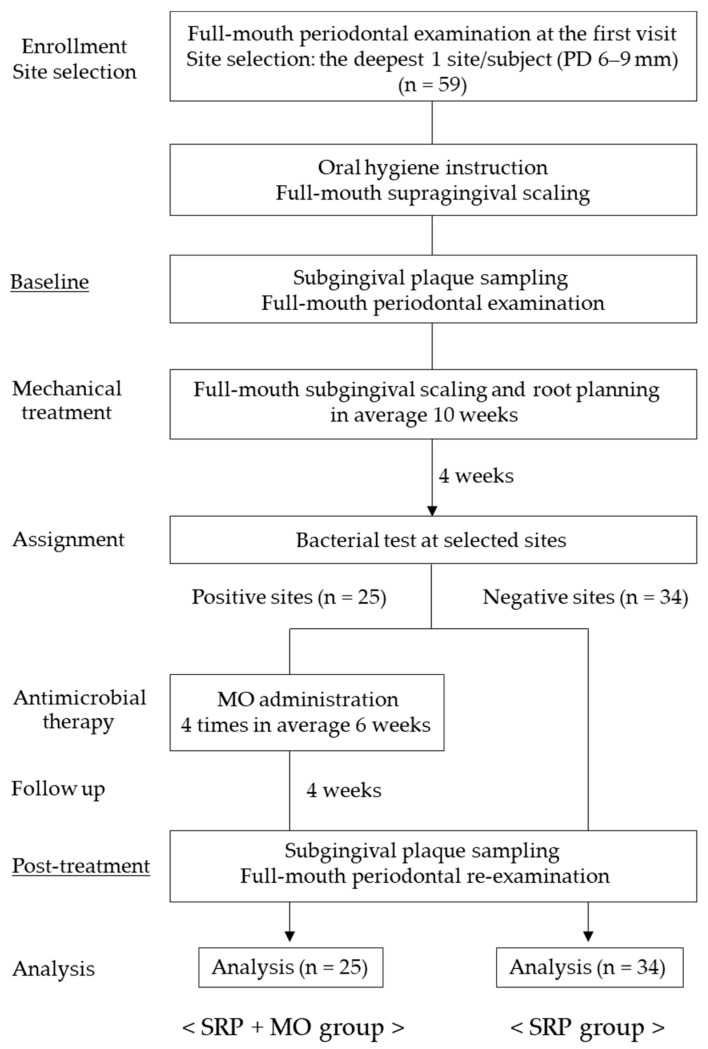
This prospective pilot study aimed to evaluate the effect of minocycline-HCl ointment (MO), locally delivered as an adjunct to scaling and root planing (SRP), on subgingival microflora. A total of 59 periodontitis patients received SRP as an initial periodontal therapy. In the selected periodontal pockets with probing depths (PD) of 6−9 mm, the sites that exhibited a positive reaction following a bacterial test using an immunochromatographic device were subsequently treated with MO (SRP + MO group, n = 25). No additional treatment was performed at sites showing a negative reaction (SRP group, n = 34). In addition to subgingival plaque sampling, measurement of clinical parameters including PD, clinical attachment level (CAL), bleeding on probing (BOP), plaque index and gingival index (GI) were performed at baseline and 4 weeks after the initial periodontal therapy. The subgingival microflora were assessed by terminal restriction fragment-length polymorphism analysis. Relative to baseline values, the mean scores for PD-, CAL-, BOP-, and GI-sampled sites were significantly decreased post treatment in both groups (p < 0.01). The intra-comparisons showed a significant decrease in the counts of the genera Eubacterium, Parvimonas, Filifactor, Veillonella, Fusobacterium, Porphyromonas, Prevotella, and unknown species in the SRP + MO group (p < 0.05). Inter-comparisons indicated a significant decrease in the genera Veillonella in the SRP + MO group (p = 0.01). Combination therapy of SRP and local MO induced a change in the subgingival microbial community: particularly, the number of Veillonella spp. was markedly reduced.
本前瞻性初步研究旨在评估盐酸米诺环素软膏(MO)作为辅助牙周刮治和根面平整(SRP)的局部给药对龈下微生物群的影响。共有 59 名牙周炎患者接受 SRP 作为初始牙周治疗。在具有 6-9mm 探诊深度(PD)的选定牙周袋中,使用免疫层析设备进行细菌测试后呈现阳性反应的部位随后用 MO 治疗(SRP+MO 组,n=25)。在呈现阴性反应的部位(SRP 组,n=34)未进行额外的治疗。除了龈下菌斑采样外,在初始牙周治疗后 4 周时还进行了包括 PD、临床附着水平(CAL)、探诊出血(BOP)、菌斑指数和牙龈指数(GI)在内的临床参数的测量。通过末端限制性片段长度多态性分析评估龈下微生物群。与基线值相比,两组治疗后 PD、CAL、BOP 和 GI 取样部位的平均评分均显著降低(p<0.01)。组内比较显示 SRP+MO 组中 Eubacterium、Parvimonas、Filifactor、Veillonella、Fusobacterium、Porphyromonas、Prevotella 和未知物种的计数显著减少(p<0.05)。组间比较表明 SRP+MO 组中的 Veillonella 属显著减少(p=0.01)。SRP 和局部 MO 的联合治疗诱导了龈下微生物群落的变化:特别是,韦荣球菌属的数量明显减少。