Perna Simone, Alawadhi Hajar, Riva Antonella, Allegrini Pietro, Petrangolini Giovanna, Gasparri Clara, Alalwan Tariq A, Rondanelli Mariangela
Department of Biology, College of Science, University of Bahrain, Sakhir Campus, Zallaq P.O. Box 32038, Bahrain.
Development Department, Indena SpA, 20139 Milan, Italy.
Cancers (Basel). 2022 May 11;14(10):2375. doi: 10.3390/cancers14102375.
Cancer is an irregular proliferation of cells that starts with a gene mutation that alters cellular function, is triggered by several factors, and can be inherited or acquired. The aim of this review is to discuss the anticancer activity of basil and its components' strength, focusing on its implication in cancer prevention and treatment.
This systematic review involves all of the studies published from 1 January 2010 through 1 January 2022.
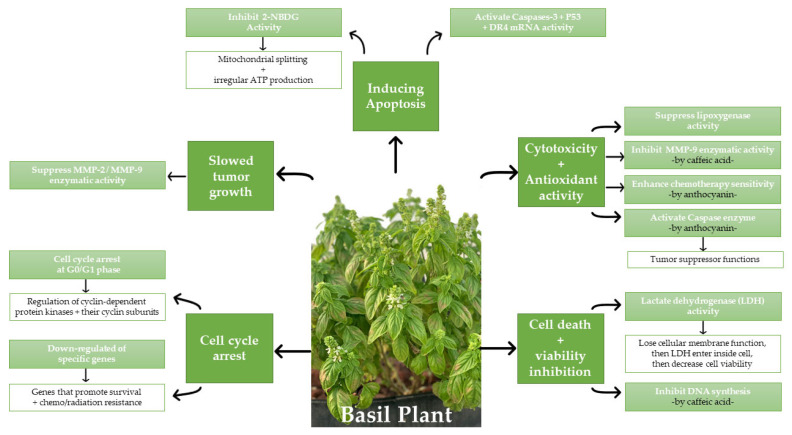
In this review, 16 research articles are included to discuss the potential anticancer ability of the extracts of various varieties at various dosages, applied to different cancer cells. Of those 16 articles, 2 were in vivo studies, 13 were in vitro studies, and 1 study conducted both in vivo and in vitro experiments. Antioxidants and other bioactive compounds in basil leaves show important potential anticancer activity at dosage of 4 mg/mL as aqueous extract or essential oil up to 200 µg/mL could slow-down tumor growth and progression with regards to cell death and viability inhibition. At dosages from 50 to 500 µg/mL is effective as anti-proliferative activities. cytotoxicity, inducing apoptosis, slowing down tumor growth, and especially cell cycle arrest, both in vivo and in vitro. Human studies show effects at dosages from 1 to 2.5 mg/daily on general vital activities and on reducing cytokines activity.
Based on 16 published studies, basil demonstrates important anticancer activities in vivo and vitro models, and it could act as a potential cancer.
癌症是细胞的不规则增殖,始于基因突变,该突变会改变细胞功能,由多种因素触发,且可能是遗传的或后天获得的。本综述的目的是讨论罗勒及其成分的抗癌活性强度,重点关注其在癌症预防和治疗中的作用。
本系统综述涵盖了2010年1月1日至2022年1月1日发表的所有研究。
在本综述中,纳入了16篇研究文章,以讨论不同品种提取物在不同剂量下对不同癌细胞的潜在抗癌能力。在这16篇文章中,2篇为体内研究,13篇为体外研究,1篇同时进行了体内和体外实验。罗勒叶中的抗氧化剂和其他生物活性化合物在剂量为4mg/mL的水提取物或高达200μg/mL的精油时显示出重要的潜在抗癌活性,可在细胞死亡和活力抑制方面减缓肿瘤生长和进展。在50至500μg/mL的剂量下具有抗增殖活性、细胞毒性、诱导凋亡、减缓肿瘤生长,尤其是在体内和体外使细胞周期停滞的作用。人体研究表明,每日剂量为1至2.5mg时对一般生命活动和降低细胞因子活性有影响。
基于16项已发表的研究,罗勒在体内和体外模型中均显示出重要的抗癌活性,并且它可能是一种潜在的抗癌物质。