Institute of Health Economics and Clinical Epidemiology (IGKE), Faculty of Medicine and University Hospital Cologne, University of Cologne, 50935 Cologne, Germany.
Int J Environ Res Public Health. 2022 May 11;19(10):5863. doi: 10.3390/ijerph19105863.
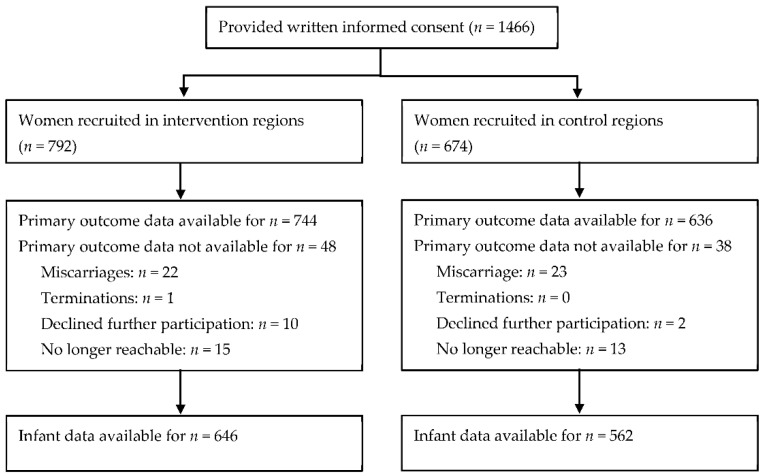
Research on perinatal programming shows that excessive gestational weight gain (GWG) increases the risk of overweight and obesity later in a child’s life and contributes to maternal weight retention and elevated risks of obstetrical complications. This study examined the effectiveness of a brief lifestyle intervention in the prenatal care setting, compared to routine prenatal care, in preventing excessive GWG as well as adverse maternal and infant health outcomes. The GeMuKi study was designed as a cluster RCT using a hybrid effectiveness implementation design and was conducted in the prenatal care setting in Germany. A total of 1466 pregnant women were recruited. Pregnant women in intervention regions received up to six brief counseling sessions on lifestyle topics (e.g., physical activity, nutrition, drug use). Data on GWG and maternal and infant outcomes were entered into a digital data platform by the respective healthcare providers. The intervention resulted in a significant reduction in the proportion of women with excessive GWG (OR = 0.76, 95% CI (0.60 to 0.96), p = 0.024). Gestational weight gain in the intervention group was reduced by 1 kg (95% CI (−1.56 to −0.38), p < 0.001). No evidence of intervention effects on pregnancy, birth, or neonatal outcomes was found.
围产期编程研究表明,孕期体重过度增加(GWG)会增加儿童后期超重和肥胖的风险,并导致产妇体重滞留和产科并发症风险升高。本研究旨在探讨在产前保健环境中,与常规产前保健相比,简短的生活方式干预在预防过度 GWG 以及母婴不良健康结局方面的有效性。该 GeMuKi 研究采用群组随机对照试验(cluster RCT)设计,并结合混合有效性实施设计,在德国的产前保健环境中进行。共招募了 1466 名孕妇。干预地区的孕妇接受了最多六次关于生活方式主题的简短咨询课程(例如,体育活动、营养、药物使用)。GWG 和母婴结局的数据由各自的医疗保健提供者输入到一个数字数据平台。干预导致过度 GWG 的女性比例显著降低(OR = 0.76,95%CI(0.60 至 0.96),p = 0.024)。干预组的体重增加减少了 1 公斤(95%CI(-1.56 至-0.38),p < 0.001)。没有发现干预对妊娠、分娩或新生儿结局有影响的证据。