Department of Psychiatry, Faculty of Medicine and Dentistry, University of Alberta, Edmonton, AB T6G 2B7, Canada.
Department of Psychiatry, Faculty of Medicine, Dalhousie University, Halifax, NS B3H 2E2, Canada.
Int J Environ Res Public Health. 2022 May 13;19(10):5937. doi: 10.3390/ijerph19105937.
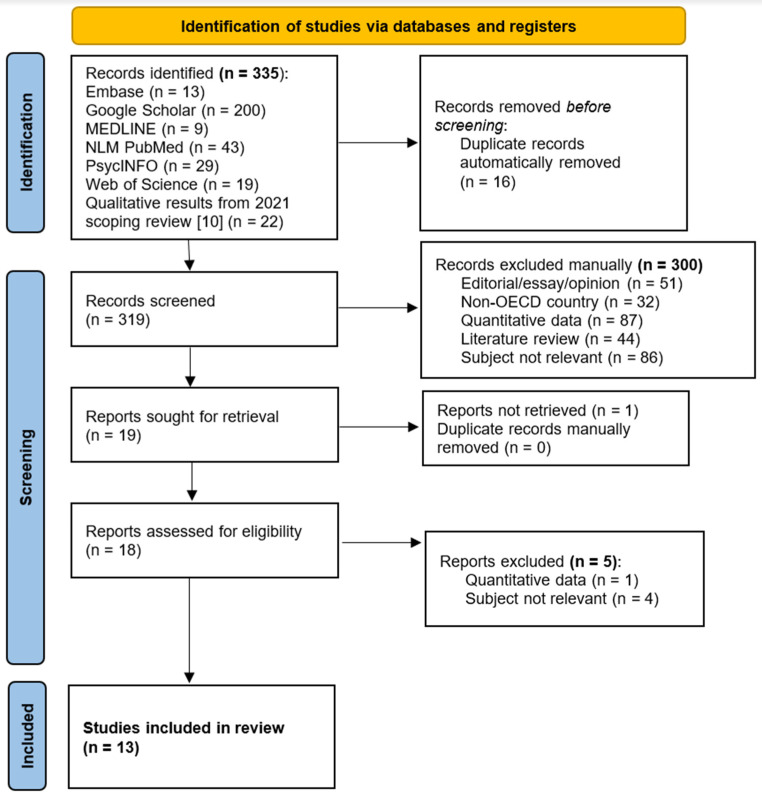
In a follow-up to our 2021 scoping review of the quantitative literature on the impacts of economic recessions on mental health, this scoping review summarizes qualitative research to develop a descriptive understanding of the key factors that transmute the socioeconomic stressors of a recession into poorer mental health. The previous study identified 22 qualitative studies from 2008 to 2020, which were updated with search results from six databases for articles published between 2020 and 2021. After inclusion and exclusion criteria were applied to the total 335 identified studies, 13 articles were included. These were peer-reviewed, qualitative studies in developed economies, published from 2008 to 2021, and available online in English. Participants perceived that financial hardship and unemployment during recessions increased stress and led to feelings of shame, loss of structure and identity, and a perceived lack of control, which increased interpersonal conflict, social isolation, maladaptive coping, depression, self-harm, and suicidal behavior. Participants struggled with accessing health and social services and suggested reforms to improve the navigation and efficiency of services and to reduce the perceived harms of austerity measures. Providers should screen for mental distress and familiarize themselves with health and social resources in their community to help patients navigate these complex systems. Policy makers should be aware of the potential protective nature of unemployment safeguards and consider other low-cost measures to bolster mental health supports and informal social networks. Research in this area was limited. Further research would be beneficial given the impacts of the ongoing COVID-19 recession.
在对 2021 年关于经济衰退对心理健康影响的定量文献进行范围综述的后续研究中,本范围综述总结了定性研究,以深入了解将衰退的社会经济压力转化为更差心理健康状况的关键因素。上一项研究从 2008 年至 2020 年确定了 22 项定性研究,并更新了 2020 年至 2021 年期间六个数据库中发表的文章的搜索结果。在对总共 335 项确定的研究应用纳入和排除标准后,纳入了 13 项文章。这些文章是在发达经济体进行的同行评审定性研究,发表于 2008 年至 2021 年期间,并且可以用英文在线获取。参与者认为,衰退期间的经济困难和失业增加了压力,导致了羞耻感、失去结构和身份感以及缺乏控制感,从而增加了人际冲突、社会孤立、适应不良的应对方式、抑郁、自残和自杀行为。参与者在获取卫生和社会服务方面遇到困难,并建议进行改革,以提高服务的可及性和效率,并减少紧缩措施的感知危害。提供者应筛查精神困扰,并熟悉其所在社区的卫生和社会资源,以帮助患者在这些复杂系统中进行导航。政策制定者应该意识到失业保障的潜在保护性质,并考虑采取其他低成本措施来支持心理健康支持和非正式社会网络。该领域的研究有限。鉴于正在进行的 COVID-19 衰退的影响,进一步的研究将是有益的。