Faculty of Bioscience and Technology for Food Agriculture and Environment, University of Teramo, 64100 Teramo, Italy.
European Center for Brain Research (CERC)/Santa Lucia Foundation IRCCS, 00143 Rome, Italy.
Int J Mol Sci. 2022 May 12;23(10):5430. doi: 10.3390/ijms23105430.
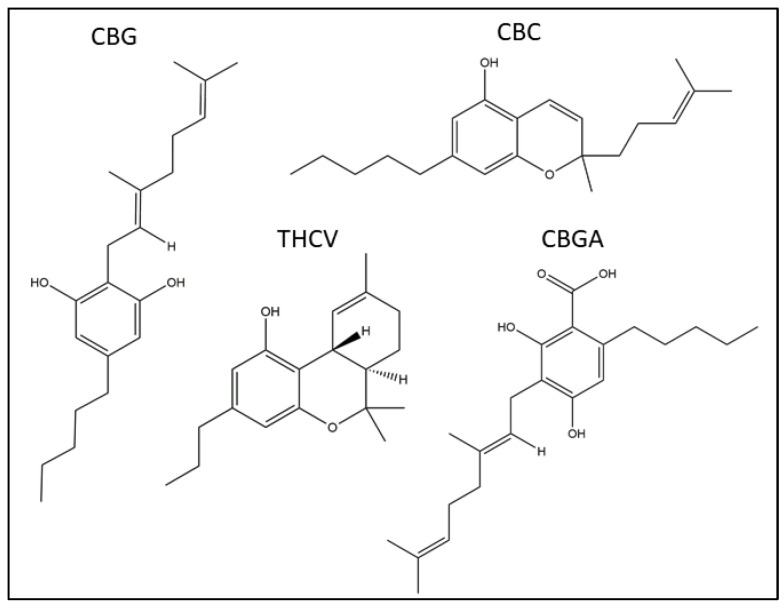
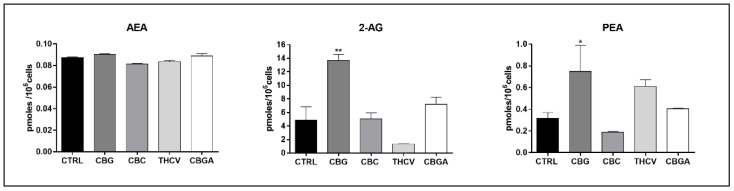
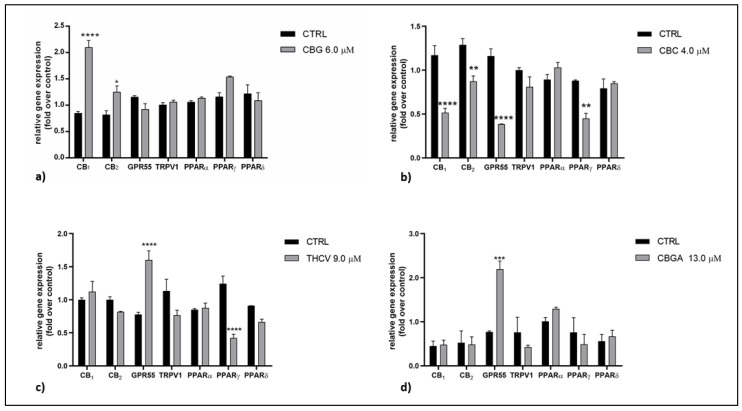
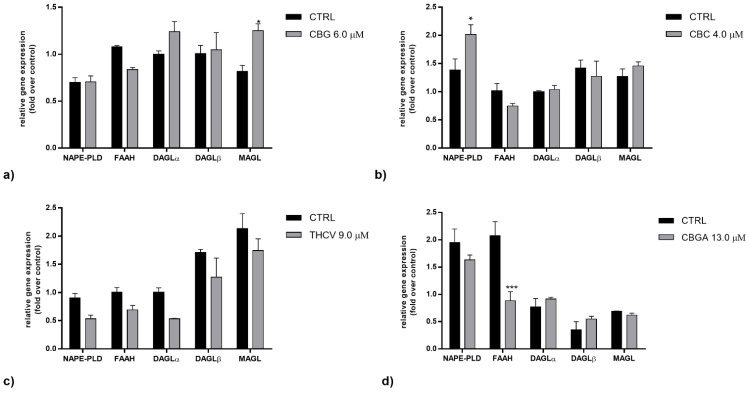
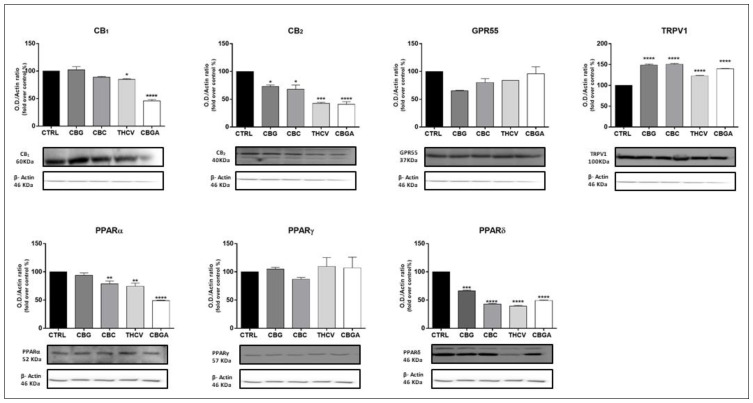
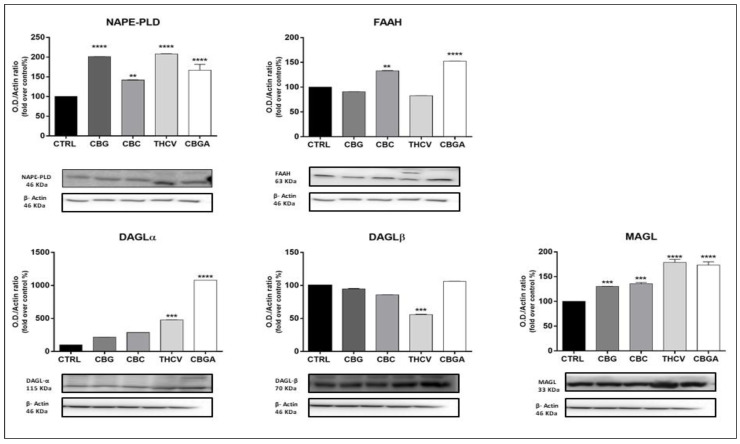
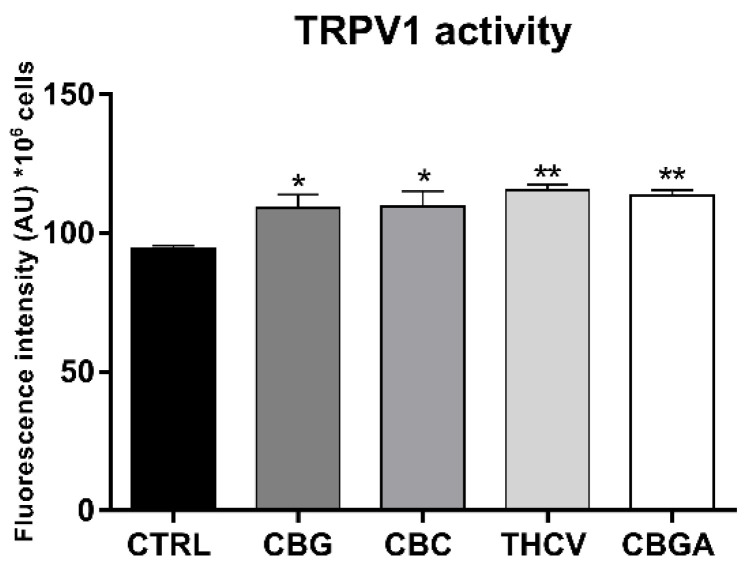
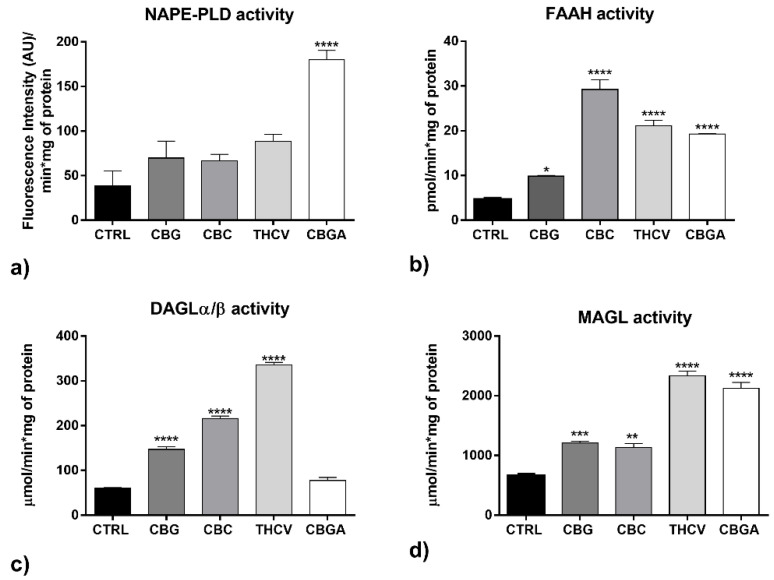
The decriminalization and legalization of has paved the way for investigations into the potential of the use of phytocannabinoids (pCBs) as natural therapeutics for the treatment of human diseases. This growing interest has recently focused on rare (less abundant) pCBs that are non-psychotropic compounds, such as cannabigerol (CBG), cannabichromene (CBC), Δ-tetrahydrocannabivarin (THCV) and cannabigerolic acid (CBGA). Notably, pCBs can act via the endocannabinoid system (ECS), which is involved in the regulation of key pathophysiological processes, and also in the skin. In this study, we used human keratinocytes (HaCaT cells) as an in vitro model that expresses all major ECS elements in order to systematically investigate the effects of CBG, CBC, THCV and CBGA. To this end, we analyzed the gene and protein expression of ECS components (receptors: CB, CB, GPR55, TRPV1 and PPARα/γ/δ; enzymes: NAPE-PLD, FAAH, DAGLα/β and MAGL) using qRT-PCR and Western blotting, along with assessments of their functionality using radioligand binding and activity assays. In addition, we quantified the content of endocannabinoid(-like) compounds (AEA, 2-AG, PEA, etc.) using UHPLC-MS/MS. Our results demonstrated that rare pCBs modulate the gene and protein expression of distinct ECS elements differently, as well as the content of endocannabinoid(-like) compounds. Notably, they all increased CB binding, TRPV1 channel stimulation and FAAH and MAGL catalytic activity. These unprecedented observations should be considered when exploring the therapeutic potential of cannabis extracts for the treatment of human skin diseases.
大麻的非刑罪化和合法化为研究植物大麻素(pCBs)作为治疗人类疾病的天然疗法的潜力铺平了道路。最近,人们对非精神活性化合物(如大麻二酚酸(CBGA)、大麻色烯(CBC)、Δ-四氢大麻酚(THCV)和大麻萜酚(CBG)等罕见的 pCBs 产生了浓厚的兴趣。值得注意的是,pCBs 可以通过内源性大麻素系统(ECS)发挥作用,该系统参与调节关键的病理生理过程,也参与皮肤的调节。在这项研究中,我们使用人角质形成细胞(HaCaT 细胞)作为体外模型,该模型表达 ECS 的所有主要成分,以系统地研究 CBG、CBC、THCV 和 CBGA 的作用。为此,我们使用 qRT-PCR 和 Western blot 分析了 ECS 成分(受体:CB1、CB2、GPR55、TRPV1 和 PPARα/γ/δ;酶:NAPE-PLD、FAAH、DAGLα/β 和 MAGL)的基因和蛋白表达,并使用放射性配体结合和活性测定评估其功能。此外,我们使用 UHPLC-MS/MS 定量了内源性大麻素(样)化合物(AEA、2-AG、PEA 等)的含量。我们的结果表明,罕见的 pCBs 以不同的方式调节不同的 ECS 元素的基因和蛋白表达,以及内源性大麻素(样)化合物的含量。值得注意的是,它们都增加了 CB 结合、TRPV1 通道刺激以及 FAAH 和 MAGL 催化活性。在探索大麻提取物治疗人类皮肤疾病的治疗潜力时,应该考虑到这些前所未有的观察结果。