Mora-Montes Héctor M, García-Gutiérrez Karina, García-Carnero Laura C, Lozoya-Pérez Nancy E, Ramirez-Prado Jorge H
Departamento de Biología, División de Ciencias Naturales y Exactas, Campus Guanajuato, Universidad de Guanajuato, Noria Alta S/N, Col. Noria Alta, Guanajuato, Guanajuato 360501, Mexico.
Unidad de Biotecnología, Centro de Investigación Científica de Yucatán, A.C., Calle 43 No. 130, Col. Chuburná de Hidalgo, Mérida, Yucatan 97205, Mexico.
J Fungi (Basel). 2022 May 20;8(5):529. doi: 10.3390/jof8050529.
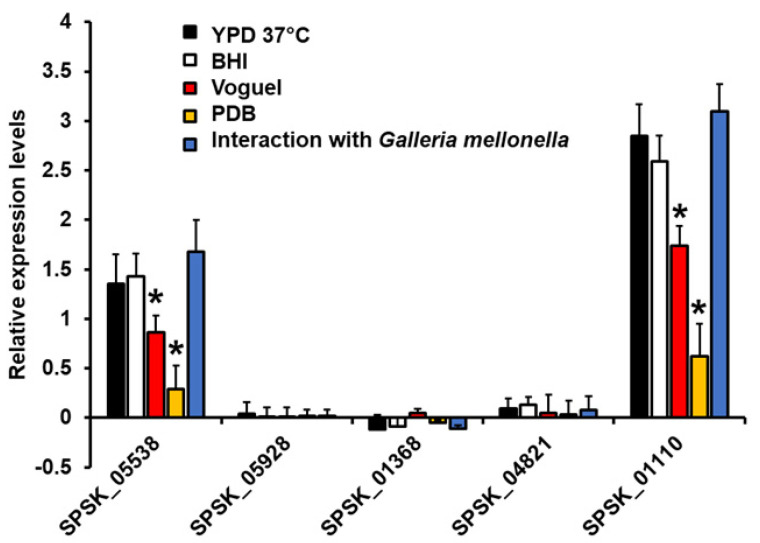
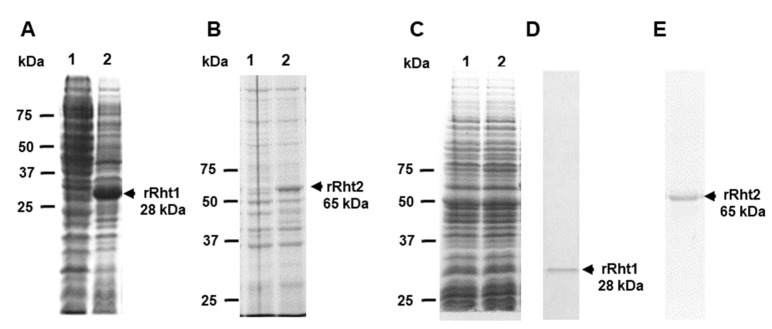
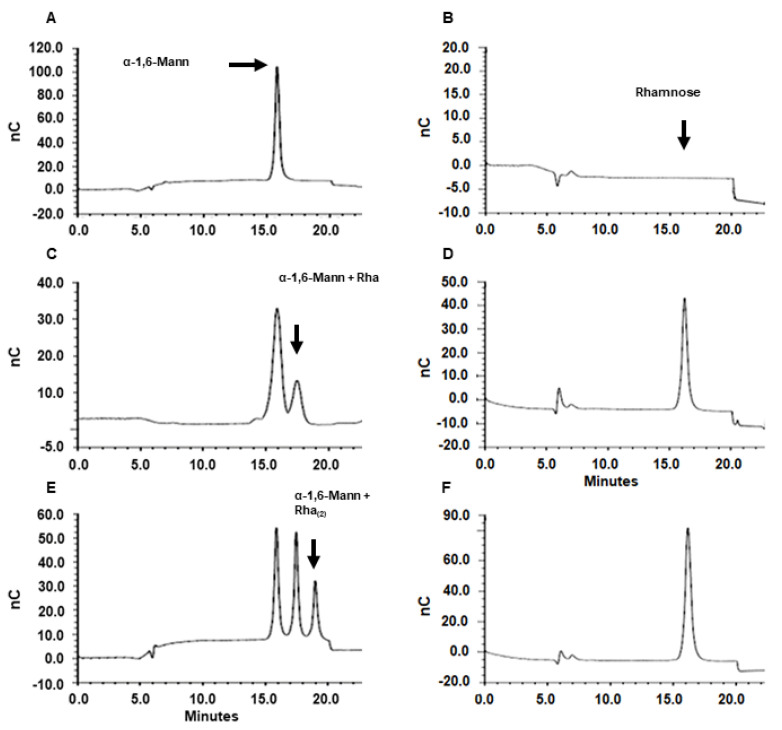
The fungal cell wall is an attractive structure to look for new antifungal drug targets and for understanding the host-fungus interaction. is one of the main causative agents of both human and animal sporotrichosis and currently is the species most studied of the genus. The cell wall of this organism has been previously analyzed, and rhamnoconjugates are signature molecules found on the surface of both mycelia and yeast-like cells. Similar to other reactions where sugars are covalently linked to other sugars, lipids, or proteins, the rhamnosylation process in this organism is expected to involve glycosyltransferases with the ability to transfer rhamnose from a sugar donor to the acceptor molecule, i.e., rhamnosyltransferases. However, no obvious rhamnosyltransferase has thus far been identified within the proteome or genome. Here, using a Hidden Markov Model profile strategy, we found within the genome five putative genes encoding for rhamnosyltransferases. Expression analyses indicated that only two of them, named and , were significantly expressed in yeast-like cells and during interaction with the host. These two genes were heterologously expressed in , and the purified recombinant proteins showed rhamnosyltransferase activity, dependent on the presence of UDP-rhamnose as a sugar donor. To the best of our knowledge, this is the first report about rhamnosyltransferases in .
真菌细胞壁是寻找新型抗真菌药物靶点以及理解宿主与真菌相互作用的一个有吸引力的结构。是人和动物孢子丝菌病的主要病原体之一,目前是该属中研究最多的物种。此前已对该生物体的细胞壁进行过分析,鼠李糖缀合物是在菌丝体和酵母样细胞表面发现的标志性分子。与其他糖与其他糖、脂质或蛋白质共价连接的反应类似,预计该生物体中的鼠李糖基化过程涉及具有将鼠李糖从糖供体转移到受体分子能力的糖基转移酶,即鼠李糖基转移酶。然而,迄今为止,在该生物体的蛋白质组或基因组中尚未鉴定出明显的鼠李糖基转移酶。在此,我们使用隐马尔可夫模型谱策略,在该生物体的基因组中发现了五个推定的编码鼠李糖基转移酶的基因。表达分析表明,其中只有两个基因,命名为和,在酵母样细胞中以及与宿主相互作用期间有显著表达。这两个基因在中进行了异源表达,纯化的重组蛋白显示出鼠李糖基转移酶活性,该活性依赖于作为糖供体的UDP-鼠李糖的存在。据我们所知,这是关于该生物体中鼠李糖基转移酶的首次报道。